|
|
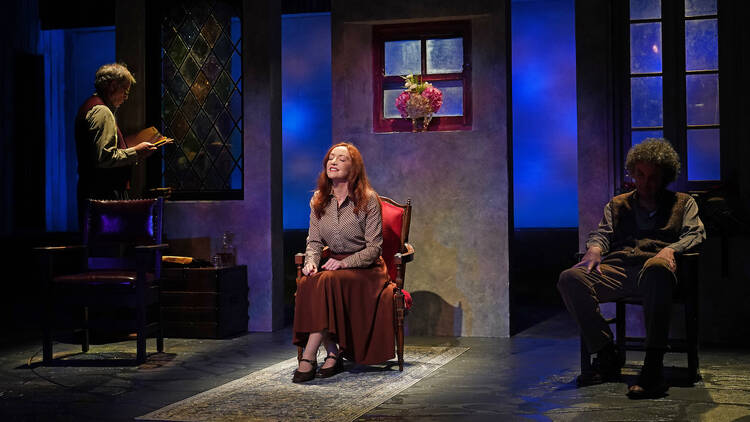
Molly Sweeney. Irish Repertory Theatre. By Brian Friel. Directed by Charlotte Moore.
Trailer
here.
When the lights go up, we discover the three characters MOLLY SWEENEY, MR
RICE, FRANK SWEENEY -- on stage. All three stay on stage for the entire play. I
suggest that each character inhabits his or her own special acting area: MR.
RICE stage left, MOLLY SWEENEY center stage, FRANK SWEENEY stage right (left and
right from the point of view of the audience).
MOLLY SWEENEY and FRANK are in
their late thirties/early forties. MR RICE is older. Most people with impaired
vision look and behave like fully sighted people. The only evidence of their
disability is usually a certain vacancy in the eyes or the way the head is held.
MOLLY should indicate her disability in some such subtle way. No canes, no
groping, no dark glasses, etc.
ACT ONE
MOLLY: By the time I was five years of age, my father had taught me the names
of dozens of flowers and herbs and shrubs and trees. He was a judge and his work
took him all over the country. And every evening, when he got home, after he'd
had a few quick drinks, he'd pick me up in his arms and carry me out to the
walled garden.
"Tell me now," he'd ask. "Where precisely are we?"
"We're in your garden."
"Oh, you're such a clever little missy!" And he'd pretend to smack me.
"Exactly what part of my garden?"
"We're beside the stream."
"Stream? Do you hear a stream? I don't. Try again."
"We're under the lime tree."
"I smell no lime tree. Sorry. Try again."
"We're beside the sundial."
"You're guessing. But you're right. And at the bottom of the pedestal there is a
circle of petunias. There are about twenty of them all huddled together in one
bed. They are -- what? -- seven inches tall. Some of them are blue-and-white,
and some of them are pink, and a few have big, red, cheeky faces. Touch them."
And he would bend over, holding me almost upside down, and I would have to count
them and smell them and feel their velvet leaves and their sticky stems. Then
he'd test me.
"Now, Molly. Tell me what you saw."
"Petunias."
"How many petunias did you see?"
"Twenty."
"Color?"
"Blue-and-white and pink and red."
"Good. And what shape is their bed?"
"It's a circle."
"Splendid. Passed with flying colors. You are a clever lady."
And to have got it right for him and to hear the delight in his voice gave me
such pleasure.
Then we'd move on to his herb bed and to his rose bed and to his ageratum and
his irises and his azaleas and his sedum. And when we'd come to his nemophila,
he always said the same thing. "Nemophila are sometimes called Baby Blue Eyes. I
know you can't see them but they have beautiful blue eyes. Just like you. You're
my nemophila."
And then we'd move on to the shrubs and the trees and we'd perform the same
ritual of naming and counting and touching and smelling. Then, when our tour was
ended, he'd kiss my right cheek and then my left cheek with that old-world
formality with which he did everything; and I loved that because his whiskey
breath made my head giddy for a second.
"Excellent!" he'd say. "Excellent testimony! We'll adjourn until tomorrow."
Then if mother were away in hospital with her nerves, he and I would make our
own meal. But if she were at home she'd appear at the front door — always in
her headscarf and wellingtons -- and she'd shout, "Molly! Daddy! Dinner!" I
never heard her call him anything but Daddy and the word always seemed to have a
mocking edge. And he'd say to me, "Even scholars must eat. Let us join your
mother."
And sometimes, just before we'd go into that huge, echoing house, sometimes he'd
hug me to him and press his mouth against my ear and whisper with fierce
urgency, "I promise you, my darling, you aren't missing a lot; not a lot at all.
Trust me."
Of course I trusted him; completely. But late at night, listening to mother and
himself fighting their weary war downstairs and then hearing him grope his way
unsteadily to bed, I'd wonder what he meant. And it was only when I was about
the same age as he was then, it was only then that I thought — I thought
perhaps I was beginning to understand what he meant. But that was many, many
years later. And by then mother and he were long dead and the old echoing house
was gone. And I had been married to Frank for over two years. And by then, too,
I had had the operation on the first eye.
MR. RICE: The day he brought her to my house — the first time I saw them
together — my immediate thought was: What an unlikely couple!
I had met him once before about a week earlier, by himself. He had called to ask
would I see her,just to give an opinion, if only to confirm that nothing could
be done for her. I suggested he phone the hospital and make an appointment in
the usual way. But of course he didn't. And within two hours he was back at my
door again with an enormous folder of material that had to do with her case and
that he had compiled over the years and he'd be happy to go through it with me
there and then because not only were the documents and reports and photographs
interesting in themselves but they would be essential reading for someone like
myself who was going to take her case on.
Yes, an ebullient fellow; full of energy and inquiry and the indiscriminate
enthusiasms of the self-taught. And convinced, as they usually are, that his own
life story was of compelling interest. He had worked for some charitable
organization in Nigeria. Kept goats on an island off the Mayo coast and made
cheese. Sold storage batteries for those windmill things that produce
electricity. Endured three winters in Norway to ensure the well-being of whales.
That sort of thing. Worthy pursuits, no doubt. And he was an agreeable fellow;
oh, yes; perfectly agreeable. Frank. That was his name. She was Molly. Reminded
me instantly of my wife, Maria. Perhaps the way she held her head. A superficial
resemblance. Anyhow, Molly and Frank Sweeney.
I liked her. I liked her calm and her independence; the confident way she shook
my hand and found a seat for herself with her white cane. And when she spoke of
her disability, there was no self-pity, no hint of resignation. Yes, I liked
her.
Her life, she insisted, was uneventful compared with his. An only child. Father
a judge. Mother in and out of institutions all her days with nervous trouble.
Brought up by various house-keepers. For some reason she had never been sent to
a blind school. Said she didn't know why; perhaps because her father thought he
could handle the situation best at home.
She had been blind since she was ten months old. She wasn't totally sightless:
she could distinguish between light and dark; she could see the direction from
which light came; she could detect the shadow of Frank's hand moving in front of
her face. But for all practical purposes he had no useful sight. Other
ophthalmologists she had been to over the years had all agreed that surgery
would not help. She had a full life and never felt at all deprived. She was now
forty-one, married just over two years, and working as a massage therapist in a
local health club. Frank and she had met there and had married within a month.
They were fortunate they had her earnings to live on because he was out of work
at the moment.
She offered this information matter-of-factly. And as she talked, he kept
interrupting. "She knows when I pass my hand in front of her face. So there is
some vision, isn't there? So there is hope, isn't there, isn't there? Perhaps, I
said. "And if there is a chance, any chance, that she might be able to see, we
must take it, musn't we? How can we not take it? She has nothing to lose, has
she? What has she tp lose? — Nothing! Nothing! And she would wait without a
trace of impatience until he had finished and then she would go on. Yes, I liked
her at once.
His "essential" folder. Across it he had written, typically, Researched and
Compiled by Frank C. Sweeney. The "C" stood for Constantine, I discovered. And
it did have some interest, the folder. Photographs of her cycling by herself
across a deserted beach. Results of tests she had undergone years ago. A
certificate for coming first in her physiotheraphy exams. Pictures of them on
their honeymoon in Stratford-on-Avon -- his idea of self-improvement, no doubt.
Letters from two specialists she had been to in her late teens. An article he
had cut out of a magazine about miraculous ophthalmological techniques once
practiced in Tibet -- or was it Mongolia? Diplomas she had won in provincial
swimming championships. And remarkably, extracts from essays by various
philosophers on the relationship between vision and knowledge, between seeing
and understanding. A strange fellow, indeed.
And when I talked to them on that first occasion I saw them together in my
house, I knew that she was there at Frank's insistence, to please him, and not
with any expectation that I could help. And as I watched her sitting there,
erect in her seat and staring straight ahead, two thoughts flitted across my
mind. That her blindness was his latest cause and that it would absorb him just
as long as his passion lasted. And then, I wondered, what then? But perhaps that
was too stern a judgement.
And the second and much less worthy thought I had was this. No, not a thought; a
phantom desire, a fantasy in my head; absurd, bizarre, because I knew only the
barest outlines of her case, hadn't even examined her yet; the thought, the
bizarre thought that perhaps, perhaps — up here in Donegal — not in Paris or
Dallas or Vienna or Milan — but perhaps up here in remote Ballybeg was I about
to be given — what is the vulgar parlance? — the chance of a lifetime, the
one-in-a-thousand opportunity that can rescue a career — no, ni, transform a
career — dare I say it, restore a reputation? And if that opportunity were
being offered to me and if after all these years I could pull myself together
and measure up to it, and if, oh my God if by some miracle pull it off perhaps... (He laughs in self-mockery)
Yes, I'm afraid so. People who live alone frequently enjoy an opulent fantasy
life.
FRANK: One of the most fascinating discoveries I made when I was in the cheese
business — well, perhaps not fascinating, but interesting, definitely
interesting — one of the more interesting discoveries I made -- this was long
before I met Molly — for three and half years I had a small goat farm on the
island of Inis Beag off the Mayo coast — no, no, not a farm for small goats
— a farm for ordinary goats — well, extraordinary goats as a matter of fact
because I imported two piebald Iranian goats — and I can't tell you how
complicated and expensive that whole process was; and the reason I wanted them,
the reason I wanted Iranians, was that in all the research I had done and
according to all the experts they were reputed to give the highest milk yield
— untrue as it turned out — and because their pelts were in great demand as
wall coverings in California — equally intrue, I'm afraid; and although they
bred very successfully — eventually I had a herd of fourteen — they couldn't
endure the Mayo winters with the result that I had to keep them indoors and feed
them for six months for God's sake — at least it did on Inis Beag. And of
course that threw my whole financial planning into disarray. As you can imagine.
And yes, as a matter of interest, they are small animals, Iranian goats. And, as
I say, from Iran which, as you know, is an ancient civilization in South West... Asia... .
But I was telling you about — what? The interesting discovery! Yes! Well,
perhaps not an interesting discovery in any general sense but certainly of great
interest to anybody who hopes to make cheese from the milk of imported Iranian
goats, not that there are thousands of those people up and down the country!
Anyhow — anyhow — what I discovered was this. I had those goats for three
and a half years, and even after all that time their metabolism, their internal
clock, stayed Iranian; never adjusted to Irish time. Their system never made the
transition. They lived in a kind of perpetual jet-lag.
So what, you may ask. So for three and a half years I had to get up to feed them
at three in the morning my time because that was seven A.M. their time, their
breakfast time! And worse — worse — they couldn't be kept awake and
consequently couldn't be milked after eight in the evening because that was
midnight their time — and they were lying there, dead out, snoring! Bizarre!
Some imprint in the genes remained indelible and immutable. I read a brilliant
article by a professor in an American magazine and he called this imprint an
engram, from the Greek word meaning something that is etched, inscribed, on
something. He said it accounts for the mind's strange ability to recognize
instantly somebody we haven't seen for maybe thirty years. Then he appears. The
sight of him connects with the imprint, the engram. And bingo — instant
recognition!
Interesting word — engram. The only other time I heard it used was by Mr.
Rice, Molly's ophthalmologist. In that swanky accent of his — "engram." And he
was born in the village of Kilmeedy in County Limerick for God's sake! I really
never did warm to that man. No wonder his wife cleared off with another man. No,
no, no, I don't mean that; I really don't mean that; that's a rotten thing to
say; sorry; I shouldn't have said that. But I was talking about the word engram
and how he pronounced it. That was before any of the operations, and he was
explaining to Molly that if by some wonderful, miraculous good fortune her sight
were restored, even partially restored, she would still have to learn to see and
that would be an enormous and very difficult undertaking.
The way he explained it was this. She knew dozens of flowers; not to see; not by
sight. She knew them only if she could touch them and smell them because those
tactile engrams were implanted in her brain since she was a child. But if she
weren't allowed to touch, to smell, she wouldn't know one flower from another;
she wouldn't know a flower from a football. How could she?
And interestingly, interestingly this very same problem was debated three
hundred years ago by two philosophers, William Molyneux and his friend, John
Locke. I came across this discussion in a do-it-yourself magazine of all places!
Fascinating stuff, philosophy — absolutely fascinating. Anyhow — anyhow. If
you are blind, said Molyneux — he was an Irishman by the way and in fact his
wife was blind — if you are blind you can learn to distinguish between a cube
and a sphere just by touching them, by feeling them. Right? Right. Now,
supposing your vision is suddenly restored, will you be able — by sight alone,
without touching, without feeling — will you be able to tell which object is
the cube and which the sphere? Sorry, friend, said Locke — incidentally he
went to Westminster School where he was flogged regularly — sorry, friend, you
will not be able to tell which is which. Then who comes along to join in the
debate but another philosopher, George Berkeley, with his essay titled "An Essay
Towards a New Theory of Vision." Another Irishman incidentally; Bishop Berkeley.
And actually when I say along came the Bishop, his "essay" didn't appear until
seventeen years after the discussion I told you about between Locke and
Molyneux. Anyhow — anyhow. When the problem was put to the Lord Bishop, he
came to the same conclusion as his friends. But he went even further. He said
that there was no necessary connection at all between the tactile world — the
world of touch — and the world of sight; and that any connection between the
two could be established only by living, only by experience, only by learning
the connection.
Which, indeed, is really what Rice said to Molly three hundred years later. That
most of us are born with all five senses; and with all the information they give
us, we build up a sight world from the day we are born -- a world of objects and
ideas and meanings. We aren't given that world, he said. We make it ourselves
— through our experience, by our memory, by making categories, by
interconnections. Now Molly had only ten months of sight and what she had seen
in that time was probably forgotten. So, if her sight were restored, everything
would have to be learned anew: she would have to learn to see. She would have to
build up a whole repertory of visual engrams and then, then she would have to
establish connections between these new imprints and the tactile engrams she
already possessed. Put it another way: she would have to create a whole new
world of her own.
How in God's name did I get into all that? The goats! Engrams! Three o'clock
every bloody morning! I'll tell you something: three and a half years on that
damned island and I lost four stone weight. And not an ounce of cheese — ever!
Not that it mattered, I suppose. I didn't go to Inis Beag to make my fortune.
God knows why I went. God knows why I've spent my life at dozens of mad schemes.
Crazy.... Billy Hughes — Billy's an old pal of mine — Billy says I'm
haunted for God's sake, always looking for... whatever....
Anyhow — anyhow. To go back for a second to our friend who knew what a cube
was by touching it but couldn't identify it by sight alone. Rice talked a lot to
Molly about all that stuff. He said neurologists had a word for people in that
condition — seeing but not knowing, not recognizing, what it is they see. A
word first used in this context by Freud, apparently. He said that people in
that condition are called agnosic. Yes. Agnosic. Strange; because I always
thought that word had to do with believing or not believing.
MOLLY: I didn't like Mr. Rice when I first met him. But I got to like him. I
suppose because I trusted him. Frank never warmed to him. He was put off by his
manner and the way he spoke. But I thought that for all his assurance there was
something... unassured about him.
He was said to have been one of the most brilliant ophthalmologists ever in the
country. Worked in the top eye hospitals all over the world — America, Japan,
Germany. Married a Swiss girl. They had two daughters. Then she left him —
according to the gossip; went off with a colleague of his from New York. The
daughters lived with her parents in Geneva. For years after that there are gaps
in his story. Nobody seems to know what became of him. They say that he had a
breakdown; that he worked as a laborer in Bolivia; that he ran a pub in Glasgow.
Anyhow he turned up here in Ballybeg and got a job in the hospital and took a
rented bungalow at the outskirts of the town. He looked after himself in a sort
of way. Walked a bit. Did a lot of fly-fishing during the season — Frank said
he was beautiful to watch. People thought him a bit prickly, a bit uppity, but
that was probably because he didn't mix much. I'm sure a brilliant man like that
never thought he'd end in a Regional Hospital in the north-west of Donegal. When
I wondered what he looked like I imagined a face with an expression of some
bewilderment.
Maybe I liked him because of all the doctors who examined me over the years he
was the only one who never quizzed me about what it felt like to be blind — I
suppose because he knew everything about it. The others kept asking me what the
idea of color meant to me, or the idea of space, or the notion of distance. You
live in a world of touch, a tactile world, they'd say. You depend almost
entirely on tactile perceptions, on knowing things by feeling their shape. Tell
us: How do you think your world compares with the world the rest of us know, the
world you would share with us if you had visual perception as well?
He never asked me questions like that. He did ask me once, did the idea, the
possibility, of seeing excite me or frighten me. It certainly excited Frank, I
said. But why should it be frightening? A stupid question, I know, he said. Very
stupid.
Why indeed should it be frightening? And how could I answer all those other
questions? I knew only my own world. Disadvantaged in some ways; of course it
was. But at theat stage I never thought of it as deprived. And Mr. Rice knew
that.
And how could I have told those other doctors how much pleasure my world offered
me? From my work, from the radio, from walking, from music, from cycling. But
especially from swimming. I used to think — and I know this sounds silly —
but I really did believe I got more pleasure, more delight, from swimming than
sighted people can ever get. Just offering yourself to the experience — every
pore open and eager for that world of pure sensation, of sensation alone —
sensation that could not have been enhanced by sight — experience that existed
only by touch and feel; and moving swiftly and rhythmically through that
enfolding world; and the sense of such assurance, such liberation, such
concordance with it... Oh I can't tell you the joy of swimming gave me. I
used to think that the other people in the pool with me, the sighted people,
that in some way their pleasure was actually diminished because they could see,
because seeing in some way qualified the sensation; and that if they only knew
how full, how total my pleasure was, I used to tell myself that they must, they
really must envy me.
Silly I suppose. Of course it was. I tried to explain how I felt to Mr. Rice.
"I know what you mean," he said.
And I think he did know.
Yes, maybe he was a bit pompous. And he could be sarcastic at times. And Frank
said he didn't look at all bewildered; ever. But although I never saw my
father's face, I imagine it never revealed any bewilderment either.
MR. RICE: In the present state of medicine nothing can be done for people who
are born blind, the clinically blind. Their retinas are totally insensitive to
light and so are nonfunctional. There are no wrecorded cases of recovery from
clinical blindness.
Molly Sweeney wasn't born blind. She was functionally blind and lived in a blind
world for forty years. But she wasn't clinically blind: her retinas weren't
totally insensitive to light. For God's sake how often did the husband, Mr.
Autodidact, tell me that she was aware of the shadow of his hand in front of her
face?
So in theory, perhaps — purely theoretically — her case wasn't exactly
hopeless. But I did make a point of giving her and her husband the only
statistic available to us; and a dispiriting statistic it is. The number of
cases known to us — of people who became blind shortly after birth and had
their sight restored many years later — the number of cases over the past ten
centuries is not more than twenty. Twenty people in a thousand years.
I know she believed me. I wasn't at all sure Frank Constantine did.
Anyhow, as a result of that first cursory examination in my home I decided to
bring her into the clinic for tests.
FRANK: Well of course the moment Rice said in that uppity voice of his, "In
theory — in theory — in theory — perhaps in theory — perhaps —
perhaps" — the first time Molly met him — after a few general questions, a
very quick examination — ten o'clock in the morning in his house — I'll
never forget it — the front room in the rented bungalow — no fire — the
remains of last night's supper on a tray in the fireplace — teapot, crusts,
cracked mug — well of course, goddamit, of course the head exploded! Just
ex-ploded!
Molly was going to see! I knew it! For all his perhapses! Absolutely no doubt
about it! A new world — a new life! A new life for both of us!
Miracle of Molly Sweeney. Gift of sight restored to middle-aged woman. "I've
been given a new world," says Mrs. Sweeney.
Unemployed husband cries openly.
And why not?
Oh my God...
Sight...
I saw an Austrian psychiatrist on the television one night. Brilliant man.
Brilliant lecture. He said that when the mind is confronted by a situation of
overwhelming intensity -- a moment of terror or ecstasy or tragedy — to
protect itself from overload, from overcharge, it switches off and focuses on
some trivial detail associated with the experience.
And he was right. I know he was. Because that morning in that front room in the
chilly bungalow — immediately after that moment of certainty, that explosion
in the head — my mind went numb; fused; and all I could think of was that
there was a smell of fresh whiskey off Rice's breath. And at ten o'clock in the
morning that seemed the most astonishing thing in the world and I could barely
stop myself from saying to Molly, "Do you not smell the whiskey off his breath?
The man's reeking of whiskey!"
Ridiculous...
MR. RICE: Tests revealed that she had thick cataracts on both eyes. But that
wasn't the main problem. She also had retinitis pigmentosa; as the name
suggests, a discoloration of the retina. She seemed to have no useful retinal
function. It wasn't at all surprising that other doctors had been put off.
There were scars of old disease, too. But what was encouraging — to put it at
its very best — was that there was no current, no active disease process. So
that if I were to decide to operate and if the operation were even partially
successful, her vision, however impaired, ought to be stable for the rest of her
life.
So in theory perhaps...
FRANK: On the morning of Tuesday, October 7, he operated on the right eye to
remove a cataract and implant a new lens.
I was told not to visit her until the following day because the eye would be
bandaged for twenty-four hours and she had to have as much rest and quiet as
possible. Naturally, of course...
And a wonderful thing happened that night when I was at home by myself. I got a
call from London; from a friend I knew in Nigeria in the old days. Chap called
Winterman, Dick Winterman. Inviting me to set up and supervise a food convoy to
Ethiopia. Was I interested?
Of course I was interested. The first job I'd been offered in months.But not
now. How could I go now for God's sake? Molly was on the verge of a new life. I
had to be with her now. Anyhow, as I told Dick, those rambling days were over.
All the same it was nice to be remembered. And to be remembered on that night
— I thought that was a good omen.
MR. RICE: I'm ashamed to say that within a week I crossed the frontier into the
fantasy life again. The moment I decided I was going to operate on Molly I had
an impulse — a dizzying, exuberant, overmastering, intoxicating instinct to
phone Roger Bloomstein in New York and Hans Girder in Berlin and Hiroshi Matoba
in Kyoto — even old Murnahan in Dublin — and tell them what I was about to
do. Yes, yes, especially old Murnahan in dublin; and say to him, "Paddy Rice
here, Professor. Of course you remember him! You called him a rogue star once
— oh, yes, that caused a titter. Well, he works in a rundown hospital in
Donegal now. And I suspect, I think, I believe for no good reason at all that
Paddy Rice is on the trembling verge, Professor. He has a patient who has been
blind for forty years. And do you know what? He is going to give her vision —
the twenty-first recorded case in over a thousand years! And for the first time
in her life — how does Saint Mark put it in the gospel — for the first time
in her life she will "see men walking as if like trees." Delirium... hubris... the rogue star's token insurrection... a final, ridiculous flourish. For
God's sake, a routine cataract operation?
Of course I made no calls. Instead I wrote to my daughters, Aisling and Helga,
in Geneva, and enclosed what money I could afford. Then to Maria, my ex-wife, in
New York; yet another open-heart letter, full of candor and dreary honesty. I
told her I was busy and in good spirits and involved in a new case that was
unusual in some respects.
Then I made supper; had a few drinks; fell asleep in the armchair. I woke again
at four A.M., my usual hour, and sat there waiting for a new day, and said to
myself over and over again: Why the agitation over this case? You remove
cataracts every day of the week, don't you? And isn't the self-taught husband
right? (Angrily) What has she to lose for Christ's sake? Nothing! Nothing at
all!
MOLLY: What a party we had the night before the operation! Three o'clock in the
morning before we got the house cleared. Oh, God! And I had to be in the
hospital for ten — fasting. Frank wanted to get a taxi but I said we should
walk to get all that alcohol out of the system.
And it wasn't that we had organized anything that night. A few neighbors just
dropped in to wish me luck; and then a few more; and then Frank said, "Come on!
This is beginning to feel like a wake!" amd away he went to the off-license and
came back with a load of stuff.
Who was there? Tony and Betty from this side; with Molly, their baby; they
called her after me; she was just a toddler then. And the Quinns from that side;
Jack and Mary. Jack wasn't drinking for some reason and
Mary certainly was; so that was a delicate situation. And old Mr. O'Neill from
across the street; first time outside his house since his wife, Louise, died
three months before; and Frank just took him by the arm and said he would fall
into a decline if he didn't pull himself together. Anyhow, after two or three
beers, what does Mr. O'Neill do? Up on top of the table and begins reciting "A
bunch of the boys were whooping it up in the Malamute saloon" — or whatever
the right name is! Yes Little timid Mr. O'Neill, the mourning widower! And he
acted it out so seriously. And of course we all began to snigger. And the more
we sniggered, the more melodramatic he became. So that by the time he got to
"The woman that kissed him and pinched his poke was the lady that's known as
Lou" — he always called Louise, his dead wife, Lou — well of course by that
time we were falling about. Oh, he was furious. Sulked in the corner for ages.
God!
Who else? Billy Highes was there; an old bachelor friend of Frank. Years ago
Frank and he borrowed money from the bank and bought forty beehives; but I
gather that didn't work out. And Dorothy and Joyce; they're physiotherapists in
the hospital. And Tom McLaughlin, another of Frank's bachelor friends. He's a
great fiddler, Tom. And that was it. And of course Rita, rita Cairns, my oldest,
my closest friend. She managed the health club I was working in. Rita probably
knows me better than anybody. There was a lot of joking that there were thirteen
of us if you counted the baby. And Billy Hughes, who was already well tanked by
the time he arrived, he suggested that maybe Jack — from that side — maybe
Jack would do the decent and volunteer to leave since he was in a bad mood and
wasn't drinking anyway. And Mary, Jack's wife, she said that was the brightest
idea all evening. So that was an even trickier situation.
And at the some point in the night — it must have been about two — I'm
afraid I had a brainwave. Here we are, all friends together, having a great
time; so shouldn't I phone Mr. Rice and ask him to join us? Wasn't he a friend,
too? And I made for the phone and dialed the number. But Frank, thank God, Frank
pulled the phone out of my hand before he answered. Imagine the embarrassment
that would have been!
Anyway we chatted and we played tapes and we sang and we drank. And Tony and
Betty from this side, Molly's parents, they sang "Anything You Can Do I Can Do
Better" and there was so much tension between them you knew they weren't
performing at all. And Dorothy and Joyce did their usual Laurel and Hardy
imitation. AndBilly Hughes, the bee man, told some of his jokes that only Frank
and he find funny. And as usual Rita, Rita Cairns, sang "Oft in the Stilly
Night," her party piece. That was my father's song, too. She has a sweety voice,
really a child's voice, and she sings it beautifully. And as usual, when she had
finished, so she tells me, she nodded her head and smiled and cried all at the
same time. That's what she — "The Shooting of Dan McGrew"! That's the title of
Mr. O'Neill's poem! Poor old Mr. O'Neill. Somebody told me recently that he's in
a hospice now.
And shortly after midnight — long before I had the brainwave to phone Mr. Rice
— Tom Mc-Laughlin, Tom the fiddler, played "The Lament for Limerick"! He
played it softly, delicately. And suddenly, suddenly I felt utterly desolate.
Maybe it was Rita singing "Oft in the Stilly Night" earlier. Or maybe it was
because all that night nobody once mentioned the next day or how they thought
the operation might go; and because nothing was said, maybe that made the
occasion a bit unreal, a bit frantic. Or maybe it was because I was afraid that
if things turned out as Frank and Mr. Rice hoped, I was afraid that I would
never again know these people as I knew them now, with my own special knowledge
of each of them, the distinctive sense each of them excluded for me; and knowing
them differently, experiencing them differently, I wondered — I wondered would
I ever be as close to them as I was now.
And then with sudden anger I thought: why am I going for this operation? None of
this is my choosing. Then why is this happening to me? I am being used. Of
course I trust Frank. Of course I trust Mr. Rice. But how can they know what
they are taking away from me? How do they know what they are offering me? They
don't. They can't. And have I anything to gain? Anything? Anything?
And then I knew, suddenly I knew why I was so desolate. It was the dread of
exile, of being sent away.
It was the desolation of homesickness.
And then a strange thing happened. As soon as Tom played the last note of "The
Lament for Limerick," I found myself on my feet in the middle of the sitting
room and calling, "A hornpipe, Tom! A mad, fast hornpipe!" And the moment he
began to play, I shouted — screamed, "Now watch me! Just you watch me!" And in
a rage of anger and defiance I danced a wild and furious dance round and round
that room; then out to the hall; then round the kitchen; then back to the room
again and round it a third time. Mad and wild and frenzied. But so adroit, so
efficient. No timidity, no hesitations, no falterings. Not a glass overturned,
not a shoulder brushed. Weaving between all those people, darting between chairs
and stools and cushions and bottles and glasses with complete assurance, with
absolute confidence. Until Frank said something to Tom and stopped him playing.
God knows how I didn't kill myself or injure somebody. Or indeed how long it
lasted. But it must have been terrifying to watch because, when I stopped, the
room was hushed. Frank whispered something to me. I don't know what he said —
I was suddenly lost and anxious and frightened. I remember calling, "Rita? Where
are you, Rita?" "Here at the window," she said. And I stumbled, groped my way to
her and sat beside her. "Come on, sweetie," she said. "We'll have none of that.
You're not allowed to cry. I'm the only one that's allowed to give a performance
and then cry."
MR. RICE: The night before I operated on Molly Sweeney I thought about that high
summer in my thirty- second year. Cairo. Another lecture; another conference;
another posh hotel. As usual we all met up: Roger Bloomstein from New York, Hans
Girder from Berlin, Hiroshi Matoba from Kyoto, myself. The meteors. The young
turks. The four horsemen. Oslo last month. Helsinki next week. Paris the week
after. That luminous, resplendent life. Those glowing, soaring careers.
Maria left the children with her parents in Geneva and flew down to join us.
Still wan and translucent after the birth of Helga. And so beautiful; my God, so
beautiful. We had a dinner party for her the night she arrived. Roger was
master-of-ceremonies. Toasted her with his usual elegance. Said she was our
Venus — no, our Galatea. She smiled her secret smile and said each of us was
her Icarus.
Insatiable years. Work. Airports. Dinners. Laughter. Operating theaters.
Conferences. Gossip. Publications. The professional jealousies and the necessary
vigilance. Work. Airports. Dinners. Laughter. Operating theaters. Conferences.
Gossip. Publications. The professional jealousies and the necessary vigilance.
The relentless, devouring exdcitement. But above all, above all the hunger to
accomplish, the greed for achievement.
Shards of those memories came back to me on the night before I operated on Molly
Sweeney on Tuesday, October 7. I had had a few drinks. I had had a lot of
drinks. The fire was dead. I was drifting in and out of sleep. Then the phone
rang; an anxious sound at two in the morning. By the time I had pulled myself
together and got to it, it had stopped. Wrong number probably. I had another
drink and sat beside the dead fire and relived for the hundredth time that other
phone call. The small hours of the morning, too. In Cario. That high summer of
my thirty-second year.
It was Roger Bloomstein. Brilliant Roger. Trecherous Icarus. To tell me that
Maria and he were at the airport and about to step on a plane for New York. They
were deeply in love. They would be in touch in a few days. He was very sorry to
have to tell me this. He hoped that in time I would see the situation from their
point of view and come to understand it. And he hung up.
The mind was instantly paralyzed. All I could think was: He's confusing seeing
with understanding. Come on, Bloomingstein. What's the matter with you? Seeing
isn't understanding.
You know that! Don't talk rubbish, man!
And then... and, then... oh, Jesus, Maria...
FRANK: Just as I was about to step into bed that night — that same Tuesday
night that Dick Winterman phoned — the night of the operation — I was on the
point of stepping into bed when suddenly, suddenly I remembered: Ethiopia is
Abyssinia! Abyssinia is Ethiopia! They're the same place! Ethiopia is the new
name for the old Abyssinia! For God's sake only last year the National
Geographic magazine had a brilliant article on it with all these stunning
photographs. For God's sake I could write a book about Ethiopia! Absolutely the
most interesting country in the world! Let me give you one fascinating fact
about the name, the name Abyssinia. The name Abyssinia is derived from the word
"habesh", ; and the word "habesh" means mixed — on account of the varied
nature of its peoples. But interestingly, interestingly the people themselves
always called themselves Ethiopians, never Abyssinians, because they considered
the word Abyssinia and Abyssinians as derogatory — they didn't want to be
thought of as mixed! So now the place is officially what the people themselves
always called it — Ethiopia. Fascinating!
But of course I had to say no to Dick. As I said. Those rambling days were over.
Molly was about to inherit a new world; and I had a sense — stupid, I know —
I had a sense that maybe I was, too.
Pity to miss Abyssinia all the same — the one place in the whole world I've
always dreamed of visiting; a phantom desire, a fantasy in the head. Pity to
miss that.
You shouldn't have dangled it in front of me, Dick Waterman. Bloody, bloody
heartbreaking.
MOLLY: I remembered so well the first day Frank came to the health club. That
was the first time I'd met him. I was on a coffee break. A Friday afternoon.
I had known of him for years of course. Rita Cairns and his friend Billy Hughes
used to go out occasionally and I'd hear his name mentioned. She never said
anything bad about him; but whern his name came up, you got the feeling he was a
bit... different.
Anyhow that Friday he came into the club and Rita introduced us and we chatted.
And for the whole ten minutes of my coffee break he gave me a talk about a
feasibility study he was doing on the blueback salmon, known in Oregon as
sockeye and in Alaska as redfish, and of his plan to introduce it to Irish
salmon farmers because it has the lowest wastage rate in all canning factories
where it is used.
When he left I said to Rita that I'd never met a more enthusiastic man in my
life. And Rita said in her laconic way, "Sweetie, who wants their enthusiasm
focused on bluebacks for God's sake?"
Anyhow, ten minutes after he left, the phone rang. Could we meet that evening?
Saturday? Sunday? What about a walk, a meal, a concert? Just a chat?
I asked him to call me the following Friday.
I thought a lot about him that week. I suppose he was the first man I really
knew — apart from my father. And I liked his energy. I liked his enthusiasm. I
liked his passion. Maybe what I really liked about him was that he was
everything my father wasn't.
FRANK: I spent a week in the library — the week after I first met her — one
full week immersing myself in books and encyclopedias and magazines and articles
— anything, everything I could find about eyes and vision and eye diseases and
blindness.
Fascinating. I can't tell you — fascinating. I look out of my bedroom window
and at a single glance I see the front garden and the road beyond and cars and
buses and the tennis courts on the far side and people playing on them and the
hills beyond that. Everything — all those details and dozens more — all seen
in one immediate, comprehensive perception. But Molly's world isn't perceived
instantly, comprehensively. She composes a world from a sequence of impressions;
one after the other, in time. For example, she knows that this is a carving
knife because first she can feel the handle; then she can feel this long blade;
then this sharp edge. In sequence. In time. What is this object? These are ears.
This is a furry body. Those are paws. That is a long tail. Ah, a cat! In
sequence. Sequentially.
Right? Right. Now a personal question. You are going to ask this blind lady out
for an evening. What would be the ideal entertainment for somebody like her? A
meal? A concert? A walk? Maybe a swim? Billy Hughes says she's a wonderful
swimmer. (She shakes his head slowly.)
The week in the library pays off. know the answer instantly. Dancing. Take her
dancing. With her disability the perfect, the absolutely perfect relaxation.
Forget about space, distance, who's close, who's far, who's approaching. Forget
about time. This is not a sequence of events. This is one continuous, delightful
event. Nothing leads to nothing else. There is only now. There is nothing
subsequent. I am your eyes, your ears, your location, your sense of space. Trust
me.
Dancing. Obvious.
Straight into a phone-box and asked her would she come with me to the Hikers
Club dance the following Saturday. It'll be small, I said; more like a party.
What do you say?
Silence.
We'll ask Billy and Rita and we'll make it a foursome and we'll have our own
table and our own fun.
Not a word.
Please, Molly.
In my heart of hearts I really didn't think she'd say yes. For God's sake why
should she? Middle-aged. No skill. No job. No prospect of a job. Two rooms above
Kelly's cake shop. And not exactly Rudolf Valentino. And when she did speak,
when she said very politely, "Thank you, Frank. I'd love to go," do you know
what I said? "All right then." Bloody brilliant!
But I vowed to myself in that phone-box, I made a vow there and then that at the
dance on Saturday night I wouldn't open the big mouth — big? — enormous for
Christ's sake! — I wouldn't open it once all night, all week.
Talking of Valentino, in point of fact Valentino was no Adonis himself. Average
height; average looks; mediocre talent. And if he hadn't died so young — in
1926 — he was only thirty-one — and in those mysterious circumstances that
were never fully explained — he would never have become the cult figure the
studios worked so hard to...
Anyhow...
MOLLY: As usual Rita was wonderful. She washed my hair, my bloody useless hair
— I can do nothing with it — she washed it in this special shampoo she
concocted herself. Then she pulled it all away back from my face and piled it
up, just here, and held it in place with her mother's silver ornamental comb.
And she gave me her black shoes and her new woolen dress she's just bought for
her brother's wedding.
"There's still something not right," she said. "You still remind me of my Aunt
Madge. Here — try these." And she whipped off her earrings and put them on me.
"Now we have it," she said. "Bloody lethal. Francis Constantine, you're a dead
duck!"
FRANK: She had the time of her life. Knew she would. We danced every dance. Sang
every song at the top of our voices. Ate an enormous supper. Even won a spot
prize: a tin of shortbread and a bottle of Albanian wine. The samba, actually. I
wasn't bad at the samba once.
Dancing. I knew. I explained the whole thing to her. She had to agree. For God's
sake she didn't have to say a word — she just glowed.
MOLLY: It was almost at the end of the night — we were doing an old-time waltz
— and suddenly he said to me, "You are such a beautiful woman, Molly."
Nobody had ever said anything like that to me before. I was afraid I might cry.
And before I could say a word, he plunged on: "Of course I know that the very
ideaof appearance, of how things look, can't have much meaning for you. I do
understand that. And maybe at heart you're a real philosophical skeptic because
you question not only the idea of appearance but probably the existence of
external reality itself. Do you, Molly?"
Honest to God... the second last dance at the Hikers Club... a leisurely,
old-time waltz...
And I knew that night that he would ask me to marry him. Because he liked me —
I knew he did. And because of my blindness — oh, yes, that fascinated him. He
couldn't resist the different, the strange. I think he believed that some
elusive off-beat truth resided in the quirky, the off-beat. I suppose that's
what made him such a restless man. Rita of course said it was inevitable he
would propose to me. "All part of the same pattern, sweetie: bees — whales
—
Iranian goats — Molly Sweeney."
Maybe she was right.
And I knew, too, after that night in the Hikers Club, that if he did ask me to
marry him, for no very good reason at all I would probably say yes.
MR. RICE: The morning of the operation. I stood at the window of my office and
watched them walk up the hospital drive. It was a blustery morning, threatening
rain.
She didn't have her cane and she didn't hold his arm. But she moved briskly with
her usual confidence; her head high; her face alert and eager. In her right hand
she carried a gray overnight bag.
He was on her left. Now in the open air a smaller presence in a shabby raincoat
and cap; his hands clasped behind his back; his eyes on the ground; his head
bowed slightly against the wind so that he looked... passive. Not a trace of
the assurance, the ebullience, that relentless energy.
And I thought: Are they really such an unlikely couple? And I wondered what
hopes moved in them as they came toward me. Were they modest? Reasonable?
Outrageous? Of course, of course they were outrageous.
And suddenly and passionately and with utter selflessness I wanted nothing more
in the world than that their inordinate hopes would be fulfiled, that I could
give them their miracle. And I whispered to Hans Girder and to Matoba and to
Murnahan and to Bloomstein — yes, to Bloomstein, too! — to gather round me
this morning and steady my unsteady hand and endow me with all their exquisite
skills.
Because as I watched them approach the hospital that blustery morning, one head
alert, one head bowed, I was suddenly full of anxiety for both of them. Because
I was afraid — even though she was in the hands of the best team in the whole
world to deliver her miracle, because she was in the hands of the best team in
the whole world — I was fearful, I suddenly knew that that courageous woman
had everything, everything to lose.
Intermission
ACT TWO
MOLLY: The morning the bandages were to be removed a staff nurse spent half an
hour preparing me for Mr. Rice. It wasn't really her job, she told me; but this
was my big day and I had to look my best and she was happy to do it.
So she sponged my face and hands. She made me clean my teeth again. She wondered
did I use lipstick — maybe just for today? She did the best she could with my
hair, God help her. She looked at my fingernails and suggested that a touch of
clear varnish would be nice. She straightened the bow at the front of my
nightdress and adjusted the collar of my dressing-gown. She put a dab of her own
very special perfume on each of my wrists — she got it from a cousin in Paris.
Then she stood back and surveyed me and said,
"Now. That's better. You'll find that from now on — if everything goes well of
course — you'll find that you'll become very aware of your appearance. They
all do for some reason. Don't be nervous. You look just lovely. He'll be here
any minute now."
I asked her where the bathroom was.
"At the end of the corridor. Last door on the right. I'll bring you."
"No," I said. "I'll find it."
I didn't need to go to the bathroom. I just wanted to take perhaps a last walk;
in my own world; by myself.
I don't know what I expected when the bandages would be removed. I think maybe I
didn't allow myself any expectations. I knew that in his heart Frank believed
that somehow, miraculously, I would be given the perfect vision that sighted
people have, even though Mr. Rice had told us again and again that my eyes
weren't capable of that vision. And I knew what Mr. Rice hoped for: that I would
have partial sight. "That would be a total success for me" is what he said. But
I'm sure he meant it would be great for all of us.
As for myself, if I had any hope, I suppose it was that neither Frank nor Mr.
Rice would be too disappointed because it had all become so important for them.
No, that's not accurate either. Yes, I did want to see. For God's sake of course
I wanted to see. But that wasn't an expectation, not even a mad hope. If there
was a phantom desire, a fantasy in my head, it was this. That perhaps by some
means I might be afforded a brief excursion to this land of vision; not to live
tere — just to visit. And during my stay to devour it again and again and
again with greedy, ravenous eyes. To gorge on all those luminous sights and
wonderful spectacles until I knew every detail intimately and utterly — every
ocean, every leaf, every field, every star, every tiny flower. And then, oh yes,
then to return home to my own world with all that rare understanding within me
forever.
No, that wasn't even a phantom desire. Just a stupid fantasy. And it came into
my head again when that poor nurse was trying to prettify me for Mr. Rice. And I
thought to myself: It's like being back at school — I'm getting dressed up for
the annual excursion. When Mr. Rice did arrive, even before he touched me, I
knew by his quick, shallow breathing that he was far more nervous than I was.
And then as he took off the bandages his hands trembled and fumbled.
"There we are," he said. "All off. How does that feel?"
"Fine," I said. Even though I felt nothing. Were all the bandages off?
"Now, Molly. In your own time. Tell me what you see."
Nothing. Nothing at all. Then out of te void a blur; a haze; a body of mist; a
confusion of light, color, movement. It had no meaning.
"Well?" he said. "Anything? Anything at all?"
I thought: Don't panic; a voice comes from a face; that blur is his face; look
at him.
"Well? Anything?"
Something moving; large; white; the nurse? And lines, black lines, vertical
lines. The bed? The door?
"Anything, Molly?" A bright light that hurt.
The window maybe?
"I'm holding my hand before your eyes, Molly. Can you see it?
"A reddish blob in front of my face; rotating; liquefying; pulsating. Keep calm.
Concentrate.
"Can you see my hand, Molly?"
"I think so... I'm not sure...."
"Now I'm moving my hand slowly."
"Yes... yes..." "Do you see my hand moving?" "Yes..." "What way is it
moving?" "Yes... I do see it... up and down... up and down... Yes! I
see it! I do! Yes! Moving up and down! Yes yes yes!"
"Splendid!" he said. "Absolutely splendid! You are a clever lady!"
And there was such delight in his voice. And my head was suddenly giddy. And I
thought for a moment — for a moment I thought I was going to faint.
FRANK: There was some mix-up about what time the bandages were to be removed. At
least I was confused. For some reason I got it into my head that they were to be
taken off at eight in the morning, October 8, the day after the operation. A
Wednesday, I remember, because I was doing a crash course in speed reading and I
had to switch from the morning to the afternoon class for that day.
So; eight o'clock sharp; there I was sitting in the hspital, all dickied up —
the good suit, the shoes polished, the clean shirt, the new tie, and with my
bunch of flowers, waiting to be summoned to Molly's ward.
The call finally did come — at a quarter to twelve. Ward 10. Room 17. And of
course by then I knew the operation was a disaster.
Knocked. Went in. Rice was there. And a staff nurse, a tiny little woman. And an
Indian man — the anaesthetist, I think. The moment I entered he rushed out
without saying a word.
And Molly. Sitting very straight in a white chair beside her bed. Her hair
pulled away back from her face and piled up just here. Wearing a lime green
dressing gown that Rita Cairns had lent her and the blue slippers I got her for
her last birthday.
There was a small bruise mark below her right eye.
I thought: How young she looks, and so beautiful, so very beautiful.
"There she is," said Rice. "How does she look?"
"She looks well."
"Well? She looks wonderful! And why not? Everything went brilliantly! A complete
success! A dream!"
He was so excited, there was no trace of the posh accent. And he bounced up and
down on the balls of his feet. And he took my hand and shook it as if he were
congratulating me. And the tiny staff nurse laughed and said "Brilliant!
Brilliant!" and in her excitement knocked the chart off the end of the bed and
then laughed even more.
"Speak to her" said Rice. "Say something!"
"How are you?" I said to Molly.
"How do I look?"
"You look great."
"Do you like my black eye?"
"I didn't notice it," I said.
"I'm feeling great," she said. "Really. But what about you?"
"What do you mean?"
"Did you manage all right on your own last night?"
I suppose at that moment and in those circumstances it did sound a bit funny.
Anyhow Rice laughed out loud and of course the staff nurse; and then Molly and I
had to laugh, too. In relief, I suppose, really...
Then Rice said to me,
"Aren't you going to give the lady her flowers?"
"Sorry," I said. "I got Rita to choose them. She said they're your favorite."
Could she see them? I didn't know what to do. Should I take her hand and put the
flowers into it?
I held them in front of her. She reached out confidently and took them from me.
"They're lovely," she said. "Thank you. Lovely."
And she held them at arm's length, directly in front of her face, and turned
them round. Suddenly Rice said,
"What color are they, Molly?"
She didn't hesitate at all.
"They're blue," she said. "Aren't they blue?" "They certainly are! And the
paper?" Rice asked. "What color is the wrapping paper?" "Is it... yellow?"
"Yes! So you know some colors! Excellent! Really excellent!"
And the staff nurse clapped with delight.
"Now — a really hard question, and I'm not sure I know the answer to it
myself. What sort of flowers are they?
She brought them right up to her face. She turned them upside down. She held
them at arm's length again. She stared at them — peered at them really — for
what seemed an age. I knew how anxious she was by the way her mouth was working.
"Well, Molly? Do you know what they are?"
We waited. Another long silence. Then suddenly she closed her eyes shut tight.
She brought the flowers right up against her face and inhaled in quick gulps and
at the same time, with her free hand, swiftly, deftly felt the stems and the
leaves and the blossoms. Then with her eyes still shut tight she called out
desperately, defiantly,
"They're cornflowers! That's what they are! Cornflowers! Blue cornflowers!
Centaurea!"
Then for maybe half a minute she cried. Sobbed really.
The staff nurse looked uneasily at Rice. He held up his hand.
"Cornflowers, indeed. Splendid," he said very softly. "Excellent. It has been a
heady day. But we're really on our way now, aren't we?"
I went back to the hospital again that night after my class. She was in buoyant
form. I never saw her so animated.
"I can see, Frank!" she kept saying. "Do you hear me? — I can see!" Mr. Rice
was a genius! Wasn't it all wonderful? The nurses were angels! Wasn't I
thrilled? She loved my red tie — it was red, wasn't it? And everybody was so
kind. Dorothy and joyce brought those chocolates during their lunch break. And
old Mr. O'Neill sent that Get Well card — there — look — on the window
sill. And didn't the flowers look so beautiful in that pink vase? She would have
the operation on the left eye just as soon as Mr. Rice would agree. And then,
Frank, and then and then and then and then — oh, God, what then! I was so
happy, so happy for her. Couldn't have been happier for God's sake. But just as
on that first morning in Rice's bungalow when the only thing my mind could focus
on was the smell of fresh whiskey off his breath, now all I could think of was
some — some — some absurd scrap of information a Norwegian fisherman told me
about the eyes of whales. Whales for God's sake! Stupid information. Useless,
off-beat information. Stupid, useless, quirky mind... Molly was still in full
flight when a nurse came in and said that visiting time was long over and that
Mrs. Sweeney needed all her strength to face tomorrow. "How do I look?" "Great,"
I said. "Really, Frank?"
"Honestly. Wonderful."
"Black eye and all?"
"You wouldn't notice it," I said.
She caught my hand.
"Do you think... ?"
"Do I think what?"
"Do you think I look pretty, Frank?"
"You look beautiful," I said. "Just beautiful."
"Thank you."
I kissed her on the forehead and, as I said good night to her, she gazed
intently at my face as if she were trying to read it. Her eyes were bright;
unnaturally bright; burnished. And her expression was open and joyous. But as I
said good night I had a feeling she wasn't as joyous as she looked.
MR. RICE: When I look back over my working life I suppose I must have done
thousands of operations. Sorry — performed. Bloomstein always corrected me on
that: "Come on, you bloody bogman! We're not mechanics. We're artists. We
perform." (He shrugs his shoulders in dismissal.)
And of those thousands I wonder how many I'll remember. I'll remember Dubai. An
Arab gentleman whose left eye had been almost pecked out by one of his
peregrines and who sent his private jet to New York for Hans Girder and myself.
The eye was saved, really because Girder was a magician. And we spent a week in
a palace of marble and gold and played poker with the crew of the jet and lost
every penny of the ransom we had just earned.
And I'll remember a city called Frankfort in Kenturky; and an elderly lady
called Busty Butterfly who had been blinded in a gas explosion. Hiroshi Matoba
and I "performed" that operation. A tricky one, but he and I always worked well
together. And Busty Butterfly was so grateful that she wanted me to have her
best racehorse and little Hiroshi to marry her.
And I'll remember Ballybeg. Of course I'll remember Ballybeg. And the courageous
Molly Sweeney. And I'll remember it not because of the operation — the
operation wasn't all that complex; nor because the circumstances were special;
nor indeed because a woman who had been blind for over forty years got her sight
back. Yes, yes, yes, I'll remember it for all those reasons. Of course I will.
But the core, the very heart, of the memory will be something different,
something altogether different.
Perhaps I should explain that after that high summer of my thirty-second year
— that episode in Cairo — the dinner party for Maria — Bloomstein's phone
call — all that tawdry drama — my life no longer... cohered. I withdrew
from medicine, from friendships, from all the consolations of work and the
familiar; and for seven years and seven months — sounds like a fairy tale I
used to read to Aisling — I subsided into a terrible darkness... .
But I was talking of Molly's operation and my memory of that. And the core of
that memory is this. That for seventy-five minutes in the theater on that
blustery October morning, the darkness miraculously lifted, and I performed —
I watched myself do it — I performed so assuredly and with such skill, so
elegantly, so efficiently, so economoically — yes, yes, yes, of course it
sounds vain — vanity has nothing to do with it — but suddenly, miraculously
all the gifts, all the gifts were mine again, abundantly mine, joyously mine;
and on that blustery October morning I had such a feeling of mastery and — how
can I put it? — such a sense of playfulness for God's sake that I knew I was
restored. No, no, no, not fully restored. Never fully restored. But a sense that
a practical restoration, perhaps a restoration to something truer — that was
possible. Yes, maybe that was possible.... Yes, I'll remember Ballybeg. And
when I left that dreary little place, that's the memory I took away with me. The
place where I restored her sight to Molly Sweeney. Where the terrible darkness
lifted. Where the shaft of light glanced off me again.
MOLLY: Mr. Rice said he couldn't have been more pleased with my progress. He
called me his Miracle Molly. I liked him a lot more as the weeks passed.
And as usual Rita was wonderful. She let me off work early every Monday,
Wednesday and Friday. And I'd dress up in this new coat I'd bought — a mad
splurge to keep the spirits up — brilliant scarlet with a matching beret —
Rita said I could be seen from miles away, like a distress signal — anyhow in
all my new style I'd walk to the hospital on those three afternoons — without
my cane! — and sometimes that was scary, I can tell you. And Mr. Rice would
examine me and say, "Splendid, Molly! Splendid!" And then he'd pass me on to a
psychotherapist, Mrs. O'Connor, a beautiful looking young woman according to
Frank, and I'd do all sorts of tests with her. And then she's pass me on to
George, her husband, for more tests — he was a behavioral psychologist, if you
don't mind, a real genius apparently — the pair of them were writing a book on
me. And then I'd go back to Mr. Rice again and he'd say "Splendid!" again. And
then I'd walk home — still no cane! and have Frank's tea waiting for him when
he'd get back from the library.
I can't tell you how kind Frank was to me, how patient he was. As soon as tea
was over, he'd sit at the top of the table and he'd put me at the bottom and
he'd begin my lesson.
He'd put something in front of me — maybe a bowl of fruit — and he'd say,
"What have I got in my hand?"
"A piece of fruit."
"What sort of fruit?"
"An orange, Frank. I know the color, don't I?"
"Very clever. Now, what's this?"
"It's a pear."
"You're guessing."
"Let me touch it."
"Not allowed. You already have your tactical engrams. We've got to build up a
repertory of visual engrams to connect with them."
And I'd say, "For God's sake stop showing off your posh new words, Frank. It's a
banana."
"Sorry. Try again."
"It's a peach. Right?"
"Splendid!" he'd say in Mr. Rice's accent. "It certainly is a peach. Now what's
this?"
And he'd move on to knives and forks, or shoes and slippers, or all the bits and
pieces on the mantlepiece for maybe another hour or more. Every night. Seven
nights a week.
Oh, yes, Frank couldn't have been kinder to me.
Rita, too. Even kinder. Even more patient.
And all my customers at the health club, the ones who had massages regularly,
they sent me a huge bouquet of pink-and-white tulips. And the club I used to
swim with, they sent me a beautiful gardening book. God knows what they thought
— that I'd now be able to pick it up and read it? But everyone was great, just
great.
Oh, yes, I lived in a very exciting world for those first weeks after the
operation. Not at all like that silly world I wanted to visit and devour —
none of that nonsense.
No, the world that I now saw — half-saw, peered at really — it was a world
of wonder and surprise and delight. Oh, yes; wonderful, surprising, delightful.
And joy — such joy, small unexpected joys that came in such profusion and
passed so quickly that there was never enough time to savor them.
But it was a very foreign world, too. And disquieting; even alarming. Every
dolor dazzled.
Every light blazed. Every shape an apparition, a specter that appeared suddenly
from nowhere and challenged you. And all that movement — nothing ever still
— everything in motion all the time; and every movement unexpected, somehow
threatening. Even the sudden sparrows in the garden, they seemed aggressive,
dangerous.
So that after a time the mind could absorb no more sensation. Just one more
color — ligt — movement — ghostly shape — and suddenly the head imploded
and the hands shook and the heart melted with panic. And the only escape — the
only way to live — was to sit absolutely still; and shut the eyes tight; and
immerse yourself in darkness; and wait. Then when the hands were still and the
heart quiet, slowly open the eyes again. And emerge. And try to find the courage
to face it all once more.
I tried to explain to Frank once how — I suppose how terrifying it all was.
But naturally, naturally he was far more concerned with teaching me practical
things. And one day when I mentioned to Mr. Rice that I didn't think I'd find
things as unnerving as I did, he said in a very icy voice.
"What sort of world did you expect, Mrs. Sweeney?"
Yes, it was a strange time. An exciting time, too — oh, yes, exciting. But so
strange. And during those weeks after the operation I found myself thinking more
and more about my mother and father, but especially about my mother and what it
must have been like for her living in that huge, echoing house.
MR. RICE: I operated on the second eye, the left eye, six weeks after the first
operation. I had hoped it might have been a healthier eye. But when the cararact
was removed, we found a retina much the same as in the right: traces of
pigmentosa, scarred macula, areas atrophied. However, with both eyes functioning
to some degree, her visual field was larger and she fixated better. She could
now see from a medical point of view. From a psychological point of view she was
still blind. In other words she now had to learn to see.
FRANK: As we got closer to the end of that year, it was quiet clear that Molly
was changing — had changed. And one of the most fascinating insights into the
state of her mind at that time was given to me by Jean O'Connor, the
psychotherapist; very interesting woman; brilliant actually; married to George,
a behavioral psychologist, a second-rater if you ask me; and what a bore -- what
a bore! Do you know what that man did? Lectured me one day for over an hour on
cheese making if you don't mind! Anyhow — anyhow — the two of them — the
O'Connors — they were doing this book on Molly; a sort of documentation of her
"case history" from early sight to lifelong blindness to sight restored to...
whatever. And the way Jean explained Molly's condition to me was this.
All of us live on a swing, she said. And the swing normally moves smoothly and
evenly across a narrow range of the usual emotions. Then we have a crisis in our
life; so that instead of moving evenly from, say, feeling sort of happy to
feeling sort of miserable, we now swing from elation to despair, from
unimaginable delight to utter wretchedness. The word she used was "delivered" to
show how passive we are in this terrifying game: We are delievered into one
emotional state — snatched away from it — delivered into the opposite
emotional state. And we can't help ourselves. We can't escape. Until eventually
we can endure no more abuse — become incapable of experiencing anything,
feeling anything at all.
That's how Jean O'Connor explained Molly's behavior to me. Very interesting
woman. Brilliant actually. And beautiful, too. Oh, yes, all the gifts. And what
she said helped me to understand Molly's extraordinary behavior — difficult
behavior — yes, goddamit, very difficult behavior over those weeks leading up
to Christmas.
For example — for example. One day, out of the blue, a Friday evening in
December, five o'clock, I'm about to do to the Hikers Club, and she says, "I
feel like a swim, Frank. Let's go for a swim now."
At this stage I'm beginning to recognize the symptoms: the defiant smile, the
excessive enthusiasm, some reckless, dangerous proposal. "Fine. Fine," I say.
Even though it's pitch dark and raining. So we'll go to the swimming pool? Oh,
no. She wants to swim in the sea. And not only swim in the sea on a wet Friday
night in December, but she wants to go out to the rocks at the far end of
Tramore and she wants to climb up on top of Napoleon Rock as we call it locally
— it's the highest rock there, a cliff really — and I'm to tell her if the
tide is in or out and how close are the small rocks in the sea below and how
deep the water is because she's going to dive — to dive for God's sake — the
eighty feet from the top of Napoleon down into the Atlantic ocean.
"And why not, Frank? Why not for God's sake?"
Oh, yes, an enormous change. Something extraordinary about all that.
Then there was the night I watched her through the bedroom door. She was sitting
at her dressing table, in front of the mirror, trying her hair in different
ways. When she would have it in a certain way, she's lean close to the mirror
and peer into it and turn her head from side to side. But you knew she couldn't
read her reflection, could scarcely even see it. Then she would try the hair in
a different style and she'd lean into the mirror again until her face was almost
touching it and again she'd turn first to one side and then the other. And you
knew that all she saw was a blur.
Then after about half a dozen attempts she stood up and came to the door — it
was then I could see she was crying — and she switched off the light. Then she
went back to the dressing table and sat down again; in the dark; for maybe an
hour; sat there and gazed listlessly at the black mirror.
Yes, she did dive into the Atlantic from the top of Napoleon Rock; first time in
her life. Difficult times. Oh, I can't tell you. Difficult times for all of us.
MR. RICE: The dangerous period for Molly came — as it does for all patients
— when the first delight and excitement at having vision have died away. The
old world with its routines, all the consolations of work and the familiar, is
gone forever. A sighted world — a partially sighted world, for that is the
best it will ever be — is available. But to compose it, to put it together,
demands effort and concentration and patience that are almost superhuman.
So the question she had to ask herself was: How much do I want this world? And
am I prepared to make that enormous effort to get it?
FRANK: Then there was a new development — as if she hadn't enough troubles
already. A frightening new development. She began getting spells of dizziness
when everything seemed in a thick fog, all external reality became just a haze.
This would hit her for no reason at all — at work, or walking home, or in the
house; and it would last for an hour, maybe several hours.
Rice had no explanation for it. But you could see he was concerned.
"It's called 'gnosis'," he said.
"How do you spell that?"
"G-n--o-s-i-s."
"And what is it?"
"It's a condition of impaired vision, Mr. Sweeney."
He really was a right little bastard at times.
Anyhow, I looked it up in the library, and interestingly, interestingly I could
find no reference at all to a medical condition called "gnosis." But according
to the dictionary the word meant a nystical knowledge, a knowledge of spiritual
things! And my first thought was: Good old Molly! Molly's full of mystical
knowledge! God forgive me; I really didn't mean to be so cheap.
I meant to tell Rice about that meaning of the word the next time I met him —
just to bring him down a peg. But it slipped my mind. I suppose because the
condition disappeared as suddenly as it appeared. And anyway she had so many
troubles at that stage that my skirmishes with Rice didn't matter anymore.
MOLLY: Tests — tests — tests — tests — tests! Between Mr. Rice and Jean
O'Connor and George O'Connor and indeed Frank himself I must have spent months
and months being analyzed and answering questions and identifying drawings and
making sketches. And, God, those damned tests with photographs and lights and
objects — those endless tricks and illusions and distortions — the Zöllner
illusion , the Ames distorting room, the Staircase illusion, the Müller-Lyer
illusion. And they never told you if you had passed or failed so you always
assumed you failed. Such peace — such peace when they were all finished.
I stopped at the florist one evening to get something for Tony and Betty from
this side — what was this side; Molly's father and mother. For their wedding
anniversary. And I spotted this little pot of flowers, like large buttercups,
about six inches tall, with blue petals and what seemed to me a whitish center.
I thought I recognized them but I wasn't quite sure. And I wouldn't allow myself
to touch them.
"I'll take these," I said to the man.
"Pretty, aren't they?" he said. "Just in front Holland this morning. And do you
know what? — I cant remember what they're called. Do you know?"
"They're nemophila."
"Are they?"
"Yes," I said. "Feel the leaves. They should be dry and feathery."
"You're right," he said. "That's what they are. They have another name, haven't
they?"
"Baby Blue Eyes," I said.
"That's it! I'd forgotten that. Getting too old for this job."
Yes, that gave me some pleasure. One silly little victory. And when I took them
home and held them up to my face and looked closely at them, they weren't nearly
as pretty as buttercups. Weren't pretty at all. Couldn't give that as a present
next door.
FRANK: It was the clever Jean O'Conner who spotted the distress signals first.
She said to me: "We should be seeing a renaissance of personality at this point.
Because if that doesn't take place — and it's not — then you can expect a
withdrawal."
And she was right. That's what's happened. Molly just... withdrew.
Then in the middle of February she lost her job in the health club. And now Rita
was no longer a friend. And that was so unfair — Rita kept making allownances
for her long after any other boss would have got rid of her: turning in late;
leaving early; maybe not even making an appearance for two or three days. Just
sitting alone in her bedroom with her eyes shut, maybe listening to the radio,
maybe just sitting there in silence.
I made a last effort on the first of March. I took her new scarlet coat out of
te warrobe and I said, "Come on, girl! Enough of this. We're going for a long
walk on Tramore beach. Then we'll have a drink in Moriarity's. Then we'll have
dinner in that new Chinese place. Right? Right!" And I left the coat at the foot
of her bed.
And that's where it lay for weeks. And weeks. In fact she never wore it out
again.
And at that point I had come to the end of my tether. There seemed to be nothing
more I could do.
MR. RICE: In those last few months a new condition appeared. She began showing
symptoms of a condition known as blindsight. This is a physiological condition,
not psychological. On those occasions she claimed she could see nothing,
absolutely nothing at all. And indeed she was telling the truth. But even as she
said this, she behaved as if she could see -- reach for her purse, avoid a chair
that was in her way, lift a book and hand it to you. She was indeed receiving
visual signals and she was indeed responding to them. But because of a
malfunction in part of the cerebral cortex none of this perception reached her
consciousness. She was totally unconscious of seeing anything at all.
In other words she had vision — but a vision that was utterly useless to her.
Blindsight... curious word...
I remember in Cleveland once Bloomstein and Maria and I were in a restaurant and
when Maria left the table Bloomstein said to me,
"Beautiful lady. You do know that?"
"I know," I said.
"Do you really?"
I said of course I did.
"That's not how you behave," he said. "You behave like a man with blindsight."
FRANK: We were in the pub this night, Billy Hughes and myself, just sitting and
chatting about — yes! I remember what we were talking about! An idea Billy had
of recycling old tea leaves and turning them into a substitute for tobacco. We
should have followed that up. Anyhow — anyhow, this man comes up to me in the
bar, says he's a journalist from a Dublin paper, asks would I be interested in
giving him the full story about Molly. He seemed a decent man. I talked to him
for maybe an hour at most. Of course it was stupid. And I really didn't do it
for the bloody money.
Jack from the next door spotted the piece and brought it in. Miracle Cure False
Dawn. Molly sulks in darkness. Husband drowns sorrow in pub.
Of course she heard about it — God knows how. And now I was as bad as all the
others: I had let her down, too.
MOLLY: During all those years when my mother was in the hospital with her nerves
my father brought me to visit her only three times. Maybe that was her choice.
Or his. I never knew.
But I have a vivid memory of each of those three visits.
One of the voice of a youngish woman. My father and mother are in her ward,
surrounded by a screen fighting as usual, and I'm standing outside in the huge
echoey corridor. And I can hear a young woman sobbing at the far end of the
corridor. More lamenting than sobbing. And even though a lot of people are
passing along that corridor I remember wondering why nobody paid any attention
to her. And for some reason the sound of that lamentation stayed with me.
And I remember another patient, an old man, leaning over me and enveloping me in
the smell of snuff. He slipped a coin into my hand and said, "Go out and buy us
a fancy new car, son, and the two of us will drive away to beautiful
Fethard-on-Sea." And he laughed. He had given me a shilling.
And the third memory is of my mother sitting on the side of her bed, shouting at
my father, screaming at him, "She should be at a blind school! You know she
should! But you know the real reason you won't send her? Not because you haven't
the money. Because you want to punish me."
I didn't tell Mr. Rice that story when he first asked me about my childhood. Out
of loyalty to father, maybe. Maybe out of loyalty to mother, too.
Anyhow those memories came into my head the other day. I can't have been more
than six or seven at the time.
MR. RICE: In those last few months it was hard to recognize the woman who had
first come to my house. The confident way she shook my hand. Her calm and her
independence. The way she held her head.
How self-sufficient she had been then — her home, her job, her friends, her
swimmings; so naturally, so easily experiencing her world with her hands alone.
And we had once asked so glibly: What has she to lose?
MOLLY: In those last few months I was seeing less and less. I was living in the
hospital then, mother's old hospital. And what was strange was that there were
times when I didn't know if the things I did see were real or was I imagining
them. I seemed to be living on a borderline between fantasy and reality.
Yes, that was a strange state. Anxious at first; oh, very anxious. Because it
meant that I couldn't trust anymore what sight I still had. It was no longer
trustworthy.
But as time went on that anxiety receded; seemed to be a silly anxiety. Not that
I began trusting my eyes again. Just that trying to discriminate, to distinguish
between what might be real and what might be imagined, being guided by what
father used to call "excellent testimony" — that didn't seem to matter all
that much, seemed to matter less and less. And for some reason the less it
mattered, the more I though I could see.
MR. RICE: In those last few months — she was living in the psychiatric
hospital at that point — I knew I had lost contact with her. She had moved
away from us all. She wasn't in her old blind world — she was exiled from
that. And the sighted world, which she had never found hospitable, wasn't
available to her anymore.
My sense was that she was trying to compose another life that was neither
sighted nor unsighted, somewhere she hoped was beyond disappointment; somewhere,
she hoped, without expectation.
FRANK: The last time I saw Rice was on the following Easter Sunday; April 7; six
months to the day after the first operation. Fishing on a lake called Lough Anna
away up in the hills. Billy Hughes spotted him first.
"Isn't that your friend, Mr. Rice? Wave to him, man!"
And what were Billy and I doing up there in the wilds? Embarrassing. But I'll
explain.
Ballybeg got its water supply from Lough Anna and in the summer, when the lake
was low, from two small adjoining lakes. So to make the supply more efficient it
was decided that at the end of April the two small lakes would be emptied into
Lough Anna and it would become the sole reservoir for the town. That would raise
the water level of Anna by fifteen feet and of course ruin the trout fishing
there — not that that worried them. So in fact that Easter Sunday would have
been Rice's last time to fish there. But he probably knew that because Anna was
his favorite lake; he was up there every chance he got; and he had told me once
that he had thought of putting a boat on it. Anyhow — anyhow.
Billy Hughes and his crazy scheme. He had heard that there was a pair of badgers
in a sett at the edge of the lake. When Anna was flooded in three weeks time,
they would be drowned. They would have to be moved. Would I help him?
Move two badgers! Wonderful! So why did I go with him? Partly to humor the
eejit. But really, I suppose, really because that would be our last day
together, that Easter Sunday.
And that's how we spent it — digging two bloody badgers out of their sett. Dug
for two and a half hours. Then flung old fishing nets over them to immobilize
them. Then lifted them into two wheelbarrows. Then hauled those wheelbarrows
along a sheep track up the side of the mountain — and each of those brutes
weighed at least thirty pounds — so that we were lauling half a hundred weight
of bloody badger meat up an almost vertical mountainside. And then — listen to
this — the greatest lunacy of all — then tried to force them into an old,
abandoned sett half-way up the mountain! Brilliant Billy Hughes!
Because of course the moment we cut them out of the nets and tried to push them
down the new hole, well naturally they went wild; bit Billy's ankle and damn
near fractured my arm; and then went careering down the hillside in a mad panic,
trailing bits of net behind them. And because they can't see too well in
daylight or maybe because they're half blind anyway, stumbling into bushes and
banging into rocks and bumping into each other and sliding and rolling and
tumbling all over the place. And where did they head for? Of course — of
course — straight back to the old sett at the edge of the water — the one
we'd destroyed with all our digging!
Well, what could you do but laugh! Hands blistered, bleeding ankle, sore arm,
filthy clothes. Flung ourselves on the heather and laughed until our sides hurt.
And then Billy turned to me and said very formally, "Happy Easter, Frank" and it
seemed the funniest thing in the world and off we went again. What an eejit that
man was!
Rice joined us when we were putting the wheelbarrows into the back of Billy's
van.
"I was watching you from the far side," he said. "What in God's name were you
doing?"
Billy told him.
"Good heavens!" he said, posh as ever. "A splendid idea. Always a man for the
noble pursuit, Frank."
The bastard couldn't resist it, I knew. But for some reason he didn't anger me
that day; didn't even annoy me. Maybe because his fishing outfit was a couple of
sizes too big for him and in those baggy trousers he looked a bit like a circus
clown. Maybe because at that moment, after that fiasco with the badgers,
standing on that shore that would be gone in a few weeks time, none of the three
of us — Billy, Rice, myself — none of the three of us seemed such big shots
at that moment. Or maybe he didn't annoy me that Easter Sunday afternoon because
I knew I'd probably never see him again. I was heading off to Ethiopia in the
morning.
We left the van outside Billy's flat and he walked me part of the way home.
When we got to the courthouse I said he'd come far enough: we'd part here. I
hoped he'd get work. I hoped he'd meet some decent woman who'd marry him and
beat some sense into him. And I'd be back home soon, very soon, the moment I'd
dorted out the economy of Ethiopia.... The usual stuff.
Then we hugged quickly and he walked away and I looked after him and watched his
straight back and the quirky way he threw out his left leg as he walked and I
thought, my God, I thought how much I'm going to miss that bloody man.
And when he disappeared round the corner of the courthouse, I thought, too —
Abyssinia for Christ's sake — or whatever it's called — Ethiopia —
Abyssinia — whatever it's called — who cares what it's called — who gives
a damn — who in his right mind wants to go there for Christ's sake? Not you.
You certainly don't. Then why don't you stay where you are for Christ's sake?
What are you looking for?
Oh, Jesus...
MR. RICE: Roger Bloomstein was killed in an air crash on the evening of the
Fourth of July. He was flying his plane from New York to Cape Cod where Maria
and he had rented a house for the summer. An eyewitness said the engine stopped
suddenly, and for a couple of seconds the plane seemed to sit suspended in the
sky, golden and glittering in the setting sun, and then plummeted into the sea
just south of Martha's Vineyard.
The body was never recovered.
I went to New York for he memorial service the following month. Hiroshi Matoba
couldn't come: he had had a massive heart attack the previous week. So of the
four horsemen, the brillant meteors, there were only two of us: Hans, now the
internationally famous Herr Girder, Silverhaired, sleek, smiling: and myself,
seedy, I knew, after a bad flight and too much whiskey.
Girder asked about Molly. He had read an article George O'Connor had written
about "Mrs. M." in the Journal of Psychology. The inquiry sounded casual but the
smiling eyes couldn't conceal the vigilance. So the vigilance was still
necessary despite the success, maybe more necessary because of the success.
"Lucky Paddy Rice," he said. "The chance of a lifetime. Fell on your feet
again."
"Not as lucky as you, Hans."
"But it didn't end happily for the lady?"
" 'Fraid not," I said.
"Too bad. No happy endings. So she is totally sightless now?"
"Totally."
"And mentally?"
"Good days — bad days," I said.
"But she won't survive?"
"Who's to say?" I said.
"No, no. They don't survive. That's the pattern. But they'll insist on having
the operation, won't they? And who's to dissuade them?"
"Let me get you a drink," I said and I walked away.
I watched Maria during the service. Her beauty had alwlays been chameleon. She
had an instinctive beauty for every occasion. And today with her drained face
and her dazed eyes and that fragile body, today she was utterly vulnerable, and
at the same time, within her devastation, wholly intact and untouchable. I had
never seen her more beautiful.
When the service was over she came to me and thanked me for coming. We talked
about Aisling and Helga. They were having a great time with her parents in
Geneva; they loved it there and her parents spoiled them; they werent good at
answering letters but they liked getting mine even though they were a bit
scrappy. They were happy girls, she said.
Neither of us spoke Roger's name.
Then she took my hand and kissed it and held it briefly against her cheek. It
was a loving gesture. But for all its tenderness, because of its tenderness, I
knew she was saying a final goodbye to me.
As soon as I got back to Ballybeg I resigned from the hospital and set about
gathering whatever belongings I had. The bungalow was rented, never more than a
lodging. So the moving out was simple — some clothes, a few books, the fishing
rods. Pity to leave the lakes at that time of year. But the lake I enjoyed most
— a lake I had grown to love — it had been destroyed by flooding. So it was
all no great upheaval.
I called on Molly the night before I left. The nurse said she was very frail.
But she could last forever or she could slip away tonight. "It's up to herself,"
she said. "But a lovely woman. No trouble at all. If they were all as nice and
quiet..."
She was sleeping and I didn't waken her. Propped up against the pillows; her
mouth open; her breathing shallow; a scarlet coat draped around her shoulders;
the wayward hair that had given her so much trouble now contained in a net.
And looking down at her I remembered — was it all less than a year ago? — I
had a quick memory of the first time I saw her in my house, and the phantom
desire, the insane fantasy that crossed my mind that day: Was this the chance of
a life-time that might pull my life together, rescue a career, restore a
reputation? Dear God that opulent fantasy life...
And looking down at her — the face relaxed, that wayward hair contained in a
net — I thought how I had failed her. Of course I had failed her. But at
least, at least for a short time she did see men "walking as if like trees." And
I think, perhaps, yes I think she understood more than any of us what she did
see.
MOLLY: When I first went to Mr. Rice I remember him asking me was I able to
distinguish between light and dark and what direction light came from. And I
remember thinking: Oh my God, he's asking you profound questions about good and
evil and about the source of knowledge and about big mystical issues! Careful!
Don't make a fool of yourself! And of course all the poor man wanted to know was
how much vision I had. And I could answer him easily now: I can't distinguish
between light and dark, nor the direction from which light comes, and I
certainly wouldn't see the shadow of Frank's hand in front of my face. Yes,
that's all long gone. Even the world of touch has shrunk. No, not that it has
shrunk: just that I seem to need much less of it now. And after all that anxiety
and drudgery we went through with engrams and the need to establish connections
between visual and tactile engrams and synchronizing sensations of touch and
sight and composing a whole new world. But I suppose all that had to be
attempted.
I like this hospital. The staff are friendly. And I have loads of visitors. Tony
and Betty and baby Molly from this side — well, what used to be this side.
They light an odd fire in the house, too, to keep it aired for Frank. And Mary
from that side. She hasn't told me yet but I'm afraid Jack has cleared off. And
Billy Hughes; out of loyalty to Frank; every Sunday in life, God help me; God
help him. And Rita. Of course, Rita. We never talk about the row we had. That's
all in the past. I love her visits: she has all the gossip from the club. Next
time she's here I must ask her to sing "Oft in the Stilly Night" for me. And no
crying at the end!
And old Mr. O'Neill! Yes! Dan McGrew himself! And Louise — Lou — his wife!
Last Wednesday she appeared in a crazy green cloche hat and deep purple gloves
up to here (elbow) and eye shadow halfway down her cheek and a shocking black
woolen dress that scarcely covered her bum! Honestly! He was looking just
wonderful; not a day over forty. And he stood in the middle of the ward and did
the whole thing for me — "A bunch of the boys were whooping it up in the
Malamute saloon." And Lou gazing at him in admiration and glancing at us as if
to say, "Isn't he just the greatest thing ever?" And he was — he was! Oh, that
gave my heart a great lift.
And yesterday I got a letter, twenty-seven pages long. Frank — who else? It
took the nurse an hour to read it to me. Ethiopia is a paradise. The people are
heroes. The climate is hell. The relief workers are completely dedicated. Never
in his life has he felt so committed, so passionate, so fulfilled. And they have
a special bee out there, the African bee, that produces twice as much honey as
our bees and is immune to all known bee diseases and even though it has an
aggressive nature he is convinced it would do particularly well in Ireland.
Maybe in Leitrim. And in his very limited spare time he has taken up philosophy.
It is fascinating stuff. There is a man called Aristotle that he thinks highly
of. I should read him, he says. And he sent a money order for two pounds and
he'll write again soon.
Mother comes in occasionally; in her pale blue headscarf and muddly wellingtons.
Nobody pays much attention to her. She just wanders through the wards. She spent
so much time here herself, I suppose she has an affection for the place. She
doesn't talk much — she never did. But when she sits uneasily on the edge of
my bed, as if she were waiting to be summoned, her face always frozen in that
nervous half smile, I think I know her better than I ever knew her and I begin
to love her all over again.
Mr. Rice came to see me one night before he went away.
I was propped up in bed, drifting in and out of sleep, and he sltood swaying at
the side of the bed for maybe five minutes, just gazing at me. I kept my eyes
closed. Then he took both my hands in his and said, "I'm sorry, Molly Sweeney.
I'm so sorry."
And off he went.
I suppose it was mean of me to pretend I was asleep. But the smell of whiskey
was suffocating; and the night nurse told me that on his way out the front door
he almost fell down the stone steps.
And sometimes father drops in on his way from court. And we do imaginary tours
of the walled garden and compete with each other in the number of flowers and
shrubs each of us can identify. I asked him once why he had never sent me to a
school for the blind. And as soon as I asked him I knew I sounded as if I was
angry about it, as if I wanted to catch him out. But he wasn't at all disturbed.
The answer was simple, he said. Mother wasn't well; and when she wasn't in
hospital she needed my company at home. But even though I couldn't see the
expression on his face, his voice was lying. The truth of the matter was he was
always mean with money; he wouldn't pay the blind school fees.
And once — just once — I thought maybe I heard the youngish woman sobbing
quietly at the far end of the corridor, more lamenting than sobbing. But I
wasn't sure. And when I asked the nurse, she said I must have imagined it; there
was nobody like that on our floor. And of course my little old snuff man must be
dead years ago — the man who wanted us to drive to beautiful Fethard-on-Sea.
He gave me a shilling, I remember; a lot of money in those days.
I think I see nothing at all now. But I'm not absolutely sure of that. Anyhow my
borderline country is where I live now. I'm at home there. Well... at ease
there. It certainly doesn't worry me anymore that what I think I see may be
fantasy or indeed what I take to be imagined may very well be real — what's
Frank's term? — external reality. Real — imagined — fact — fiction —
fantasy — reality — there it seems to be. And it seems to be all right. And
why should I question any of it anymore?
THE END
"Learning to see is not like learning a new language.
It's like learning language for the first time." - DENIS DIDEROT
I am particularly indebted to Oliver Sacks' case history "To See and Not See,"
and the long, strange tradition of such case histories. BRIAN FRIEL

BRIAN FRIEL [1929 - 2015] escreveu mais de vinte peças desde a sua estreia em 1965, incluindo a premiada com um Tony,
Dancing at Lughnasa. É também autor de Translations, Philadelphia, Here I Come!,
Lovers, Aristocrats, Faith Healer, Fathers and Sons e
Making History. Membro da Academia Irlandesa de Letras desde 1983, recebeu doutoramentos honorários em literatura pela Universidade Nacional da Irlanda e pela Queen’s University, em Belfast.
Molly Sweeney
uma peça em dois atos de Brian Friel. Conta a história de sua personagem-título,
Molly, uma mulher cega desde a infância, que passa por uma operação para tentar
restaurar sua visão. O Teatro das Beiras regressa à dramaturgia irlandesa com
Molly Sweeney, de Brian Friel. O texto estrutura-se a partir da alternância das
narrativas de três personagens sem interação umas com as outras – Molly, uma
mulher independente e capaz, cega desde a infância, submete-se a uma cirurgia
para tentar restaurar a visão; Frank, o entusiasta e inquieto marido que faz da
cegueira da esposa a sua última causa; e Dr. Rice, outrora um famoso cirurgião,
agora um alcoólico caído em desgraça que tenta restaurar a visão de Molly, numa
tentativa de recompor a sua reputação. Parte da construção dramática do texto é inspirada no estudo
“Ver e Não Ver” de Oliver Sacks, mais especificamente em Virgil, um homem cego desde a infância cuja visão fora recuperada em adulto e, assim como Molly, após a operação, vê o seu mundo percetivo desmoronar e não se consegue ajustar ao novo mundo visual. A sua experiência é descrita como um “milagre abortado". No final, Molly diz: “vivo agora num país
de fronteiras” onde as perceções deixaram de ser fidedignas, e a loucura e a
realidade se fundem no mesmo caos. A estreia desta peça, em 1994, no Gate
Theatre de Dublin foi a primeira encenação de Brian Friel. Em Portugal, a obra chegou ao público pela primeira vez em 1999, encenada por Nuno Carinhas para a companhia Ensemble – Sociedade de Actores.
Centro Dramático
de Évora
REVIEWS |
”Brian Friel has been recognized as Ireland's greatest living playwright… his
latest work, MOLLY SWEENEY... confirms that Mr. Friel still writes like a
dream.“ — The New York Times
”Brian Friel's beautiful and dazzling MOLLY SWEENEY… is one of those marvelous
onion plays… As you peel away each plump and juicy layer, another layer emerges
underneath, and yet another… What a marvelous play this is! See it—wander in it
and wonder at it.“ — New York Post
”Dispassionate eloquence and psychological honesty… Brian Friel's writing has
such vitality and warmth, such kindly accuracy of observation.” — The Times
(London)
ϟ
Molly Sweeney
A Play
by BRIAN FRIEL
first produced at the Gate Theatre, Dublin, on Tuesday, August
9, 1994
in
http://pioneer.chula.ac.th/~tpuckpan/mollysweeney.html
7.Jul.2026
Publicado por
MJA
|
