Image
source:
Braille Reading by Yun-Fei
Takua Liu
Measurement of Braille reading performance
Measuring Braille reading speed is a controversial topic. It is important,
though, for a better understanding of the perceptual factors that
influence reading speed. Braille reading speed has traditionally been
measured in number of words per minute, however, it has been argued
that this may be problematic because mean word length varies from
passage to passage. It was stated that number of characters/sec is a
better metric because reading speeds are constant across text sources
when measured in this unit. The conventional estimate of mean reading
speed of adults is about 100 words/min, although some have claimed
that experienced Braille readers can achieve rates between 200 and 400 words/min.
Possible explanations for this difference in performance may be due to
the type of Braille used, context effects or individual factors. For
instance, some researchers compared word-recognition times for
contracted and uncontracted words of high and low familiarity. Although
contractions slowed recognition, they resulted in faster recognition for
words of high familiarity and slower recognition for words of low
familiarity. The same researchers also studied context effects in Braille
word recognition and found, not surprisingly, that words of high
familiarity were recognized more rapidly in context, whereas words of
low familiarity were recognized more slowly. Among the individual
factors that may influence Braille reading speed figure tactile sensitivity,
finger size, age at testing, age at which Braille was learned, number of
years reading Braille. In a study from 1999, only the age at which Braille
was learned proved to be significant.
Phonological processes in reading print and Braille
Three interrelated but distinctive phonological processes play a crucial
role in the development of reading in sighted persons, and are affected
in dyslexia: phonological awareness, verbal short-term memory and
lexical retrieval of phonological codes.
Although information about the role of phonological processing in Braille
reading is hardly available, a clear relationship has been shown between
phonological awareness and Braille reading accuracy and
comprehension. Veispak and co-workers (2012) showed that
phonological measures are strongly related to reading performance in
both print and Braille readers, but there seems to be a fundamental
difference in the way specific phonological skills interact in support of the
reading process. First, pseudo-words rely on phonological awareness in
both blind and sighted readers, but word and story reading are only
associated with phonological awareness in the group of Braille readers.
Second, verbal short-term memory is highly related to all reading
accuracy measures in Braille readers, while it is not related to any
reading measure in print readers. Next, phonological awareness
explains unique variance in pseudo-word reading accuracy in the group
of print readers, while in the group of Braille readers it explains unique
variance in all the reading accuracy measures. Finally, lexical retrieval of
phonological codes, assessed by a rapid automatic naming task,
explains variance in all the reading speed measures across both groups,
but it is only in the print reading group that it also uniquely explains
variance in word reading accuracy.
The results of this study suggest that highly developed phonological
awareness and verbal short-term memory skills, together with adequate
tactile spatial sensitivity determine the level of Braille reading skills.
Parallel versus sequential processing in print and Braille reading
In contrast to print reading, Braille reading is sequential rather than
simultaneous (Braille cells are encountered one at a time), and
exhaustive rather than selective (words are not skipped). This sequential
nature implies that blind readers predominantly rely on the non-lexical
grapho-phonological reading route, whereas sighted readers variably
switch between a lexical and a grapho-phonological reading mode,
depending on word characteristics.
In print reading, the use of an indirect grapho-phonological or a direct
orthographic reading strategy depends on the frequency, irregularity and
familiarity of the items. While words are typically recognised accurately
and fast (parallel processing), pseudo-words are decoded (i.e.
sequential processing). The sequential nature of the Braille system, on
the other hand, does impose a constant sequential decoding on Braille
reading, as well as an effective use of phonological awareness skills.
Differences and similarities between reading with the fingers and
the eyes
In the following, differences and similarities between reading print and
Braille with respect to reading acquisition stages will be discussed,
reading efficiency, and item length.
Reading acquisition stages. A researcher established an influential
model of print reading acquisition in alphabetic writing systems. The
model postulates that the child goes through three consecutive
developmental stages. The first one is the logographic stage, in which
the child treats words just like any other visual object or symbol. The
recognition rate here is highly inaccurate. The second stage is called the alphabetic stage, which is reached by the association of phonemes with
corresponding letters and graphemes. Repeated exposure to the same
words results in the storage of whole-word grapheme sequences,
constituting an orthographic lexicon. This orthographic stage is made
possible by the direct connections from the orthographic and the
semantic lexicon, without implying grapheme-phone correspondence
rules. Whereas sighted children have the opportunity to experiment with
incidental exposure to written language, blind children usually do not
encounter written language until they are introduced to Braille words at
home or at school. As a consequence, blind children directly start by the
alphabetic stage, identifying Braille. They have to learn to discriminate
the physical tactile patterns while associating them with the spoken
equivalents in the language, and to remember the association. The
tactile memory span comprises no more than two to three items, and as
memory for tactile shapes is generally much poorer than memory for
visually presented shapes. Phonological recoding is essential in Braille
reading, particularly in the beginning of the reading development.
Researchers are still debating if the orthographic stage exists in Braille
reading. The effect of item length on reading speed has been considered
to be one of the hallmarks of the grapho-phonological reading strategy.
In contrast, others, however, showed that words are read faster than
pseudo-words, which is in favour of the latest stage existence.
Reading efficiency. Braille reading is slower compared to print reading,
100 vs 250-300 words per minute, respectively. Braille reading also
seems less accurate than print reading. This reduced accuracy is usually
explained by the lower resolution of the tactile modality and the nature of
Braille, where each character contains a maximal amount of information.
The misplacement of one dot can result in an incorrect identification of
the letter, whereas in print reading a large part of the display can be
missing but leaving identification of letters fairly intact.
Item length. In young and adults print readers, the accuracy and speed
of word reading are nearly constant, and are not influenced by item
length. However, item length affects accuracy and speed for pseudoword
reading, and this is more the case for young compared to adult
readers. These results are in line with those of earlier studies, showing
that the number of syllables only impacts reading performance for low frequency
and non-words (which are presumably read by the graphophonological
reading route), but not for high-frequency words (which
ought to be read by the direct orthographic reading route). In Braille
readers, the impact of item length on word and pseudo-word reading
accuracy is identical for young and adults. Concerning reading speed,
while pseudo-word reading speed is influenced by item length in a
similar manner across both age groups, word reading speed on the
other hand, is more determined by item length in young as compared to
adult braille readers.
Braille reading and activation of the somatosensory system registration of (tactile and temperature information)
1. Tactile receptors activated by Braille reading
Braille reading starts with the activation of mechanoreceptors in the
outer layer of the skin, more specifically the Meissner's corpuscles. This
type of nerve ending is responsible for sensitivity to light touch. In
particular, Meissner corpuscles have their highest sensitivity (lowest
threshold) when sensing vibrations between 10 and 50 Hz. Meissner's
corpuscles are primarily located in glabrous skin just beneath the
epidermis; they are most densely concentrated in thick hairless skin, in
areas that are highly sensitive to light touch, such as the fingers and lips.
Tactile corpuscles respond optimally to shape and textural changes in
exploratory and discriminatory touch. Their acute sensitivity provides the
neural basis for reading Braille text. Any physical deformation in the
corpuscle will cause an action potential in the nerve. Since Meissner’s
corpuscles are of the rapid adapting type, the action potentials that are
generated quickly decrease and eventually cease. If the stimulus is
removed, the corpuscle regains its shape and, while doing so, causes
another neuronal discharge (or activation).
2. Nerve fibre types conveying tactile information to the brain
Following activation of the Meissner's corpuscles, the information is
relayed via fast-conducting (30 – 70 metres pper second - large
myelinated Abeta fibers (the thicker fibers with a myelin layer (consisting
of insolating fatty substance) around them, also known as Abeta fiber)s
to the central nervous system where they enter in the posterior part of
the spinal cord, and travel ipsilateral via the posterior (lemniscal) column
pathway to the lower brainstem, to make synapse with a second order
neuron at the level of the dorsal column nuclei. Here, they cross the
midline, and the tactile information is further projected to the
ventroposterolateral (VPL) nucleus of the thalamus, from where it will be sent
further to the primary somatosensory cortex (SI), the brain cortical area
that is specifically involved in the processing of somatosensory
information.
3 The somatosensory cortex and Penfield’s homunculus
Within the somatosensory cortex (abbreviated as SI), the body is
represented in an orderly manner. Each part of SI represents a specific
body area, be it the little finger, ring finger, the lips, the chest, etc. When
electrically stimulating for instance the lip area of SI, this will evoke
subjective (tactile, thermal) sensations in his body part. The organisation
of the body in SI follows a few principles. First, some body areas take a
relatively large cortical territory, which is directly related to their tactile
sensitivity. For instance, the fingers, lips and tongue, i.e. body areas that
are very sensitive to touch - but fairly small in size - , have an abnormally
large cortical representation in SI. This leads to a “distorted” map of the
body within SI, whereby size is not determined by the physical size of
the body part but by its sensitivity. This is called the homunculus.
(explanatory note: the body map within the primary somatosensory
cortex is not determined by the physical size of the body parts (e.g. the
leg is much larger than the fingers, but takes relatively little space in the
primary somatosensory cortex) but by its tactile sensitivity. This is called
the homunculus, which is the latin term for a very small human or
humanoid creature. The homunculus looks like a strongly deformed
human being with hands and lips that are taller than chest, belly and
legs combined.)
A next characteristic is that there is a large reproducibility of these maps
across different individuals. These maps are plastic and hence subject to
change/reshaping. For instance, people who had a limb amputated show
a reorganization of their body map in SI, whereby the neighboring
cortical area will invade the area that is normally occupied by the
amputated body part.
Changes in tactile perception in Braille readers
It is commonly believed that congenitally blind individuals are better in
tactile discrimination tasks, compared to their sighted counterparts.
However, early behavioral studies provided contradictory results:
A study undertaken in 1988, conducted in a small group of blind
individuals, showed improved tactile letter recognition performance at
the fingertips in blind individuals. A subsequent study undertaken in
2000 compared tactile orientation discrimination related to space and
direction in a group of 15 proficient early blind Braille readers and 15
matched control individuals without Braille reading experience. The
blind participants had a lower tactile orientation spacial and directional
threshold (called Grating orientation threshold (GOT), not only for the
dominant Braille reading finger but also for the remaining fingers of the
dominant hand. Using the same methodology, we compared GOT in
congenitally blind, late blind and matched sighted controls. Blindness
duration index (BDI) in the late blind group varied from 0.23 till 0.95.
(The BDI is an index of the proportion of time, a person has been blind in
his/her life, with “0” meaning never and “1” blind for the whole life/congenital).) Average Braille reading performance was significantly
higher in the congenitally blind, compared to late blind participants, 111
and 69 words per minute, respectively. In the late blind group, we found
a significant positive correlation between the BDI and reading
performance. Congenitally blind individuals had a lower GOT compared
to both late blind and sighted controls, indicating a finer tactile
discrimination sensitivity.
In a test performed 2003 somewhat different results were found in a
large group of blind individuals (43 persons participated), consisting of
both congenitally and late blind, and sighted control (47 individuals in
this control group). Enhanced tactile sensitivity for grating orientations
was present in both groups of blind participants at the dominant (Braille
reading) index finger. The average blind subject had a tactile sensitivity
of an average sighted subject of the same gender but 23 years younger.
More recently, in a research test performed in 2008 compared agerelated
changes in tactile sensitivity at the fingertips in a large group of
blind Braille readers and matched sighted controls. The authors
confirmed higher tactile sensitivity in the blind compared to the sighted
control subjects. Whereas tactile sensitivity declined by nearly 1% per
year in the sighted individuals, blind individuals did not show an agerelated
decline. Noteworthy, it seems to be established that tactile
sensitivity neither correlated with Braille reading speed, nor with the
amount of Braille reading, or the age at which Braille reading was
learned. In contrast to the above results, other studies did not find
systematic differences between blind and sighted individuals in
thresholds for light touch, vibratory detection, length discrimination or
two-point discrimination, or reported that the advantage of the blind
disappeared after the sighted received additional training.
Improved tactile sensitivity in blind individuals can be explained either
by the fact that they rely more strongly on tactile experience (tactile
experience hypothesis), or by the fact that lack of vision by itself drives
increased tactile sensitivity (visual deprivation hypothesis.) this question
was addressed in an elegant study 2011 in a large group of blind
individuals with varying degrees of Braille reading experience. The
authors tested grating orientation on the index, middle and ring finger of
both the dominant and non-dominant hand, and on the lips. The results
showed that blind participants outperformed the sighted on the fingers,
but not on the lips. Additionally, proficient blind Braille readers performed
better with the preferred reading finger than with the other fingers, and
their sensitivity scores on the preferred reading finger correlated with
measures of the amount of Braille reading. These results are in line with
the tactile experience hypothesis, and suggest that higher tactile spatial
sensitivity in the blind is caused by a stronger reliance on the sense of
touch.
Concrete Data on non-haptic tactile perception have to a large extent
confirmed the findings: Blind individuals were trained to discriminate
patterns of electro-tactile stimulation that were applied to the tongue by
means of a tongue display unit (TDU. Data showed that at the group
level, congenitally blind and matched sighted control individuals
performed equally well in discriminating orientation, motion and shapes.
In a study in which “tactile-visual” sensitivity of the tongue was tested, a
significant difference in the average performance of congenitally blind
and sighted participants were likewise not found. Braille reading puts
high demands on spatial processing in time (Braille reading puts high
demands because it requires the simultaneous processing of spatial and
temporal (time) information).
Braille characters consist of raised dots (±0.5 mm in height and 1 mm in
diameter), spaced 2.4 mm apart, that are arranged within a three-row by
two-column matrix, the so-called Braille cell. In order to identify a Braille
character, the reader must detect which of the six positions contain
embossed dots, while rapidly sweeping the finger over the Braille text.
Proficient Braille readers encounter a cell approximately every 100 ms,
and neighbouring dots within a cell every 50 ms. In sighted people, such
short interstimulus intervals cause perceptual interference; participants
may fail to perceive one of the stimuli, or merge two stimuli into a single
percept. Therefore, researchers went to examine how proficient Braille
readers avoid perceptual interference during Braille reading. For this
purpose, they tested whether presenting another tactile stimulus in blind
and sighted participants, using masked and unmasked vibrotactile
detection and discrimination tasks, just before or after the mechanical
tap, would interfere with task performance. The masking consisted of the
presentation of a 100-ms lasting vibratory stimulus that was presented
either 100 ms before (forward masking) or after (backward masking) the
to be detected mechanical tap. Although blind and sighted participants
performed equally well in the unmasked tasks, congenitally blind Braille
readers, in particular the fastest among them, exhibited significantly less
masking interference than the sighted. Braille reading speed correlated
specifically with masking task performance. These data show that
vibrotactile sensitivity per se is unchanged, but that perceptual
processing is accelerated in congenitally blind Braille readers. The
authors hypothesized that two plausible neural mechanisms might
mediate this effect, on the one hand an enlarged somatosensory cortical
representation of the Braille reading fingers, and cross-modal tactile
responsiveness of the visual cortex, particularly in congenitally blind
individuals, on the other hand The authors hypothesized that two plausible neural mechanisms might mediate this effect: 1) an enlarged
somatosensory cortical representation of the Braille reading fingers, and
2) cross-modal tactile responsiveness of the occipital cortex, particularly
in congenitally blind individuals (see below).
So far, the data all point in the direction of improved tactile discrimination
performance in blind individuals. However, sometimes the plastic
changes can also lead to increased error performance. For instance, in a
piece of research performed in 1998, tactile detection thresholds and
spatial localization of tactile stimuli at the fingertips in blind Braille
readers in a combined behavioral and brain imaging study were
measured. The behavioral results showed that blind Braille readers had
a significantly lower tactile detection threshold compared to matched
sighted controls. However, blind individuals more often than the sighted
controls misperceived which finger was stimulated by the light touch
stimuli. The brain imaging data revealed that the tactile misperception in
the blind individuals was associated with changes in the central
representation of the fingers in the primary somatosensory cortex.
Neuroplastic cortical changes in Braille readers
It is well known that extensive practice leads to neuroplastic changes in
brain structure and function. For instance, professional musicians who
have been playing a music instrument for many years show specific
changes in white matter and grey matter. of brain areas and pathways
involved in motor function and auditory processing, e.g. the *** corticospinal tract and the posterolateral aspect of Heschl's gyrus,
respectively. (The brain consists of grey matter and white matter. The
grey matter is the outer part of the brain and is a thin layer, 3 to 4 mm
thick, packed with neurons. The white matter are fibers that connect the
different parts of the cortex with each other, hence allowing information
to be exchanged between different parts of the brain. The human brain
has about 80 billion of neurons and 140.000 kilometre of white matter fibres.)
Since many blind individuals use Braille extensively, one might assume
that this may cause changes in brain areas involved in Braille reading,
such as the primary somatosensory cortex and the motor cortex. A first
piece of evidence in this direction came from a study performed in 1993.
These authors studied the organization of the primary somatosensory cortex in proficient Braille readers, using somatosensory evoked
potentials (SEPs) elicited by a focal electrical stimulus to the tip of the
index finger, and transcranial magnetic stimulation (TMS) that was
delivered simultaneously with, and at different intervals after, the finger
stimulus. The scalp areas, from which SEPs with amplitude of at least
70% of the maximal amplitude could be recorded, were larger when
evoked from the reading fingers. Detection of the stimulus applied to the
reading finger was blocked by TMS delivered over a larger contralateral
scalp area, and during a longer time window after the stimulus. These
results suggest that reading Braille is associated with expansion of the
sensorimotor cortical representation of the reading finger.
In another test performed by a different group of scientists in 1998, it
was tested whether fusion of cortical representations in SI in Braille
readers is caused by increased simultaneous stimulation of the fingers
during Braille reading. To this effect, they tested differences in the
somatotopic representations of the fingers (systematically called digits)
digits D1, D2 and D5 in blind Braille readers who used three fingers
(digits 2–4) of both hands simultaneously for reading, Braille readers
who employed only one finger for reading, and sighted non-Braille
readers. Magnetic source imaging was used to determine the centre of
cortical magnetic responsivity to light tactile stimulation of the finger tips
and lower lip. The results showed a massive enlargement of the hand
representation in the three-finger Braille readers compared with the onefinger
readers and sighted controls. Three-finger readers also had a
different arrangement of the finger representations along the postcentral
gyrus in one or both hemispheres. Only one of the one-finger Braille
readers’ cortical topography of finger representations that was
disordered. This “smearing” of the cortical representation could be
adaptive for Braille readers who use three fingers in that it serves to fuse
input transmitted over different fingers, so that the incoming information
can be processed as a whole.
Under normal circumstances, stimulation of a particular cortical area
produces a subjective sensation within the same domain. Thus, direct
electrical stimulation of SI induces somatotopically organized tactile
sensations referred to a particular body area (established way back in
1937 by Penfield and Boldrey). Transcranial magnetic stimulation (TMS)
is a non-invasive technique that allows to stimulate the cortex underlying
the TMS coil. The technique is used to temporarily block activity of a
specific brain area, or to assess cortical excitability, i.e. the stimulus level needed to activate the cortex. (A highly excitable cortex is one that
needs little energy to evoke a cortical response). This may be done by
e.g. evoking a motor response (in case of TMS over the primary motor
cortex) or a subjective sensation such as a phosphene (a sensation of a
ring or spot of light) (in case of TMS over the primary visual cortex).
Since congenitally blind individuals do not have a visual repertoire, the
question arises as to which type of subjective sensation will be induced
when applying TMS over their visual cortex. In view of the high capacity
of the visual cortex of congenitally blind individuals to show cross-modal
responses, Ron Kupers and consortium hypothesised that the subjective
character of the TMS-evoked sensations might be tactile. This was
tested in 2008 in a direct manner by asking proficient blind Braille
readers to report the subjective sensation following activation of the
visual cortex by TMS. We found that TMS over the visual cortex induced
distinct tactile sensations in the fingers in blind Braille readers; these
varied in intensity, extent and topography depending on the stimulated
visual area. There were important inter-individual differences with
respect to the number of sites from which tactile sensations could be
induced and in the topography of the referred sensations. The individual
with the highest amount of finger paresthesiae (tingling sensations in the
fingers) was the one with the best Braille reading performance. In
contrast, blindfolded sighted control subjects exclusively reported visual
phosphenes (point or circle of light) when we applied TMS over the
visual cortex. These data indicate that due to *** cross-mal plastic
changes, the subjective character of visual cortex activation in
congenitally blind individuals may be tactile in nature.
Brain imaging studies of Braille reading
In 1996, a seminal paper was published in which the researchers, for the
first time, measured brain responses while blind individuals were reading
Braille. They included 8 individuals who had become blind early in life,
learned Braille in early childhood and practiced Braille reading for at
least one hour every day. The results of this study showed that Braille
reading induced significant activations in various parts of the visual
cortex in blind readers, including the primary visual cortex, and other
parts of the visual cortex. Blindfolded sighted control subjects,
performing a non-Braille tactile control task, deactivated their visual
cortex. This study was important because it showed for the first time in
humans that the visual cortex, deprived of its normal visual input, is ***
recruited by non-visual, i.c. tactile, input. This phenomenon of activation of a sensory-deprived cortex by another sensory modality is referred to
as cross-modal plasticity. The findings by the research team gave an
explanation to an experimental observation, made ten years earlier by a
Belgian team, showing that the visual cortex of the blind, at rest and
during tactile and auditory stimulation, is *** metabolically more active
compared to that of matched sighted control subjects. The more recent
research highlights the discovery that Braille reading activates the visual
cortex in congenital blindness, was confirmed by a number of other
investigators in the years following. Using a different control condition
(auditory word processing) a subsequent study showed that congenitally
blind individuals activate *** extrastriate visual cortex, but not primary
visual cortex, whereas late blind individuals activated in addition their
primary visual cortex. The authors explained this difference in primary
visual cortex activation by the fact that Braille reading might trigger
visual imagery in late blind individuals. As congenitally blind individuals
had never had any visual experience, by definition, they cannot have
any visual imagery.
The issue of differential activation in congenital and acquired blindness
was also addressed in later neuroimaging studies. For instance, using a
tactile discrimination task (instead of a Braille reading task), a research
team reported that if blindness was acquired after the age of 16 years,
the primary visual cortex becomes activated, whereas this is not the
case for individuals born blind or who became blind before this critical
age. The finding that 16 years is a critical age for activation of the
primary visual cortex has not been confirmed by other authors.
In a study performed 2002, functional magnetic resonance imaging
(fMRI) was used to compare brain activation patterns associated with
Braille reading in a group of nine congenitally blind and 7 late blind
individuals. Average onset of blindness in the late blind group was 13
years and average number of years of Braille reading was 30. The
authors showed robust activation of large areas of the visual cortex in all
blind participants. Congenitally blind individuals differed from late blind
individuals by showing stronger activation in the visual -temporal cortex.
The authors did not find evidence for modifications in language areas
(e.g. Broca’s area of the brain) or in somatosensory or primary motor
cortex representing the Braille reading fingers. Therefore, the
researchers concluded that the visual responses may represent
language processing mechanisms that are normally present in the visual
cortex (see below).
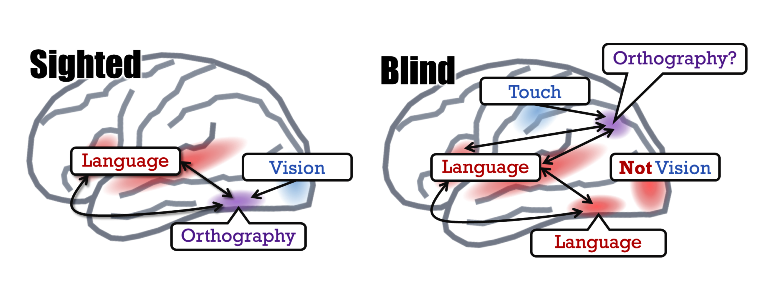
The activation of the visual cortex by Braille reading in blind individuals
can be explained in two different manners. A first possible interpretation
is that blind Braille readers use their visual cortex in a completely novel
manner. An alternative interpretation is that the visual cortex is
necessary for encoding orthography, either presented visually or tactile,
into information that can be used by language areas in *** frontal and
temporo-parietal brain areas. In the latter scenario, visual cortex
activation by Braille readers would not represent a *** de novo
adaptation, but rather a normal function present in normal sighted
individuals but that becomes triggered in a cross-modal manner. This
hypothesis was tested in a series of ensuing studies from the same
group. In one of these studies, the investigators measured brain
responses to phonological and semantic tasks, presented auditorily. In
the phonological task, participants heard words and they were asked to
covertly find another word that rhymed with the cue-word (e.g. bake –
rake), whereas in the semantic task they were asked a word that was
semantically associated with the cue-word (e.g. bed – sleep). The fMRI
results revealed that only blind individuals showed increased activity in
various subparts of the visual cortex. The spatial extent of visual cortex
activity was larger in congenitally compared to late blind participants.
The congenitally blind activated the visual cortex in both lexical tasks,
but more strongly in the semantic task. Late blind individuals exhibited
visual brain responses only for the semantic task. *** These findings
hence support the claim that the visual cortex activity in blind people
engaged in language processing may be related to semantic processing.
The question that remains to be answered is whether the activation of
the visual cortex during Braille reading is also functionally relevant.
Formulated differently, is the visual activation observed during Braille
reading just an *** epiphenomenon, of f.i. mental imagery or attention, or
is it really involved in Braille reading? Indeed, the fact that a brain area
shows increased activity during a task does not necessarily imply that it
also actively contributes to task performance. Two studies have
addressed this question using TMS: In In the first study, undertaken in
(1997, Braille performance was measured in participants receiving TMS
stimulation over the visual cortex or another control site not involved in
Braille reading. Results showed that when TMS was applied over the
visual cortex, congenitally blind individuals made significantly more
mistakes, and they reported distortions in tactile perception.
In the second study, undertaken in 2006, the effect of repetitive TMS
(rTMS) was tested on Braille reading performance. A difference from the
first study mentioned above, is that in this study, the effect on Braille
reading was measured after and not during the TMS application. In brief,
a group of congenitally blind participants were asked to read as quickly
as possible, a list of Braille words that were written in an unfamiliar
(Finnish) language. Both reaction times and number of errors were
measured. The same list was repeated three times in a row, a procedure
which induces repetition priming, meaning that time needed for reading
the word list will be shorter with each successive repetition. Next, rTMS
was applied for 15 minutes over the visual cortex or SI (control).
Immediately thereafter, participants received a new word list which they
had to read again three times. Results showed that following rTMS over
visual cortex, compared to SI, blind participants made significantly more
errors and were significantly slower. In addition, the repetition priming
effect was significantly smaller following rTMS over the visual cortex.
Together, the results of both studies show that the visual cortex is
indeed functionally involved in Braille reading in congenital blindness.
It is worth mentioning a unique case report of a congenitally blind
proficient Braille reader, who after bilateral damage to the visual cortex
following a stroke was no longer able to read Braille, despite the fact that
tactile perception remained unchanged. Indeed, the patient did not
notice any impairment in touch discrimination when trying to identify the
roughness of a surface or locate items on a board.
A question that may emerge is whether similar functional reorganization
can also happen in individuals with normal vision who have learned to
read Braille. This was examined in a quite recent study in 2016, where
healthy sighted people were trained to read Braille. The authors
monitored changes in brain activity that occurred following 9 months of
daily training with Braille reading. Subjects showed enhanced activity for
tactile reading in the visual cortex, including the visual word form area
(VWFA) that was modulated by their Braille reading speed and
strengthened resting-state connectivity between visual and
somatosensory cortices. Moreover, TMS disruption of VWFA activity
decreased their tactile reading accuracy. No changes in brain activation
were measured in SI.
Conclusion
In this paper, the effect of Braille reading on tactile discrimination has
been reviewed and brain responses in blind individuals. The available
data suggest that congenitally blind Braille readers have superior tactile
discriminatory performance compared to normal sighted subjects. This
improved tactile performance is limited to the Braille reading hand and
does not generalize to the rest of the body, suggesting that it is
traininginduced.
Brain imaging studies revealed that long-term Braille reading
induces structural and functional changes in both the somatosensory
and visual cortex. Braille reading consistently activates the visual cortex
in congenitally blind individuals. Finally, visual cortex activity in blind
people engaged in language processing may be related to semantic
processing.
Acknowledgments
Ron Kupers expresses his thankfulness to the many blind participants
who participated in the many behavioural and brain imaging studies in
our multiple research projects on the blind brain. It is thanks to their
generous good-will and relentless enthusiasm that we have been able to
perform the project on plastic changes in the blind brain. I would also like
to thank the Lundbeck foundation and the FSS for their financial support.
(Note: the entire article with references may be acquired upon request to
John Heilbrunn. the text below has been shortened and somewhat
simplified to adapt it to the project report format and purpose).
ϟ
Braille Reading and the Blind Brain
author: Ron Kupers
in Braille Teaching and Literacy
A Report for the European Blind Union and
European Commission
-Appendix 4-
January 2018
|
