|
|
excerpt
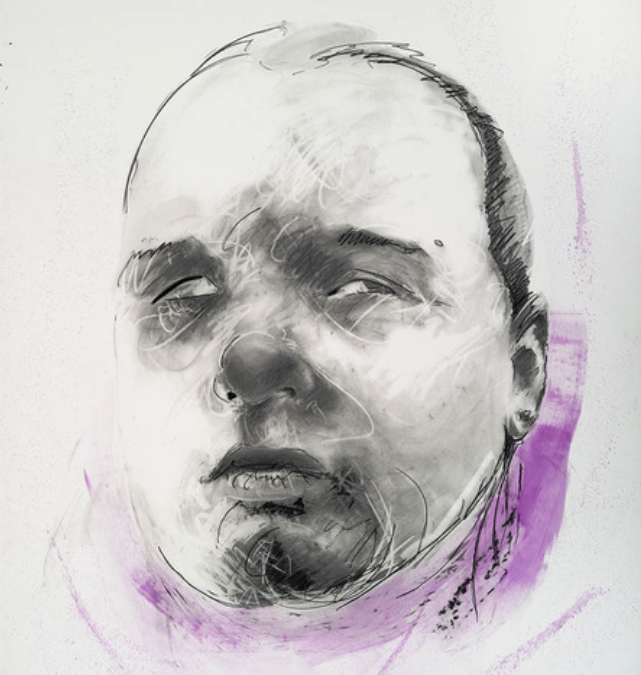
Cego - Philippe Pasqua, 2020
[ It is a Thursday evening. After work Martin Blom drives to the supermarket to
buy some groceries. As he walks back to his car, a shot rings out. When he wakes
up he is blind. His neurosurgeon, Bruno Visser, tells him that his loss of sight
is permanent and that he must expect to experience shock, depression, self-pity,
even suicidal thoughts before his rehabilitation is complete. The bullet has damaged the occipital lobe in his brain, rendering him cortically blind. At night-time, however, Blom is convinced he still has the ability to see. One spring evening, while Martin is practising in the
clinic gardens with his new white cane, something miraculous happens... ]
‘You've been shot.’
I heard someone say it. I wouldn’t have known otherwise; I wouldn’t have
realised. All I could remember was four tomatoes – three of them motionless, one
still rolling. And a black shape, too. A shape that had a curve to it.
I’ve been shot.
Sirens circled me like ghosts.
I slipped away, the feeling of having fallen from a plane, of falling through
dark air, and the plane flying on without me …
Each time I woke up, it was night.
Then voices spoke to me, out of nothing. Voices told me the rest. You’d been
shopping, they said. You were in a supermarket car-park when it happened. It was
a Thursday evening. You were walking towards your vehicle when you were fired
upon, a single shot. The bullet took a horizontal path through the occipital
cortex. One millimetre lower and you would’ve died instantaneously. You suffered
no damage to adjacent structures; however, you have lost your vision and that
loss is permanent. There were no witnesses to the shooting.
I lay in bed, my neck supported by a padded brace. My head had a strange
deadness to it, as if it was an arm and I’d slept on it.
My mouth tasted of flowers.
The voices told me I was in a clinic in the northern suburbs. They told me how
much time had passed, and how it had been spent: brain-scans, neuro-surgery,
post-traumatic amnesia. They told me that my parents had visited. My fiancée,
too. None of what they said surprised me. I could smell bandages and, behind the
smell of bandages, methylated spirits, linoleum, dried blood. I imagined, for
some reason, that the lino was pale-green with streaks of white in it, like
certain kinds of soap or marble. It seemed to me that several people were
positioned around my bed, though only one of them was speaking. I turned my face
in his direction.
‘Something I didn’t understand. Occipital something.’
The same voice answered. ‘Occipital cortex. It’s located at the back of the
head, the very base of the brain. It’s responsible for visual interpretation. In
your case, the damage is bilateral: both lobes are affected.’
‘You said the loss of vision is permanent …’
‘That’s correct.’
‘So there’s no chance of recovery?’
‘None.’ The voice paused. ‘I’m sorry.’
Somebody placed a hand on my shoulder. I wasn’t sure which one of them it was –
the man who’d been talking to me or one of the others. I couldn’t have said what
it communicated. Pity, maybe. Consolation. It reminded me of the feelings I’d
had about churches when I was young. How I’d imagined an angel’s touch might be.
I found that my eyes had filled with water.
Bits fly off me as I run.
The place is always the same. It’s a city street, though not one I recognise.
Sunlight everywhere. The buildings blaze with it.
I can see myself running. The bits flying off me. Two ribs, an ear. One of my
arms. Some teeth. They come loose, drop silently away. It’s like the way things
happen in space. I watch a finger leave my hand, spin backwards through the
bright gold air behind me. Soon there’s just the running left.
You might think it would stop then, but it doesn’t. I keep running, even though
I don’t have any legs. Even though the body’s gone, the elbows too, the lungs.
It’s hard to describe. It’s like one kind of air passing through another. It’s
not a bad feeling. The flesh has gone. There’s only the spirit left.
I wake up sweating …
The man who had talked to me before was sitting by my bed. This time he was
alone.
‘My name’s Visser. Bruno Visser.’
‘What do you look like?’ I said.
‘An understandable question.’ He mentioned light-brown hair, pale-blue eyes. He
was fairly tall, he said. Then he told me he was my neuro-surgeon, as if he
thought that detail might complete the picture.
‘And what about me?’ I said. ‘What do I look like?’
He paused, his silence awkward – or perhaps just curious, intrigued.
‘I mean, am I disfigured?’ I asked him. ‘Would I recognise myself?’
‘There’s only one disfigurement, as you put it, and it’s not really apparent.’
He explained that I’d lost a small section of bone on the left side of my
cranium, shattered by the stranger’s bullet as it exited. The normal procedure
was to wait until the tissues healed, and then to fit a titanium plate. It was a
fairly simple operation, he assured me. There would be a scar, of course, but
the hair would grow back over it. Nobody would know.
He continued, more earnest now (he had moved his chair closer to the bed, his
voice was lower). I shouldn’t underestimate the task that lay ahead, he said.
When someone loses their vision suddenly, at least three stages can usually be
distinguished. First there’s shock, a numbness that may last for weeks – the
body’s own protective anaesthesia. Then depression sets in. This stage could
last longer. Months. Years even. Hopelessness, self-pity, suicidal thoughts – I
had to be ready, he said, for any or all of these. Finally, when I’d finished
mourning my loss of vision, there was the gradual rehabilitation: the
development of a new personality, with different capacities, different
potential.
‘And now for the bad news,’ I said.
‘At this clinic, Martin,’ Visser said, ‘we don’t believe you should be under any
illusions about your condition.’
‘I don’t think there’s much danger of that.’
There was a silence. ‘Perhaps you should get some rest.’ His chair creaked
twice. He was gone.
I wake sweating, wait for my heart to settle. It always takes a while, after the
dream, for my hands to join the smooth, glossy stumps of my wrists. For my body
to piece itself together.
This is what must have happened after I was shot. I mean, that must have been
the first time it happened. Only then it would have taken longer. Hours,
probably. Maybe days. And there were parts of me that didn’t reappear, of
course. One small section of my skull, measuring, according to Visser, 2.75 cm.
by 1.93 cm. My eyesight, too. That never came back either.
I lie here with my neck supported by the brace. I move my fingers against the
coarse wool of the blanket that covers me. I move my feet against the
undersheet. There will come a time, I think to myself, when this won’t happen.
When I don’t wake up in a hospital bed – or any other bed, for that matter. When
disintegration’s pull can no longer be resisted. When the bits of my body
continue to fly outwards, like the universe itself.
Visser returned. I knew him by his footsteps – or, to be more accurate, his
shoes. They’d been repaired with metal, those steel crescents that prevent heels
or toes from wearing out. I turned my head towards him. He wanted to explain
something to me – I sensed his need – but he wasn’t sure how to begin.
At last he leaned forwards, his clothes releasing a faint odour of carbolic.
‘NPL,’ he said.
‘I’m sorry?’
‘No perception of light. I’ll give you a demonstration.’ He reached into a
trouser or a jacket pocket. ‘I’m holding a torch. Now, can you tell me, is it
on?’
I stared hard, but I had no awareness of a torch. I wasn’t aware of anything.
‘Is it off,’ Visser said, ‘or on?’
‘I’ve no idea.’
‘And yet your pupils still contract.’ The torch clicked. ‘What’s interesting
about cortical blindness is that it’s absolute. Your eyes still see, they still
respond to light. It’s just that what they’re seeing is not being recorded in
the brain.’ He shifted in his chair. ‘Imagine a TV. A TV receives
electromagnetic waves from a transmitter and it reconverts those waves into
visual images. If the TV’s faulty, the electromagnetic waves are not converted.
Unfortunately, that’s where the analogy ends. Unlike a TV, the occipital cortex
cannot be replaced, or even repaired. We simply don’t have the technology as
yet. Do you understand?’
‘I think so.’
‘It’s perhaps for this reason – the fact that the retina, the optic nerves and
the anterior visual pathways are all still functioning as normal – that people
who suffer from cortical blindness often believe, despite proof to the contrary,
that they can see. This is a condition known as Anton’s Syndrome. Rare,
admittedly, but it exists.’
I didn’t know what he meant by proof to the contrary.
‘Oh, falling downstairs,’ he said, ‘bumping into furniture – that kind of
thing.’ Visser’s tone was light, almost playful, and yet I wasn’t offended. I
saw what he was describing – it was slapstick, it was farce: policemen walking
into lampposts, fat women slipping on banana-skins – and I, too, was
entertained.
‘You might also experience visual hallucinations,’ Visser went on, ‘flashes of
light and so forth. It’s quite common in cases like yours, where there has been
a severe insult to the brain –’
‘I think I know what you’re trying to say, Doctor.’
Visser was silent, waiting.
‘You’re trying to say that I shouldn’t fall into the trap of believing I can
still see.’
‘Well, yes. Precisely.’
He sounded so surprised, so pleased with me, that I couldn’t help feeling proud
of myself. In fact, I had the feeling that the pride was mutual, that we were,
to some as yet unknown extent, dependent on each other.
Once or twice a year, when I was young, my parents would put me on a train to
the city. My grandparents met me at the other end. From the station we caught a
tram out to their small house in the suburbs (in my memory it’s always the same
ride, through streets that are sunlit, tree-lined, deadened by the heat, and my
grandmother always offers me a pear, picked from a tree on their allotment). I
usually stayed for two weeks, and was always sad when it was time to go.
Not far from where they lived was a big house that stood in a private park. I
would ride there on my grandfather’s bicycle, slow down as I passed the gates.
Standing on the pedals, I’d turn in an unsteady circle, unwilling to stop, but
wanting a second glimpse. There was a driveway leading up to the house between
two rows of trees. On winter evenings their branches, black and gleaming, seemed
to hoard the gold windows in their fingers. In spring, white blossoms lay
scattered on the gravel, each petal curved and pale, eyelid-shaped. Otherwise
there was nothing much to see. The house itself was a kilometre away, at least,
a faÇade of dark bricks in the distance. Green drainpipes. Chimneys.
When I asked my grandparents about it, they told me it was a sanatorium. That
means people who are sick, they said. I was never sure if they meant mad or just
ill, and they were dead now, my grandparents; the last time I looked for the
sanatorium, I was told it had been pulled down. If I’d been called upon to
explain my fascination I don’t know what I would have said. It wasn’t so much
what I saw as what I might see. Part of you recognises a potential. Thinking
about it now, I found a cruel irony in it. It occurred to me that, if the boy on
the bicycle had looked hard enough, if he’d looked really hard, he might have
seen the man he would eventually become.
More than twenty years had passed since then, but just for a moment, lying in my
bed in the clinic, I’m that boy again, turning circles on his grandfather’s
bicycle. And, looking up, I notice a man moving down the gravel drive towards
me. I drop one foot to the ground and stand there, watching. The man’s eyes are
bandaged and yet he’s walking in a straight line, as though he can see. And when
he reaches the gates he stops and looks at me, right through the bandages, right
between the black wrought-iron bars.
‘Martin?’ he says. ‘Is that you?’
My hands tighten on the handlebars.
‘It’s you,’ he says, ‘isn’t it.’
I start pedalling. There’s a hill luckily, it’s steep, the wind roars in my
ears. But even when I’m back with my grandparents and everything’s normal again,
I can’t be sure that I won’t turn round and see him walk towards me through the
house.
Knowing me, despite the bandages.
Knowing my name.
‘Mr Blom?’
It was the nurse, Miss Janssen. She had two detectives with her. One of them,
Slatnick, was making noises, strange little squeaks and splashes, which I
finally identified as the sound of someone chewing gum. The other man’s name was
Munck. Munck did most of the talking. His voice was easy to listen to, almost
soporific. I wanted to tell him he was in the wrong job; with a voice like that,
he should have been a hypnotist.
He was shocked, he said – they both were – by what had happened. He could only
express the deepest sympathy for me in my predicament. If there was anything
that they could do …
‘Thank you,’ I said.
Munck talked on. The last ten years had seen a proliferation of firearms in the
city. Incidents of the type it had been my misfortune to be involved in had
increased a hundredfold. Random violence, seemingly senseless crimes. He had his
theories, of course, but now was not the time. He paused. Wind rushed in the
trees outside. A window further down the ward blew open; I felt cold air search
the room. Munck leaned closer in his chair. The reason they’d come, he said, was
to hear my version of the event.
‘I’m sorry,’ I said. ‘I don’t have a version.’
‘You don’t remember anything?’
‘No, not really.’
‘Did you see anything at all?’
I smiled. ‘Tomatoes.’
Slatnick stopped chewing for a moment.
‘They must’ve spilled out of my bag,’ I said. ‘I suppose I was going to make a
salad that night.’
‘I see.’ I heard Munck stand up and start to pace about. ‘Where do you work, Mr
Blom?’
‘A bookshop.’ I mentioned the name of it.
‘I know the place. I’m often in there myself.’ Munck walked to the end of the
bed. ‘Do you have any enemies?’
I raised my eyebrows.
‘It sounds dramatic, I know,’ Munck said, ‘but we have to ask.’
‘None that I can think of.’
‘You have no idea who might’ve shot at you?’
‘I’m afraid not.’
Slatnick spoke next. ‘Am I correct in assuming therefore that you would not be
able to identify your assailant?’
I stared in his direction. What is it about policemen?
‘Slatnick,’ Munck said, ‘I think the answer’s yes.’
‘Yes?’ Slatnick hadn’t understood.
‘Yes, you’d be correct in that assumption.’
There was a silence.
‘I’m sorry to have disturbed you, Mr Blom,’ Munck said. ‘I have to say that, in
this case, it seems unlikely that justice will be done. All that remains is for
us to wish you a speedy recovery. Once again, if there’s anything we can do –’
‘Thank you, Detective.’
I listened to the two men walk away, their footsteps mingling with those of
other visitors. One of them sounded like a diver, the soles of his shoes
slapping down like flippers on the floor …
Absolute blindness is rare. There’s usually some suggestion of movement, some
sense of light and shade. Not in my case. What I ‘saw’ was without texture or
definition: it was constant, depthless and impenetrable. Sometimes I thought:
Your eyes are closed. Open them. But they were already open. Wide open, seeing
nothing. I could look straight into the sun and my pupils would contract, but I
wouldn’t know it was the sun that I was looking at. Or I could put my head
inside a cardboard box. Same thing. There were no gradations in the blankness,
no fluctuations of any kind. It was what depression would look like, I thought,
if you had to externalise it.
Miss Janssen spent part of every morning at my bedside. It was her job to
motivate me, though I found most of her efforts infantile and embarrassing. Take
the rubber balls, for instance. She told me to hold one in each hand. I was
supposed to ‘squeeze and then relax, squeeze and then relax’.
‘What’s it for?’ I asked.
‘You’d be surprised,’ she said, ‘how quickly muscles atrophy.’
‘Is that so?’
‘Yes, it is. If you don’t exercise, they just wither away.’
‘Well, in that case,’ I said, ‘there’s one muscle we definitely shouldn’t
overlook.’
She brought the session to an abrupt end.
The next morning she was back again, as usual. She made no reference to what I’d
said the day before. In what was intended as a gesture of repentance, I asked
her for the rubber balls. I lay there, one in each hand, squeezing and relaxing.
I behaved. And, since her voice was all there was, I began to listen to it. Not
the words in themselves, but the sound of the words. I tried to work out how old
she was, what she did in her spare time, whether she was happy. There were
moments when I thought I could picture her, the way you picture strangers on the
phone, just from their voices: I saw the colour of her eyes, the shape of her
mouth. It was like what happened when the dream I had was over: the gradual
assembly of a physical presence. Some mornings I found that I could only see her
breasts. Her voice seemed to be telling me that they were large. The curve from
the rib-cage to the nipple, for example. That fullness, that wonderful
convexity. Not unlike a fruit bowl. But I could never sustain it. Sooner or
later the picture always broke up, fell apart, dissolved. And, anyway, they
weren’t her breasts. They were just breasts. They could have been anybody’s.
I tried the same thing with the man in the next bed. His name was Smulders. He
used to work for the national railways, first as a signalman and, later, as a
station announcer. Then he got cataracts in both eyes. They’d operated during
the summer, but the results had been disappointing. I asked him the obvious
question, just to start him talking: ‘Can you see anything at all?’
‘Sometimes I see dancing girls. They move across in front of me, legs kicking,
like they’re on a stage.’ Smulders took a breath. His lungs bubbled.
He must be a smoker, I thought. Forty a day, non-filter. The tips of two of his
fingers appeared, stained yellow by the nicotine.
‘Anything else?’ I said.
‘Dogs.’
‘Dogs? What kind of dogs?’
‘Poodles. With ribbons and bows all over them.’
‘No trains?’
‘Once.’ Smulders chuckled. ‘It was the 6.23, I think. Packed, it was.’
He talked on, about his work, his colleagues, his passion for all things
connected with the railways; he talked for hours. But nothing came. Nothing
except a pair of black spectacles, their lenses stained the same colour as the
fingertips. Then I realised that they belonged to a friend of my father’s, a man
who used to work at the post office, in Sorting. I couldn’t seem to picture
Smulders at all. Somehow his breathing got in the way, like frosted glass.
These were, in any case, minor entertainments, scant moments of distraction.
There were days, whole days, when I lay in bed without moving. Almost without
thinking. The TV cackled and muttered, the way a caged bird might. Meals came
and went on metal trolleys – hot, damp smells that were lurid, rotten, curiously
tropical. My head felt as if it had been wrapped in cloth, layer upon layer of
it. I often had to fight for breath. Once I tried to tear the covering from my
face, but all I found beneath my fingernails was skin.
My skin.
There was no covering, of course.
Nurse Janssen sat with me each morning, her voice in the air beside me. It was
still a kind of seed, yet I could grow nothing from it, no comfort, no desire.
I’d lost all my wit, my ingenuity.
‘How’s your face?’ she asked me.
‘You tell me.’
‘It’s looking much better. How does it feel?’
‘Feels all right.’
‘You know, there are three trees outside your window,’ she said, ‘three
beautiful trees. They’re pines.’
If this was an attempt at consolation, it was misconceived, hopelessly naive. I
stared straight ahead. ‘Pines, you say?’
‘Yes.’
‘I can smell them.’
‘It’s a beautiful smell, isn’t it?’
I scowled. ‘If you like toilet cleaner.’
Later that day I picked up one of my rubber balls and threw it into the
blankness in front of me. Now that was beautiful, the silence of the ball
travelling through the air, an unseen arc, and then the splintering of glass. I
hadn’t realised there might be a window there. I saw the impact as a flower
blooming, from tight green bud to petals in less than a second. It was like
those programmes on TV where they speed a natural process up.
The next morning Visser put me on a course of medication. I took the drug in
liquid form. It was acrid, syrupy in texture, but I didn’t make any fuss. I
drank it down and then lay back, waiting for the effect.
What happens is this:
The world shrinks. The world’s a ball of dust. It rolls silently along the
bottom of a wall, meaningless and round. You watch it go. You don’t have to
think about it any more. It’s got nothing to do with you, nothing whatsoever.
You’d wave goodbye to it if you could lift your arm.
Not long after I surfaced from the anaesthetic, Visser visited me. He told me
that he had replaced the missing bone with a piece of precision-engineered
titanium. The fit was perfect; he’d checked it with a CT scan. There had been no
complications, nor was there any trace of infection – at least not so far. The
entire operation had taken less than four hours. The way he described it, he
made my head sound like some kind of jigsaw, and there was a note of genuine
pride in his voice, as if it had been clever of him to finish it.
‘In short,’ I said, rather drily, ‘it was a success.’
I heard his lips part on his teeth. ‘Oh yes. Most certainly. How do you feel?’
‘Not bad.’ I paused. ‘It’s a strange idea, though, a piece of metal in your head
–’
‘No stranger than a hip replacement,’ he said.
I didn’t agree. The point was, it was in my head. That’s what made it squeamish.
But Visser would have none of it. ‘You might experience some numbness where the
cut nerves are,’ he went on cheerfully, ‘but there shouldn’t be too much
discomfort. You’ll be up and about in no time.’
He was right about that. Within a week I’d recovered from the surgery and I was
embarking on my rehabilitation. Every afternoon I was taken to the Mobility
Training Centre, a special room in the east wing. It was laid out like a
surreal, random version of the world outside. There were flights of stairs that
stopped in mid-air. There were arbitrary brick walls – some knee-high, others
reaching to the ceiling. There were kerbstones, but no roads. This was Dr
Kukowski’s domain. Kukowski had a patient, almost weary manner, and his skin
smelled of vinegar. I sometimes speculated on the effect his work might have on
him. I could imagine him pausing halfway up the stairs at home, for example,
unwilling to go further. Or stepping off the pavement into the path of an
oncoming car because he had completely forgotten about the possibility of
traffic.
Kukowski gave me my first cane. It was lighter than I’d expected. Longer, too,
almost shoulder-height. I was supposed to hold it at waist-level and then walk
forwards, scanning, rather in the manner of someone with a metal detector. Tap,
tap, tap went the toughened nylon tip. There was something ludicrous about the
whole process; I wanted to pour scorn on it. But behind Kukowski’s patience
there lurked a threat: it was either the cane or it was back to tranquillisers,
headaches, isolation. I took the cane.
The End
RUPERT THOMSON is the author of eight highly
acclaimed novels, of which 'Air and Fire' and 'The Insult' were shortlisted for
the Writer’s Guild Fiction Prize and the Guardian Fiction Prize respectively.
His most recent novel, 'Death of a Murderer', was shortlisted for the 2008 Costa
Novel Award. His memoir 'This Party's Got to Stop' was published in 2010.
THE INSULT | A gritty yet sublimely intelligent
psychological thriller, this book is a return to the vivid, unsettling urban
underworld Thomson explored in his first two novels. We are in the dark side of
the brain, full of grief and deliciously strange comedy. I've never read
anything like it, writes Michael Ondaatje, author of The English Patient.
ϟ
The Insult
Rupert Thomson
Bloomsbury Publishing
Aug 1996
10.Abr.2026
Publicado por
MJA
|
