|
|
![El Reino de los Ciegos 3 - Verena Urrutia, 2009 [tinta da china, acrílico e lápis]](https://www.deficienciavisual.pt/Quadros/El%20Reino%20de%20los%20Ciegos3-VERENA%20URRUTIA-2009.jpg)
El Reino de los Ciegos 3
| Verena Urrutia, 2009
Summary | A couple is in a house together, remembering their happy times and
adventures. The man continually tells the woman that she should leave him, at
least temporarily. It is revealed that he has recently been blinded and is no
longer able to care for himself. Although his wife is happy to assist him, he
wants her to leave him because it embarrasses him - as another symbol of
thwarted masculinity - to be taken care of in this way.
“And what did we do then?” he asked her. She told him.
“That part is very strange. I can’t remember that at all.”
“Can you remember the safari leaving?”
“I should. But I don’t. I remember the women going down the trail to the beach
for the water with the pots on their heads and I remember the flock of geese the
toto drove back and forth to the water. I remember how slowly they all went and
they were always going down or coming up. There was a very big tide too and the
flats were yellow and the channel ran by the far island. The wind blew all the
time and there were no flies and no mosquitoes. There was a roof and a cement
floor and the poles that held the roof up, and the wind blew through all the
time. It was cool all day and lovely and cool at night.”
“Do you remember when the big dhow came in and careened on the low tide?”
“Yes, I remember her and the crew coming ashore in her boats and coming up the
path from the beach, and the geese were afraid of them and so were the women.”
“That was the day we caught so many fish but had to come in because it was so
rough,”
“I remember that.”
“You’re remembering well today,” she said. “Don’t do it too much.”
“I’m sorry you didn’t get to fly to Zanzibar,” he said. “That upper beach from
where we were was a fine place to land. You could have landed and taken off from
there quite easily.”
“We can always go to Zanzibar. Don’t try to remember too much today. Would you
like me to read to you? There’s always something in the old New Yorkers that we
missed.”
“No, please don’t read,” he said. “Just talk. Talk about the good days.”
“Do you want to hear about what it’s like outside?”
“It’s raining,” he said. “I know that.”
“It’s raining a big rain,” she told him. “There won’t be any tourists out with
this weather. The wind is very wild and we can go down and sit by the fire.”
“We could anyway. I don’t care about them any more. I like to hear them talk.”
“Some of them are awful,” she said. “But some of them are quite nice. I think
it’s really the nicest ones that go out to Torcello.”
“That’s quite true,” he said. “I hadn’t thought of that. There’s really nothing
for them to see unless they are a little bit nice.”
“Can I make you a drink?” she asked. “You know how worthless a nurse I am. I
wasn’t trained for it and I haven’t any talent. But I can make drinks.”
“Let’s have a drink.”
“What do you want?”
“Anything,” he said.
“I’ll make a surprise. I’ll make it downstairs.”
He heard the door open and close and her feet on the stairs and he thought, I
must get her to go on a trip. I must figure out some way to do it. I have to
think up something practical. I’ve got this now for the rest of my life and I
must figure out ways not to destroy her life and ruin her with it. She has been
so good and she was not built to be good. I mean this sort of good. I mean good
every day and dull good.
He heard her coming up the stairs and noticed the difference in her tread when
she was carrying two glasses and when she had walked down barehanded. He heard
the rain on the windowpane and he smelled the beech logs burning in the
fireplace. As she came into the room he put his hand out for the drink a little
too soon. But then he felt it tall and cold and closed his hand on it and felt
her touch the glass with her own.
“It’s our old drink for out here,” she said. “Campari and Gordon’s with ice.”
“I’m certainly glad you’re not a girl who would say ‘on the rocks.’ ”
“No,” she said. “I wouldn’t ever say that. We’ve been on the rocks.”
“On our own two feet when the chips were down and for keeps,” he remembered. “Do
you remember when we barred those phrases?”
“That was in the time of my lion. Wasn’t he a wonderful lion? I can’t wait till
we see him.”
“I can’t either,” he said.
“I’m sorry.”
“Do you remember when we barred that phrase?”
“I nearly said it again.”
“You know,” he told her, “we’re awfully lucky to have come here. I remember it
so well that it is palpable. That’s a new word and we’ll bar it soon. But it
really is wonderful. When I hear the rain I can see it on the stones and on the
canal and on the lagoon, and I know the way the trees bend in every wind and how
the church and the tower are in every sort of light. We couldn’t have come to a
better place for me. It’s really perfect. We’ve got the good radio and a fine
tape recorder and I’m going to write better than I ever could. If you take your
time with the tape recorder you can get the words right. I can work slow and I
can see the words when I say them. If they’re wrong I hear them wrong and I can
do them over and work on them until I get them right. Money, in lots of ways we
couldn’t have it better.”
“Oh Philip — ”
“Shit,” he said. “The dark is just the dark. This isn’t like the real dark. I
can see very well inside and now my head is better all the time and I can
remember and I can make up well. You wait and see. Didn’t I remember better
today?”
“You remember better all the time. And you’re getting strong.”
“I am strong,” he said, “Now if you — ”
“If me what?”
“If you’d go away for a while and get a rest and a change from this.”
“Don’t you want me?”
“Of course I want you, darling.”
“Then why do we have to talk about me going away? I know I’m not good at looking
after you but I can do things other people can’t do and we do love each other.
You love me and you know it and we know things nobody else knows.”
“We do wonderful things in the dark,” he said.
“And we did wonderful things in the daytime too.”
“You know I rather like the dark. In some ways it is an improvement.”
“Don’t lie too much.” she said. “You don’t have to be so bloody noble.”
“Listen to it rain,” he said. “How is the tide now?”
“It’s way out and the wind has driven the water even further out. You could
almost walk to Burano.”
“All except one place,” he said. “Are there many birds?”
“Mostly gulls and terns. They are down on the flats and when they get up the
wind catches them.”
“Aren’t there any shore birds?”
“There are a few working on the part of the flats that only comes out when we
have this wind and this tide.”
“Do you think it will ever be spring?”
“I don’t know,” she said. “It certainly doesn’t act like it.”
“Have you drunk all your drink?”
“Just about. Why don’t you drink yours?”
“I was saving it.”
“Drink it up,” she said. “Wasn’t it awful when you couldn’t drink at all?”
“No, you see,” he said. “What I was thinking about when you went downstairs was
that you could go to Paris and then to London and you’d see people and could
have some fun and then you’d come back and it would have to be spring by then
and you could tell me all about everything.”
“No,” she said.
“I think it would be intelligent to do,” he said. “You know this is a long sort
of stupid business and we have to learn to pace ourselves. And I don’t want to
wear you out. You know — ”
“I wish you wouldn’t say ‘you know’ so much.”
“You see? That’s one of the things. I could learn to talk in a non-irritating
way. You might be mad about me when you came back.”
“What would you do nights?”
“Nights are easy.”
“I’ll bet they are. I suppose you’ve learned how to sleep too.”
“I’m going to,” he told her and drank half the drink. “That’s part of The Plan.
You know this is how it works. If you go away and have some fun then I have a
good conscience. Then for the first time in my life with a good conscience I
sleep automatically. I take a pillow which represents my good conscience and I
put my arms around it and off I go to sleep. If I wake up by any odd chance I
just think beautiful happy dirty thoughts. Or I make wonderful fine good
resolutions. Or I remember things. You know I want you to have fun — ”
“Please don’t say ‘you know.’ ”
“I’ll concentrate on not saying it. It’s barred but I forget and let the bars
down. Anyway I don’t want you just to be a seeing-eyed dog.”
“I’m not and you know it. Anyway it’s seeing-eye not seeing-eyed.”
“I knew that,” he told her. “Come and sit here, would you mind very much?”
She came and sat by him on the bed and they both heard the rain hard against the
pane of the window and he tried not to feel her head and her lovely face the way
a blind man feels and there was no other way that he could touch her face except
that way. He held her close and kissed the top of her head. I will have to try
it another day, he thought. I must not be so stupid about it. She feels so
lovely and I love her so much and have done her so much damage and I must learn
to take good care of her in every way I can. If I think of her and of her only,
everything will be all right.
“I won’t say ‘you know’ all the time any more,” he told her. “We can start with
that.”
She shook her head and he could feel her tremble.
“You say it all you want,” she said and kissed him.
“Please don’t cry, my blessed,” he said.
“I don’t want you to sleep with any lousy pillow,” she said.
“I won’t. Not any lousy pillow.”
Stop it, he said to himself. Stop it right now.
“Look, tu,” he said. “We’ll go down now and have lunch in our old fine place by
the fire and I’ll tell you what a wonderful kitten you are and what lucky
kittens we are.”
“We really are.”
“We’ll work everything out fine.”
“I just don’t want to be sent away.”
“Nobody is ever going to send you away.”
But walking down the stairs feeling each stair carefully and holding to the
banister he thought, I must get her away and get her away as soon as I can
without hurting her. Because I am not doing too well at this. That I can promise
you. But what else can you do? Nothing, he thought. There’s nothing you can do.
But maybe, as you go along, you will get good at it.
The End
Most readers don’t know that
Ernest Hemingway wrote in his old age two stories about blind men and that these
are great stories. The stories appeared in The Atlantic Monthly on December 20,
1957. One was entitled, “A Man of the World,” the other, “Get a Seeing-Eyed
Dog.”
“Get a Seeing-Eyed Dog” urges in what respect Hemingway felt he was blind. In
this story, a blind writer is at home during a heavy rain with his wife. She and
he are talking, and she brings up days from their past, the specific events and
sights of those days, and he remembers well a day she refers to: “Yes, I
remember her and the crew coming ashore in her boats and coming up the path from
the beach, and the geese were afraid of them and so were the women.”
They are reminiscing and he, remembering; and at one point, he says, “Listen to
it rain. How is the tide now?” [...] What one learns is that the blind writer
can no longer observe nature and has trouble remembering past scenes. [...]
When Hemingway was at his peak, he had a photographic memory and could reproduce
the very atmosphere and accidents of any day he chose to write about. [...] But
in his old age, after so much trauma and pain, he could no longer do so. He was
blind. This was the condition he wanted to convey in these great stories shortly
before his death. He was left without the tools he thought necessary for the
writer. These stories are his letter to posterity. They tell why he felt worn
out with life.
by
David Massey
ϟ
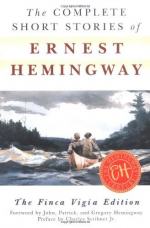
GET A SEEING-EYED DOG
Ernest Hemingway
in Two Tales of Darkness
1.st published: The Atlantic Monthly, November 1957
in
https://www.theatlantic.com/
24.Set.2025
Publicado por
MJA
|
