|
|
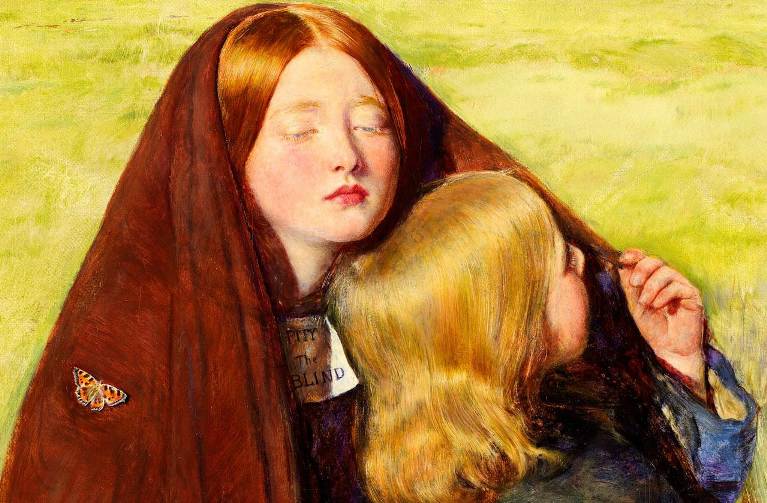
John Everett Millais's famous painting of an itinerant blind girl
- The Blind Girl (1856) - depicts her with a label round her neck inscribed "PITY
THE BLIND."
Abstract |
In this article, I examine images of blind people in nineteenth-century Europe
and America, and question the ways in which shifting sensory hierarchies
constituted the representation of blindness in this period. I focus particularly
on images of blind people reading by touch, an activity that became a public
symbol of the various initiatives and advancements in education and training
that were celebrated by both blind and sighted spokespeople. My discussion is
structured around institutionally- and individually-commissioned portraits and I
distinguish between the different agendas shaping representations of blind
people. These include instances where blind people's achievements are
problematically displayed for sighted benefactors; as well as examples of blind
people determining the compositional form and modes of circulation of their
likenesses thus altering "key directions in figurative possibilities" (Snyder
173). Moreover, the portraits I consider demonstrate the multisensory status of
images, alerting us to a nineteenth-century aesthetic that was shaped by touch
as well as vision. I draw on sensory culture theory to argue that attending to
the experience and representation of the haptic in the circulation of visual
images of blind people signals a participatory beholding, via which blindness is
creatively – rather than critically – engaged.
Blindness was represented in nineteenth-century portraiture in multifaceted ways
which were shaped by the complex interactions of artists, commissioners and
blind sitters. The engagement of blind people with both the compositional forms
and circulatory modes of their likenesses created new opportunities of beholding
the experience of blindness. In this article, I show how blind people were both
represented in, and actively used, visual media to promote positive images of
the experience of blindness as a corrective to stereotypical depictions of them
as uneducated, poor and itinerant. Significantly, this coincides with important
developments in blind education and advocacy, which centred on the development
of raised-print systems that provided blind people with new access to the
written word via touch from the 1820s onwards. The images I have assembled in
this essay all depict or acknowledge this new mode of literacy. Reading by touch
became a public symbol of the various initiatives and advancements in education
and training that were celebrated by both sighted and blind spokespeople for the
way they opened out the social, cultural and spiritual potential of blind
communities.
Representations of blindness prior to the nineteenth century were concerned
largely with its role within mythical and biblical narratives, or with blind
people's itinerant existence (thus linking blindness with poverty).
1 Blindness
was often the subject of an anxious gaze, with observers including artists and
writers worried about the ways in which a loss of vision equated to a
diminishment of social and cultural status. Notably for my discussion, the
popular figure of the blind beggar was increasingly represented with a label
bearing the inscription "blind" from the late eighteenth century onwards, a
gesture which signified the person's blindness, and which also, in an
increasingly literate society, ironically reminded the viewer of their inability
to participate in a visible print economy. This is exemplified in an
early-nineteenth century etching by John Thomas Smith of a blind seller of
halfpenny ballads (fig. 1).
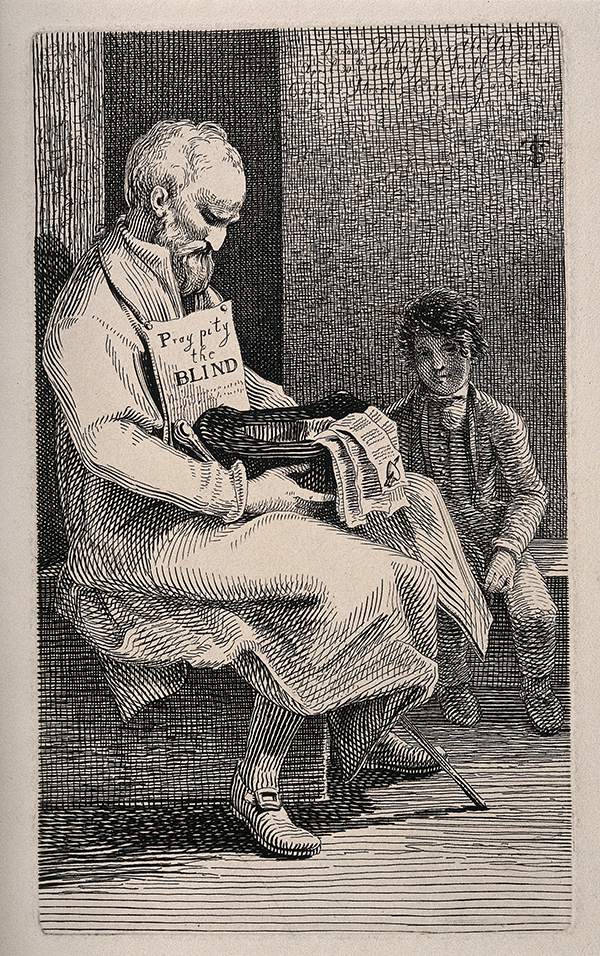
Fig. 1: John Thomas Smith, 'A sitting blind beggar sells 'love sonnets' to
obtain money with a young boy'. Etching, 1816. Credit: Wellcome Collection. CC
BY
An etching, in black and white tones, depicts an old man in a long,
light-coloured coat, with white hair and beard, seated in front of a wall and
holding a basket of printed papers. His eyes are shut and cast downwards. A
placard around his neck reads "Pray pity the blind." A boy of about fourteen
sits behind him to the right, looking in his direction.
He bears a written plea for assistance and charity ('Pray Pity the Blind'), and
he relies for his meagre income upon the sale of printed texts, which he
presumably cannot read (Smith). Embossed literature, introduced to Britain some
ten years after Smith's print, offered an alternative opportunity for blind
people to participate more directly in a textual economy. Whilst the
representational mode of the blind beggar continued to an extent in
nineteenth-century culture, in this essay I identify more positive cultural
associations between blindness and literacy.
2 Blind communities seized on
public interest in reading by touch to fashion a corrective iconography for
blindness marked by education and industry.
Nineteenth-century interest in touch was contextualised by a reframing of
sensory hierarchies, whereby philosophers, scientists and psychologists promoted
the role of touch as an information-gathering sense.
3 This shift is discernible
in the images I discuss, which tend to portray what a blind person could do,
rather than pointing to their lack, thus complicating ideas around what
constituted a sensory impairment and, relatedly, disability (Tilley and Olsen).
Yet as I and others including Vanessa Warne have discussed elsewhere, the
discourse around tactile reading was also contradictory, and, certainly in the
earlier part of the century, visual prejudices continued to shape the form of
raised alphabets at a design level; whilst anxieties around the nature of
blindness continued to prohibit a broader expansion of literary materials (Warne
56; Tilley, "The Sentimental Touch" 232-33). These debates are indicative of
what has been described in disability studies as an ocularcentric privileging in
modern culture: that is, a privileging of vision as the dominant mode for
knowing (Garland-Thomson 25). 4 Certainly, there is a tension inherent in the
images I introduce which use visual mediums to communicate ideas to largely
sighted audiences about the ways in which blind people learned via touch. My
discussion is structured around institutionally- and individually-commissioned
portraits: this will enable me to distinguish between the different agendas
shaping representations of blind people, and thus to explore these tensions
further. However, I emphasize the multifarious work these portraits do and
consider – borrowing from Sharon L. Snyder – how they are "significations of
disability" which "alter key directions in figurative possibilities" (173). In
particular, the portraits I consider demonstrate the multisensory status of
images, alerting us to a nineteenth-century aesthetic that was shaped by touch
as well as vision. 5 In the final part of my discussion, I will turn to sensory
culture theory to develop more nuanced readings of the material and sensory
functions of these images as objects, which are handled, exchanged and beheld by
both sighted and blind people, with distinctive effects generated by the
different mediums of print, photography and painting. I argue that attending to
the experience and representation of the haptic in the circulation of visual
images of blind people can signal a participatory beholding, via which blindness
is creatively – rather than critically – engaged (Calè and di Bello 4).
6
Institutional portraits of blindness: conforming to visual modes
The following images exemplify the practice of using portraiture to promote the
work of institutions committed to blind people's education and training, and
signal the complex and contradictory agendas that shaped representations of
blind people reading by touch. Whilst this mode of portraiture raises ethical
questions about the potential exploitation of sitters to serve institutional
agendas (including fundraising), often consolidating ableist narratives, it
nonetheless also conferred status on blind communities by re-framing blind
people as intellectual, active and independent.
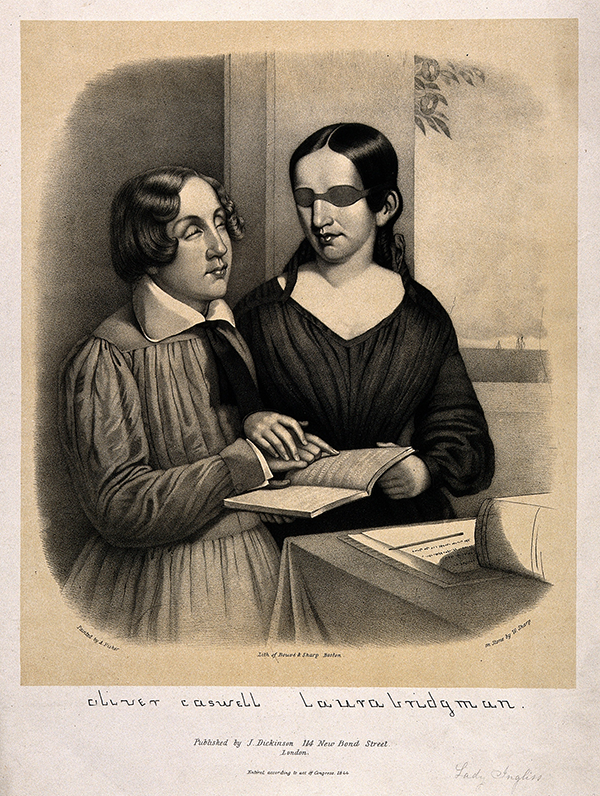
Fig. 2: 'Portrait of Oliver Caswell and Laura Bridgman reading embossed letters
from a book'. Lithograph by W. Sharp, after Alanson Fisher. Credit: Wellcome
Collection. CC BY
A lithograph in black and white tones shows two young blind people: on the left
a boy of about fourteen and standing next to him on the right a girl of about
sixteen. They are positioned in an interior: behind the girl to the right is an
open window, with tree leaves just visible behind the window frame. In front of
her to the right is a desk, on which rests a large book and a sheet of paper,
which has been partly inscribed: a ruler rests below the last line of writing.
The boy and girl are facing forward, and lean in slightly towards each other. He
wears a long-sleeved coat with a white collar and black cravat. His eyes are
closed. She wears a dark, long-sleeved dress, with a large white collar. Her
eyes are covered by dark glasses. They are holding a book: the girl's left hand
is laid over the boy's left hand, which is positioned on the book, his index
finger stretched out to touch the paper. The lithograph is inscribed with the
names Oliver Caswell and Laura Bridgman made in square handwriting in Roman
script.
Figure 2 depicts Laura Bridgman and Oliver Caswell, two pupils of the Perkins
Institution for the Blind in Boston, which was directed by the charismatic,
sighted Samuel Gridley Howe. Bridgman was arguably the heroine in the story of
blindness and literacy at the mid-nineteenth century, as important studies by
Elisabeth Gitter and Karen Bourrier have demonstrated, and was famous for having
learned a system of language based on arbitrary signs. Celebrated by Howe, she
gained international fame following Charles Dickens's account of his meeting
with her on his tour of America in 1842, published in American Notes for General
Circulation (33-71). Touch is embedded in the portrait and the pair's tactile
intelligence clearly emphasized. The lithograph itself has a sense of waxy
roundness, in which the flesh and fingers have an almost three-dimensional
quality, corresponding to the haptic nature of Bridgman's subjectivity.
However, as I've written elsewhere, Howe's continued promotion at the
mid-nineteenth century of reading and writing systems based on the Roman
alphabet, more conveniently legible to the eye of the Institution's sighted
instructors, was problematically at odds with some of Perkins's more progressive
goals (Tilley, "The Sentimental Touch" 226-227, 230-233). That tension is
embodied in this image. At the bottom of the image, both Caswell's and
Bridgman's signatures have been inscribed, pencilled in the standard square
handwriting Perkins pupils were taught to write in and which conformed to
sighted literacy practices. 7 Their signatures alert us firstly to Howe's
concern that pupils learn a system of writing based on the Roman letter rather
than one of the so-called arbitrary alphabetic systems in circulation that were
more suited to touch but illegible to sighted teachers. Secondly, they point to
Howe's anxiety that pupils might be able to author their own text in an embossed
format, thus facilitating private communication between them. Rather, the
inclusion of their signatures in this format suggests how their entry into
literacy was intended to both conform to and elicit the admiration of sighted
audiences. The inscription added in pencil to the print in the Wellcome
collection ("Lady Ingliss, with Mrs Howe's [wife of the Perkins director, Samuel
Gridley Howe] kind regards") suggests that the print was a gift to an existing
or potential benefactor. The inscription indicates the ideological function that
the print was supposed to perform as a visual display of the achievements of the
Perkins Institute. It enacts a more genteel version of the street readings
performed by blind beggars, a practice which Warne argues linked "blind literacy
with poverty and charity […] consequently distancing it from sighted reading
practices" (59). By framing blind reading as a spectacle, both street reading
and displays of blind reading in schools traded on the exceptionality of finger
reading in order to raise either personal income or charitable funds (58-59).
This portrait thus raises an ethical question concerning how individuals –
notably Laura Bridgman in this example – were co-opted into promoting the
agendas of sighted educationalists.
Whilst Warne focuses on displays of tactile reading which helped reinforce the
links between blindness and poverty, figure 3 is an institutional portrait which
helped to re-orientate the relationship between blindness, literacy and ability
(Warne 58-61).
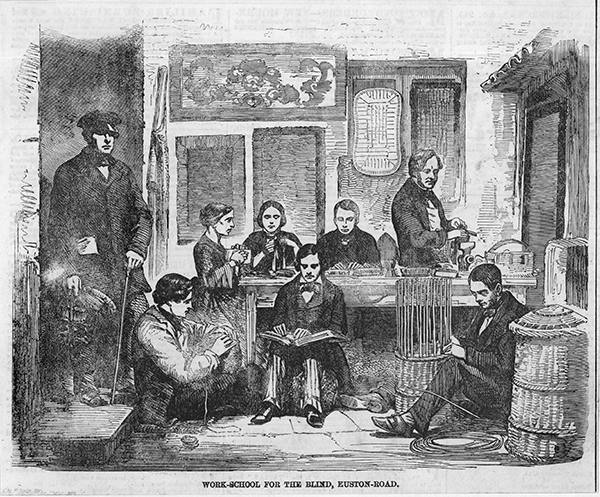
Fig. 3: Unknown engraver after Hubbard, Work-School for the Blind, Euston Road.
Engraving (published in Illustrated London News, 24 April 1858). Credit:
Chronicle / Alamy Stock Photo.
An engraving in black and white is a group portrait depicting a scene of quiet
industry and education: two women and two men are seated around a desk, making
brushes and working a machine; three men are seated on the floor in front of the
table, two engaged in basket making and cane work, one reading an embossed book.
A man stands by the doorway laden with handcrafted items, suggesting that he is
about to leave to sell some of the group's wares. All the sitters wear Victorian
clothing: the men wear heavy coats over suits, and the women long dark dresses.
The wall directly behind the table is decorated with three panels, one of which
appears to be a decorated picture, and a rectangular woven object. A printed
caption at the bottom of the image reads 'Work-School for the Blind,
Euston-Road'.
This group portrait depicts some of the blind workers of a workshop in London
operated by the Association For Promoting the General Welfare of the Blind,
established and managed in the 1850s by two blind people, Elizabeth Gilbert and
William Hanks Levy. The original portrait, painted by an artist named Hubbard,
was commissioned in 1858, then engraved and published alongside an account of
the workshop in the Illustrated London News in 1858. This portrait emphasizes
the importance of tactile reading by placing the reader in the centre of the
image frame; yet it also de-spectacularizes the act by quietly absorbing it into
a scene of wider industry. The reader, rather than displaying his skills as a
finger reader by reading out loud to the wider group, instead appears to be
absorbed in a more private contemplation of the text.
The workshop community was divided, however, between moderate and radical
approaches towards blind identity. Elizabeth Gilbert's first biographer Frances
Martin (a long-term friend of Gilbert) claimed that she advocated cooperation
between sighted and blind people, so that, she argued "the blind may be left
those processes in which the loss of sight places them at the least
disadvantage" (133). Gilbert favoured training in handicrafts, as shown in this
portrait. She also articulated a more moderate position than some of her other
colleagues, including Levy. Despite his lack of wealth, Levy had risen to the
position of teacher at the London Society for Teaching the Blind to Read, and
was selected by the society to demonstrate his reading before Queen Victoria at
the Great Exhibition of 1851, around the time he met Gilbert in the early 1850s.
The Association initially, according to Levy's wishes, employed only blind
people, though this was not practical for a sustained period and sighted
co-workers were introduced.
Martin's chastisement of Levy suggests the distaste with which polite sighted
society may have held blind radicalism, as she described him as one with "an
extreme view", who "himself educated in an institution, surrounded only by blind
people, often of a very feeble capacity, had learned to look upon himself more
as a member of an oppressed and persecuted race than as an afflicted man" (87).
Levy's more radical aims were shared by other blind spokespeople at this time,
including the writer and editor John Bird, the musician Alexander Mitchell (who
set up a short-lived Society for Improving the Condition of the Blind in
Walworth Road), the poet Edmund White, and the teacher, interpreter and musician
Mrs Hippolyte van Landeghem. Their writings characteristically display anger at
the way in which they had been treated as inferior by sighted people in
positions of power. This portrait however has no sense of anger or radicalism;
rather, the figures have been absorbed into a normative scene of industrious
self-improvement. No individual bears any visible markers of blindness, and all
display qualities of decorum and quietude. They certainly do not resemble the
kind of rabble that Martin fears characterises blind communities. As such, the
portrait conforms to dominant sighted cultural expectations of industrious,
compliant blind people. The following section extends this analysis by
considering the ways in which blind individuals absorbed trends in contemporary
photographic portraiture to promote their professional and personal identities.
As individually-commissioned portraits, these images evidence greater levels of
autonomy in self-presentation, whilst consolidating divisions in tactile reading
practices according to gender.
Sitter-commissioned portraiture: creating parity
Rosemarie Garland-Thomson argues that the "most prevalent pictures of people
with disabilities have come to us through the genres of freak show photography,
charity campaigns or medical photography" and that the range of representation
has only recently expanded 'as people with disabilities have entered into the
newly accessible public realm" (23). However, a large and international
community of blind people actively used and commissioned portraiture to
establish their place and status within nineteenth-century society. Sitters were
frequently depicted with markers that identified them as blind – notably, for my
discussion, they were shown touching raised print texts – but these images also
drew upon standard iconographies of contemporary photographic portraiture
(dress, pose, studio props) to affirm their parity with non-blind peers. The
next three images I discuss bear out, avant la lettre, Garland-Thomson's
argument relating to a set of twentieth-century portraits, that portraiture can
make possible the "recognition of subjects as worthy and – at the same time –
disabled" (37). The images I discuss in this section thus perform an ethical
function as well, and reflect the extensive activity of blind campaigning and
advocacy groups in the nineteenth century. They exemplify how blind people
actively used visual technologies to draw attention to their status as literate
and educated, particularly through the practice of sharing their portraits with
wider communities. Here, however, gendered distinctions between the identities
blind men and women could assume become apparent; the form and composition of
male portraits are associated with their public work and reputation, whereas the
form and composition of female portraits tend to position women within the
domestic sphere. 8
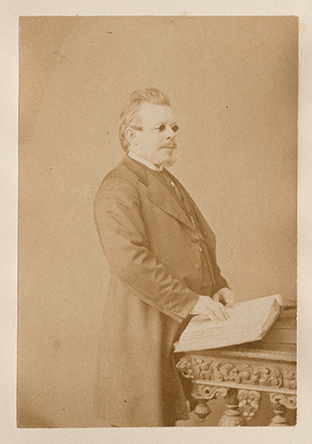
Fig. 4: Unknown photographer, William Moon. Published in Light for the Blind: A
History of the Origin and Success of Moon's System of Reading (1873). Private
Collection.
A photographic portrait of a man of around fifty pasted onto a book
frontispiece. The photograph fills about the middle third of the page and is set
within a decorative border consisting of two red parallel lines about 1.5cm from
the image edge. At the bottom of the image, within the border, is inscribed in
red typeface 'W. Moon, LL.D.' The man is standing in an interior setting.
Positioned centrally, he faces right. He wears dark glasses, and is dressed in a
smart long coat, worn over a jacket or waistcoat. He is of a medium-large build,
with a rounded stomach. He is turned towards a wooden desk with a decorated
foliage edge. A large book volume rests on this desk, on which both his hands
are placed, his fingers stretched out over the text.
Figure 4 is a photographic portrait of William Moon, a blind inventor of one of
the leading early embossed alphabets, published in his memoir of 1873. Moon was
a particularly keen self-promoter, who did much to secure the success of his
alphabetic system in the latter part of the nineteenth century: it was the
dominant arbitrary alphabet in Britain, and had a strong global reach through
the British Empire, until it was displaced by braille around the turn of the
century. Moon's portrait carefully utilizes visual media to inscribe a new
relationship between touch, literacy and respectability. Indeed, the portrait
resembles his alphabetic system, which adapted the Roman alphabet by reducing it
to a fixed number of shapes and symbols that were easier for the finger to
process, but appealed to readers who had lost their sight later in life and
retained visual memory. Like his alphabet, the portrait blends visual and
tactile codes by co-opting the visual form of the photograph to communicate the
practice of reading by touch.
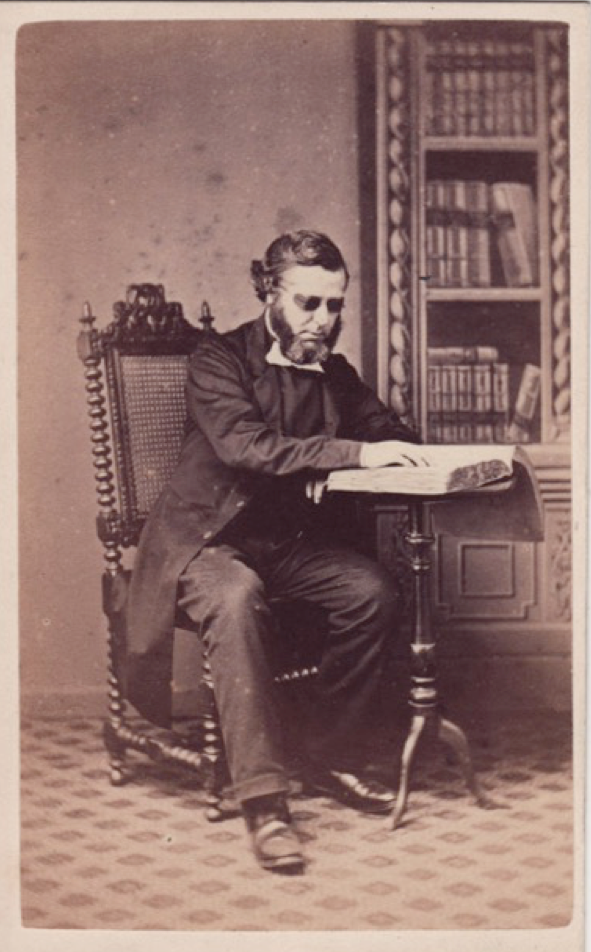
Fig. 5: Starbuck, Unidentified Man. Carte de visite, c. 1870s. Private
Collection
A photograph in black and white tones shows a man, aged about forty, sitting
within an interior setting. He is seated on an ornately decorated chair behind a
circular wooden table, across which a large book volume of embossed print
spills; his right hand is placed on top of an open page. He wears a dark suit,
with a knee-length coat, and a pair of dark glasses. A painted backdrop of
bookshelves on the back wall creates an impression of a library, or study. A
printed inscription at the bottom of the photograph reads "By Starbuck. Alford".
This set of portraits also highlight the role played by gender in the
performance of embossed reading and suggest how efforts to re-frame public
perceptions of visual impairment were complicated by their entanglement with
other sets of identity politics. Male blind readers were more often depicted
with professional props such as desks (see for example fig. 5), reinforcing
their role in public discourses of tactile reading, whereas female sitters were
usually depicted in domestic interiors, their books awkwardly placed on their
laps rather than confidently positioned on desks. These compositions
circumscribe the limits for female blind readers, reinforcing wider cultural
associations between femininity and private reading. This is epitomized in
figure 6, an ambrotype photograph of a blind woman.
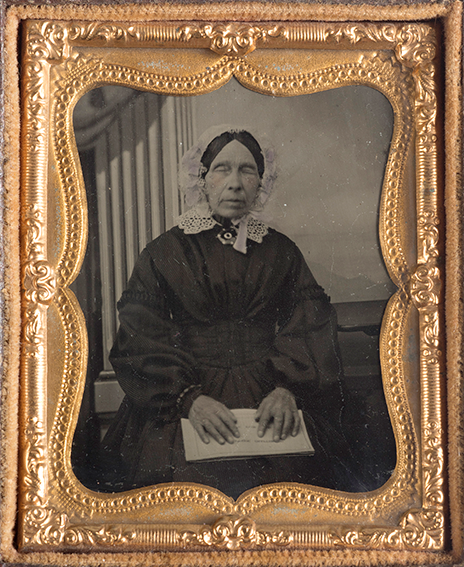
Fig. 6: Unknown Photographer, Ann Whiting. Ambrotype, c. 1860s. Private
Collection
A photograph in a gilt frame shows an older woman of about 50 years who is
seated, facing forward, in an interior location (behind her left shoulder is a
detail of a fireplace). She wears a white lace bonnet and a dark full-sleeved
gown, and her eyes are closed. A book consisting of both printed and embossed
text rests on her lap, and both her hands are placed on the text, her fingers
touching the paper.
Unlike the carte de visite, the ambrotype was a unique object and so created for
a more private audience. An inscription on its back reading "Ann Whiting"
indicates the sitter's identity. However, I have not been able to trace further
information about Ann Whiting. The difficulty of establishing her identify and
indeed locating evidence of her experience of blindness in the nineteenth
century highlights the challenges faced by researchers who want to question the
dominant accounts and representations of blindness that have been left by the
historical record. The back of the frame also details that Ann Whiting is "nurse
and friend" and gives the dates "1820 to 186-" suggesting this may have been
taken as a memento for a friend. The small, handheld size of the ambrotype also
speaks of the intimacy of its form. It suggests, perhaps, a sitter taking
pleasure or pride in her proficiency of reading, and sharing this skill with a
friend.
Whilst implicit, the association between touch and learning represented in these
images is reinforced further through the haptic encounters that viewers had with
these photographs. Sensory culture studies offers here a fresh way of analysing
these objects outside of straightforwardly visual frameworks. As the
anthropologist David Howes explains, following a model of inter-sensoriality
compels us to "interrelate sensory media, to contextualise them within a total
sensory and social environment" that also takes account of embodied experience
(169). Further, the visual anthropologist and curator Elizabeth Edwards reminds
us that photographs are not simply spectral images to be looked at; they are
also material, multi-sensory objects that are handled, touched and caressed: "in
considering the photograph we have to consider not just sight but even touch and
smell" ("Grasping the Image" 421). Whilst the original intention of a photograph
may be to create an image, Edwards demonstrates how "the sensory engagement with
the physical photograph as material object" elicits "specific gestural and
haptic forms" that shape and enhance our affective engagement with it ("Thinking
Photography" 31, 45). Figures 4, 5 and 6 are typical of other examples of
portraits of blind people, which were often circulated as prints embedded into
books, or small photographic images pasted into albums or exchanged by hand. As
such, they draw attention to the tactile dimension of sighted reading in
nineteenth-century culture, reconfiguring directions in figurative
possibilities, as Sharon Snyder has claimed, as one potentiality for disability
representation (173).
Beholding portraits
Thus far, my discussion has explored how we can approach portraits of blind
people both critically and recuperatively. As well as being ocularcentric
artefacts, these portraits are also objects which engage the sense of touch,
through their themes, material form and circulation,. This resonates with the
notion of "feeling seeing, or seeing feelingly", that Mark Paterson has recently
identified in the "sharing of affective experience" between blind writers and
predominantly sighted readers in literary genres, as he outlines how "literary
tropes and persistent myths of blindness were counterbalanced by
autobiographical or 'insider' accounts". Significantly, Paterson argues that:
"descriptions, portrayals, and evocations of aesthetic experience by a non-visual
subject have heightened the role of the haptic, of somatic sensibilities, of
non-visual experiences related through sensory associations and analogues that
indicate a sensorially reconfigured body". (174)
A similar heightening of haptic and somatic sensibilities and empathic exchange
between blindness, sight and touch structures the representations of blindness I
have discussed. I now want to consider how such pictorial depictions of
blindness may also have shaped experiments in portraiture in the wider cultural
imagination, and will explore the ways in which attending to the experience and
representation of the haptic in the circulation of visual images of blind people
can signal a participatory "beholding", similar to Paterson's notion of empathic
vision (Calè and di Bello 4). I argue that we need to attend not simply to the
binary of sightedness/blindness in these representations, but to explore – as
Georgina Kleege has emphasized in her discussion of blindness and visual culture
– a theory of "multiple senses … which function sometimes in concert with and
sometimes in counterpoint to others" (187).
Such a multisensory dynamic is embodied in a double portrait of the leading
Victorian-era Liberal politician Henry Fawcett, who became blind in his
mid-twenties, and his wife, the writer and suffragist Millicent Garrett Fawcett,
by the Pre-Raphealite artist Ford Madox Brown, painted in 1872.
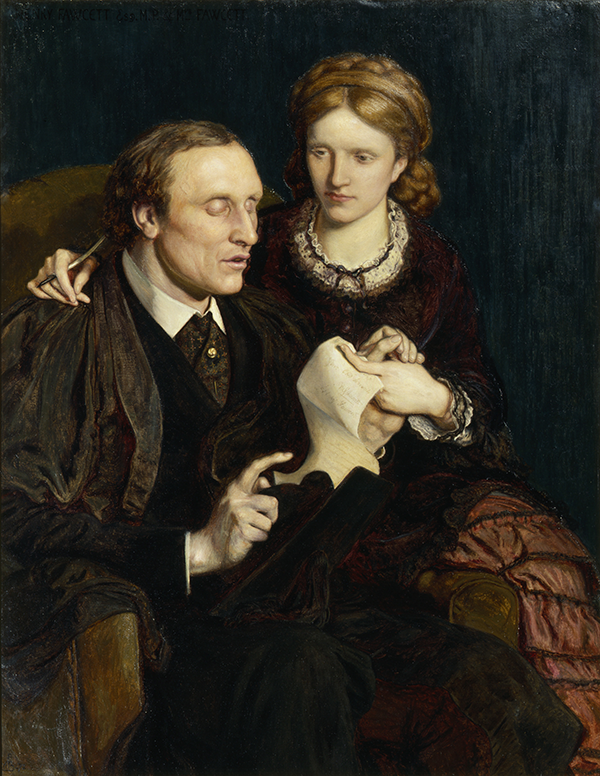
Fig. 7: Ford Madox Brown, Henry Fawcett; Dame Millicent Garrett Fawcett (née
Garrett). Oil on canvas, 1872. © National Portrait Gallery, London
A painting depicts a man and woman aged around 40 and 25 respectively. The man
is seated in an armchair and is wearing academic dress of a long gown in brown
tones worn over a dark suit, which is buttoned up to his breastplate: a pinned
cravat and white collar are above it. His face is white and pale, his hair is
brown-blonde and cut short. His eyes are shut and his eyelids appear scarred.
The woman sits on his left perched on the side of the chair, slightly raised
above him and looking in his direction but not quite focused on him. She wears a
long-sleeved jacket in dark brown, fringed at the sleeves and collar in white
lace, over a full-length skirt or dress in a lighter brown silk material. Her
face is also white and pale, and her blonde-red hair is worn in braids. Her
right arm is wrapped across his right shoulder, and she holds a pen in her right
hand; their left hands are touching and together holding a piece of paper, to
which the man gestures with his right hand. His mouth is open, as if in speech.
Henry Fawcett's self is shaped through the senses of sound and crucially touch –
both in his hands that encircle his wife, who co-authored a volume on political
economy with him in the same year that Brown's portrait was painted – and in a
touch that gestures towards paper. The portrait positions its audiences as
beholders, rather than simply viewers, by fostering an embodied response to its
subjects. Beholders are invited less to consider what Fawcett cannot see, and
more to anticipate what he might say, to feel the pressure of touch, and stroke
the different textures of creamy skin, crisp paper, silk dress and woollen
academic gown, which are all vividly rendered in the painting. There is an
encouragement to behold, rather than simply view, the portrait of Fawcett and
his wife. Whilst Fawcett himself never mastered finger reading, he was an
important advocate for blind people's education, speaking at platforms on the
issue and leading efforts to establish a Royal Commission on blindness, which
took place after his death in 1884 (Holt 51, 66-69).
In conclusion, I want to consider the Danish painter Ejnar Nielsen's A Blind
Girl Reading (1905), which brings together several of the themes raised
throughout this article.

Fig. 8: Ejnar Nielsen, A Blind Girl Reading. Oil on canvas, 1905. © DACS 2018
A painting shows a young woman aged about 20 who is sitting in a darkened room,
with a large opened book of embossed text resting on her lap (the pages are
painted in white and green colours); she holds the book with her right hand
whilst tracking text with the fingers of her left hand. She is dressed in a
full-length, long-sleeved dress in a heavy dark material. Her face is pale and
white, and her eyes closed. Behind her, and to the bottom right of the picture,
a thin shaft of light indicates the presence of a shut door.
Like Brown, Nielsen depicts his subject is depicted in an interior setting and
again the darkened background emphasizes the interiority of private reading. The
work also suggests the coincidence of the subject's and the artist's tactile
intelligence. The embossed book, which is built up in layers of green and white
paint, is the most thickly painted area of the canvas and the text the girl
touches merges into the medium of paint. Nielsen seems drawn to the subject of
blindness not simply to reflect on the limits of sight, but also to explore the
tactile qualities of paint. The power of the gaze is challenged, as sight is
suggested to be the inferior sense, an aspect also indicated by the encroaching
darkness. Crucially, it is the raised-print book that radiates the most light,
challenging traditional associations of sight with knowledge. 9 Further, the
girl's closed eyes signal to the beholder that she does not operate within the
sighted realm, whilst the foregrounding of her hands and the richly textured
book re-orient the painting's sensory modality around touch and the haptic.
Significantly, however, whilst the blind girl's hands are represented directly
touching the book, museum display conditions place the painting outside the
reach of the beholder's touch, necessitating the working of a tactile
imagination to share the girl's experience. 10
My discussion has drawn attention to the often-contradictory agendas that shaped
the production of these portraits. Certainly, blind sitters conformed to ocular
modes of representation through the very act of having their likenesses captured
in photographic or painted mediums. At the same time, cultural perceptions of
embossed literature produced new contexts and modes through which blind people
might be portrayed, and in turn provided rich imaginative material for ongoing
haptic engagements with the multisensory image. Whilst the historical record is
poor in terms of documenting both sighted people's and blind people's responses
to these portraits, I have suggested ways of approaching these representations
which move beyond an othering that merely stresses the limits of sight. Instead,
I have shown how we might also consider these portraits as objects that
empathically depend on the embodied conditions through which nineteenth-century
audiences, with a range of visual and tactile perceptions and experiences, both
viewed and handled cultural media. Bringing together this archive of images
affords ways for contemporary audiences similarly to critically and creatively
respond to blindness as a subject of the visual arts.
Works Cited
-
Ambrotype of Ann Whiting. c. 1860s, Private collection.
-
Barasch, Moshe. Blindness: the History of a Mental Image in Western Thought.
Routledge, 2001.
-
Berenson, Bernard. The Florentine Painters of the Renaissance, 2nd ed., Putnam's
Sons, 1903.
-
Bolt, David. The Metanarrative of Blindness: A Re-Reading of Twentieth-Century
Anglophone Writing. U of Michigan P, 2014.
-
---. "Aesthetic Blindness: Symbolism, Realism, and Reality." Mosaic: a Journal
for the Interdisciplinary Study of Literature, vol. 46, no. 3, Sept. 2013, pp.
93-108.
-
Bourrier, Karen. "Reading Laura Bridgman: Literacy and Disability in Dickens's
'American Notes.'" Dickens Studies Annual, vol. 40, 2009, pp. 37–60.
https://doi.org/10.7756/dsa.040.003.37-60
-
Brown, Ford Madox. Henry Fawcett; Dame Millicent Garrett Fawcett (née Garrett).
1872, National Portrait Gallery, London.
-
Calè, Luisa and Patrizia di Bello. "Introduction: Nineteenth-Century Objects and
Beholders." Illustrations, Optics and Objects in Nineteenth-Century Literary and
Visual Cultures, edited by Calè and di Bello, Palgrave Macmillan, 2010, pp.
1-21. https://doi.org/10.1057/9780230297395_1
-
Crary, Jonathan. Techniques of the Observer: On Vision and Modernity in the
Nineteenth Century. 7th ed., MIT Press, 1996.
-
Dickens, Charles. American Notes for General Circulation (1842). Edited by
Patricia Ingham, Penguin, 2004.
-
Edwards, Elizabeth. "Grasping the Image: How Photographs are Handled." The Book
of Touch, edited by Constance Classen, Berg, 2005, pp. 421-425.
-
---. "Thinking Photography Beyond the Visual". Photography: Theoretical
Snapshots, edited by J. J. Lang, et al., Routledge, 2009, pp. 31-48.
-
---. "Photographs and History: emotion and materiality." Museum Materialities:
Objects, Engagements, Interpretations, edited by Sandra M. Dudley, Routledge,
2010, pp. 21-38.
-
Fisher, Alanson. "Portrait of Oliver Caswell and Laura Bridgman Reading Embossed
Letters from a Book. Lithograph by W. Sharp, 1844, after A. Fisher." 1844,
Wellcome Collection, London. wellcomecollection.org/works/xp9pwrqe.
-
Garland-Thomson, Rosemarie. Staring: How We Look. Oxford U P, 2009.
-
---. "Picturing People with Disabilities: Classical portraiture as
reconstructive narrative." Re-Presenting Disability: Activism and Agency in the
Museum, edited by Richard Sandell and Jocelyn Dodd, Routledge, 2010, pp. 23-40.
-
Gitter, Elisabeth. The Imprisoned Guest: Samuel Howe and Laura Bridgman, the
Original Deaf-Blind Girl. Farrar, Strauss, & Giroux, 2001.
-
Holt, Winifred. A Beacon for the Blind: Being a Life of Henry Fawcett, the Blind
Postmaster-General. Constable and Company Ltd, 1915.
-
Howes, David. "Scent, Sound and Synaesthesia: Intersensoriality and Material
Culture Theory." Handbook of Material Culture, edited by Christopher Tilley, et
al., Sage Publications, 2006, pp. 161-172.
https://doi.org/10.4135/9781848607972.n11
-
Kleege, Georgina. "Blindness and Visual Culture: An Eye-Witness Account."
Journal of Visual Culture, vol. 4, no. 2, Aug. 2005, pp. 179-190.
https://doi.org/10.1177/1470412905054672
-
Martin, Frances. Elizabeth Gilbert and Her Work for the Blind. Macmillan and
Co., 1887.
-
Mirzoeff, Nicholas. Bodyscape: Art, Modernity and the Ideal Figure. Routledge,
1995.
-
Nielsen, Ejnar. A Blind Girl Reading. 1905, Statens Museum for Kunst,
Copenhagen.
-
Parisi, David. "Tactile Modernity: On the Rationalization of Touch in the
Nineteenth Century." Media, Technology, and Literature in the Nineteenth Century
Image, Sound, Touch, edited by Colette Colligan and Margaret Linley, Ashgate,
2011, pp. 189-213.
-
Paterson, Mark. "'Looking on darkness, which the blind do see': Blindness,
Empathy, and Feeling Seeing." Mosaic: a Journal for the Interdisciplinary Study
of Literature, vol 46, no. 3, Sept. 2013, pp. 159-177.
-
Smith, John Thomas. "A sitting blind beggar sells 'love sonnets' to obtain money
with a young boy. Etching by J.T. Smith after himself, 1816." 1816, Wellcome
Collection, London. wellcomecollection.org/works/e8y3z9z4.
-
Snyder, Sharon L. "Infinities of Forms: Disability Figures in Artistic
Traditions." Disability Studies: Enabling the Humanities, edited by Sharon L.
Snyder, et al., Modern Language Association of America, 2002, pp. 173-196.
-
Starbuck, Alford. Carte de visite of Unidentified Man. c. 1870s, Private
collection.
-
Tilley, Heather. Blindness and Writing: From Wordsworth to Gissing. Cambridge U
P, 2017. https://doi.org/10.1017/CBO9781108151863
-
---. "Introduction: the Victorian Tactile Imagination". 19: Interdisciplinary
Studies in the Long Nineteenth Century, vol. 19, 12 Oct. 2014. Open Library of
Humanities, https://doi.org/10.16995/ntn.723
-
---. "The Sentimental Touch: Dickens's Old Curiosity Shop and the Feeling
Reader." Journal of Victorian Culture, vol. 16, no. 2, 1 Aug. 2011, pp. 226-241.
https://doi.org/10.1080/13555502.2011.589679
-
Tilley, Heather and Jan-Eric Olsen. "Touching blind bodies: a critical inquiry
into pedagogical and cultural constructions of visual disability in the
nineteenth century." The Edinburgh Companion to the Critical Medical Humanities,
edited by Anne Whitehead and Angela Woods, Edinburgh U P, 2016, pp. 260-275.
-
Unknown engraver after Hubbard. "Work-School for the Blind, Euston Road."
Illustrated London News, 24 April 1858, Chronicle / Alamy Stock Photo
-
Warne, Vanessa. "'So that the sense of touch may supply the want of sight':
Blind Reading and Nineteenth-Century British Print Culture." Media, Technology,
and Literature in the Nineteenth Century: Image, Sound, Touch, edited by Colette
Colligan and Margaret Linley, Ashgate, 2011, pp. 43-64.
-
"William Moon." Light for the Blind: A History of the Origin and Success of
Moon's System of Reading, 1873, Private collection.
Notes
1. For a fuller discussion of trends in representing blind people prior to the
nineteenth century, consult Barasch 115-148. For a discussion of the ways in
which the subject of blindness shaped Western aesthetic practice from the
Renaissance to the contemporary period consult Mirzoeff 37-57.
2.
For example, John Everett Millais's famous painting of an itinerant blind girl,
The Blind Girl (1856), depicts her with a label round her neck inscribed
"blind".
3.
For further discussions of nineteenth-century contexts of touch consult Parisi;
Tilley 2014.
4.
For a discussion of the "terminological typology of visual impairment", and the
effects of ocularcentrism, consult Bolt, The Metanarrative 17-22. For a more
focused discussion on the function of ocularcentrism in nineteenth-century
culture, consult Bolt, "Aesthetic Blindness" 94.
5.
For a discussion of the ways in which cultural historians, including Calè and di
Bello, have challenged critical accounts of nineteenth-century culture as
ocularcentric (notably Crary) consult Tilley Blindness and Writing, 34-35.
6.
Calè and di Bello use this term to describe embodied, rather than simply visual,
practices of interacting with cultural material amongst nineteenth-century
audiences, as part of their efforts to challenge dominant critical accounts of
the period (for example Crary). It is in this sense that I employ the term,
although there is also overlap in my discussion with Rosemarie Garland-Thomson's
use of 'beholding' in her exploration of whether and how staring at subjects
with disabilities might be 'ethical'. Beholding, argues Garland-Thomson, allows
the beholder to "vivify human empathy through bearing visual witness" (185-96,
188), suggesting that the act of looking in turn generates empathic, embodied
effects in the viewer.
7.
Presumably Bridgman's and Caswell's signatures were included to demonstrate
their aptitude in writing as well as in reading.
8.
Nicholas Mirzoeff draws attention to further important ways in which blindness
as a metaphoric framework in aesthetic discourse and practice is gendered,
noting how 'blindness-as-lack-of-sight affects only women, whereas
blindness-as-insight is a peculiarly male phenomenon' (55).
9.
For a fuller discussion on the problematic association of sight with knowledge
within an ableist metanarrative of blindness, consult Bolt, The Metanarrative
17-22.
10.
Bernard Berenson introduced the term "tactile imagination" in his 1896 study of
Florentine painters, as part of his advocating for an embodied aesthetic
practice (5).
ϟ
How to Cite: Tilley, H., (2018) “Portraying Blindness: Nineteenth-Century Images of Tactile Reading”, Disability Studies Quarterly 38(3). doi:
https://doi.org/10.18061/dsq.v38i3.6475
Portraying Blindness: Nineteenth-Century Images of Tactile Reading
by
Heather Tilley
Birkbeck, University of London
in Disability Studies Quarterly (DSQ) - the journal of the Society for Disability Studies (SDS)
Vol. 38 No. 3 (2018): Blindness Arts
in https://dsq-sds.org/article/id/1500/
31.Out.2025
Publicado por
MJA
|
