|
|
I first noticed something wrong with my eyes in New Mexico. I was a freshman in
high school, in the mid-nineties, and had recently been accepted into a clique
of older kids whom I admired—the inner circle of Santa Fe Prep’s druggie
bohemian scene. We hung out at Hank’s house; he was our charismatic leader, and
his mom was maximally permissive. One night, in Hank’s room, our friend Chad sat
on a beanbag chair, packing a pipe with weed. Nina danced alone in front of a
boom box to Jane’s Addiction, throwing around her bleached hair. After dark, we
hiked up the hill behind the house to get a view of the city. The moon was
bright, but I found myself tripping on roots and stones and wandering off track.
At one point, I walked right into a piñon tree with prickly branches. My friends
laughed—“You’re stoned, aren’t you?” Chad said—and I played up my intoxication
for effect. But, on the way down, I quietly put a hand on Hank’s shoulder.
This became common. At the movies, I got up to get a soda, and, when I returned,
I couldn’t find my mother in the rows of featureless bodies. I complained about
night blindness, but my mother assured me it was normal—it was dark out there!
Eventually, though, she brought me to see an eye doctor. After a series of
tests, he sat us down and said that I had retinitis pigmentosa, or R.P., a rare
disease affecting about a hundred thousand people in the U.S. As the disease
progressed, the rod cells around the edges of my retina would die, followed by
the cones. My vision would contract, like looking through a paper-towel roll. By
middle age, I’d be completely blind. The doctor asked if I could see stars, and
I said that I hadn’t seen them in years. This was the detail that made it real
for my mother. “You can’t see stars?” she asked.
I spent my teen-age years mostly in denial: my blindness seemed distant, like
fatherhood, or death. But in my thirties the disease caught up with me. One
morning, I swung my car into a crosswalk and heard—and felt—something slamming
my hood: I had almost hit a pedestrian, and he was banging my car with his fist,
shouting, “Open your fucking eyes!” Soon after, I almost hit a cyclist, and I
gave up driving. One weekend, while living in Missouri, I found that I had lost
my sunglasses. My wife, Lily, was out of town, so I decided to walk to a nearby
LensCrafters. But what was normally a ten-minute drive became a harrowing ordeal
on foot. There were few sidewalks, so I walked in the road, with cars speeding
past. The sun and haze made it hard to see. I stood for a long time at a large
intersection, trying to turn left without getting hit by a truck.
In 2011, I ordered an I.D. cane, used less for tapping around than to signal to
the world that its bearer might not see well. It folded up, and mostly I hid it
in my bag. But, after running into fire hydrants and hip-checking a toddler in a
café, I began using it full time. Reading became difficult: the white of the
page took on a wince-inducing glare, and the words frosted over, like the
lowermost lines on the optometrist’s eye chart. It was only once I’d reached
this stage that my diagnosis started to feel real. I frantically wondered
whether I should use my last years to, say, visit Japan, or plow through the
Criterion Collection, instead of spending my evenings watching “Crazy
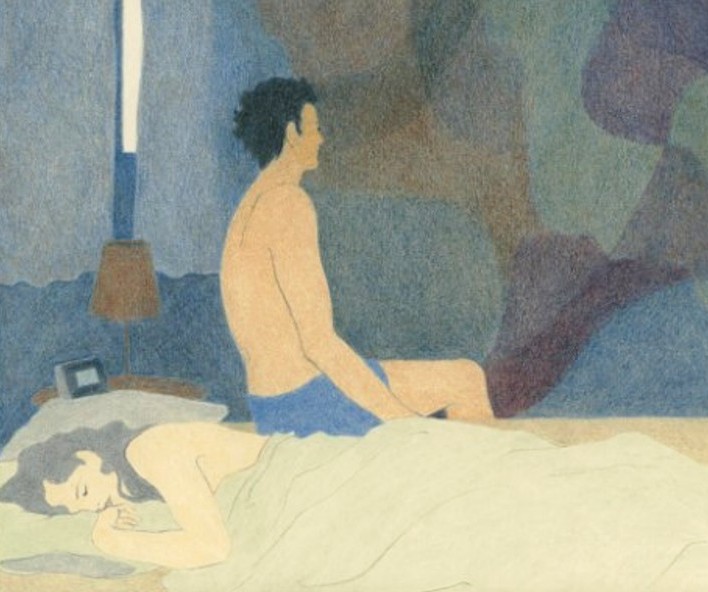
Ex-Girlfriend” with Lily. One night, I lay awake in bed. I knew that, if Lily
were awake, she’d be able to see the blankets, the window, the door, but, when I
scanned the room, I saw nothing, just the flashers and floaters that oscillated
in my eyes. Is this what it will be like? I wondered, casting my gaze around
like a dead flashlight. I felt like I’d been buried alive.
In 2020, I heard about a residential training school called the Colorado Center
for the Blind, in Littleton. The C.C.B. is part of the National Federation of
the Blind, and is staffed almost entirely by blind people. Students live there
for several months, wearing eye-covering shades and learning to navigate the
world without sight. The N.F.B. takes a radical approach to cultivating blind
independence. Students use power saws in a woodshop, take white-water-rafting
trips, and go skiing. To graduate, they have to produce professional documents
and cook a meal for sixty people. The most notorious test is the “independent
drop”: a student is driven in circles, and then dropped off at a mystery
location in Denver, without a smartphone. (Sometimes, advanced students are left
in the middle of a park, or the upper level of a parking garage.) Then the
student has to find her way back to the Colorado Center, and she is allowed to
ask one person one question along the way. A member of an R.P. support group
told me, “People come back from those programs loaded for bear”—ready to hunt
the big game of blindness. Katie Carmack, a social worker with R.P., told me, of
her time there, “It was an epiphany.” That fall, I signed up.
In 1966, the sociologist Robert Scott spent three years visiting agencies for
the blind for his book “The Making of Blind Men.” Most of these agencies, whose
methods were based on the training programs developed for veterans after the
First World War, took an “accommodative approach”: they believed that clients
could never be truly independent, and strove only to keep them safe and
comfortable. The agencies installed automated bells over their front doors so
that residents could easily find the entrance from the street, served pre-cut
foods, and gave out only spoons. They celebrated clients for the tiniest
accomplishments, with the result that, as Scott put it, “many of them come to
believe that the underlying assumption must be that blindness makes them
incompetent.”
Blind education already had a fraught history. The first secular institution for
the blind—the Hospice des Quinze-Vingts, established by King Louis IX of France
around 1260—housed residents, but required them to beg on the streets for bread.
Blind people were popularly depicted as lecherous, duplicitous, and drunk. The
first schools that actually tried to teach blind students were established in
the eighteenth century. Catherine Kudlick, a disability historian, pointed out
that this was during the height of the Enlightenment, when there were
discussions about educating women and people from the lower classes. “The idea
was to give them the tools so that they could become educated members of
society,” she said. But, in their determination to prepare students for
employment, many schools, like other institutions at the time, came to resemble
sweatshops, making blind children spin wool and grind tobacco for subminimum
wages.
The best institutions Scott visited were those that followed the philosophy of
Father Thomas Carroll, a Catholic priest who worked at the Army’s rehabilitation
centers during the Second World War, where many innovations—including the long
white cane—were first developed. Carroll argued that the average blind person is
capable of some independence. His students took fencing lessons, which he
thought helped with balance. But Carroll took a surprisingly grim view of
blindness. “Loss of sight is a dying,” he wrote. His students, he believed,
would always be significantly impaired. One student who recently attended the
Carroll Center, in Newton, Massachusetts, told me that he felt coddled there. “I
didn’t feel a lot of independence,” he said. “We go to these places because we
want to level up our independence, and be pushed to the edge. We need that.”
Carroll’s philosophy met its sharpest critic in Kenneth Jernigan, the president
of the National Federation of the Blind. The N.F.B. was founded, in 1940, as an
organization of and not for the blind: its constitution mandated that a majority
of its chapter members had to be blind. Jernigan rejected Carroll’s Freudian
sense of blindness—Carroll has described it in terms of castration—in favor of a
civil-rights approach. Blindness, he insisted, was merely a characteristic, like
hair color; it was an intolerant society that was disabling. He organized
protests against airline policies that forced blind passengers to sit in
handicap seats and give up their canes; his followers held sit-ins on planes,
and were physically carried off by police.
In the fifties, Jernigan and his colleagues proposed an experiment: the N.F.B.
would take control of a state agency for the blind in Iowa—which a federal study
had rated one of the worst in the country—and reinvent it. At this center, and
those which followed, blind teachers took students waterskiing and rock
climbing. At traditional agencies, blind students (but not instructors) were
addressed by their first names. Jernigan mandated that his students be addressed
by “Mr.” and “Ms.” as a sign of respect. N.F.B. employees followed a strict
dress code: ties and jackets for men, skirts for women. Bryan Bashin, the former
C.E.O. of the San Francisco LightHouse for the Blind, one of the largest
blindness agencies in the U.S., compared this to the suited brothers in the
Nation of Islam: “We were not going to give our oppressors the right to say
we’re sloppy or unprofessional.”
Blindness agencies traditionally taught students to travel by route
memorization: walk down the block for fifty-five paces, and the entrance to the
café is on your right. Jernigan pointed out the obvious flaw: you were at a loss
as soon as you travelled or the coffee shop closed. The N.F.B. developed a
method that came to be known as “structured discovery”: students learn to pay
attention to their surroundings and use the information to orient themselves.
Instructors were constantly asking Socratic questions, such as “What direction
do you hear the traffic coming from?” and “Can you feel the sun warming one side
of your face?” Bashin told me, of what he learned by spending a year at a
center, “Confidence isn’t a deep enough word. It’s a faith in your ability to
figure it out.” He added, “Until you get profoundly lost, and know it’s within
you to get unlost, you’re not trained—until you know it’s not an emergency but a
magnificent puzzle.”
Students were pushed out of their comfort zones. Gene Kim, a recent C.C.B.
graduate, told me that, for his independent drop, he was let off at some place
resembling a hospital. He spent hours crossing bridges, “weird islands and
right-turn lanes, weirdly cut curbs.” He was on the verge of giving up when he
heard a dinging sound, and followed it to a light-rail train that took him home.
The experience, he said, helped him make peace with the “relentless uncertainty”
of blind travel. The historian Zachary Shore, on the other hand, got so lost on
his independent drop that he stubbornly picked a direction and just kept
walking. Police officers stopped him when he was about to walk onto a highway,
and gave him a ride back to the center, where the director told him, “You failed
this time. But we’re gonna make you do it again—and you will do it. I know you
can do it. And we’re going to give you an even harder route.” (On his second
try, Shore found his way back.)
Sometimes teachers crossed a line. In 2020, dozens of students alleged that
staff at N.F.B. centers had bullied them, sexually harassed or assaulted them,
or made racist remarks. Many students at the centers had, in addition to
blindness, a range of other disabilities: hearing loss, mobility impairments,
cognitive disabilities. Some reported being mocked for having impairments that
made the intense mental mapping required by blind-cane travel a challenge.
Bashin ascribed this to the fact that blind people, like any collection of
Americans, regrettably included their share of racists, abusers, and jerks. He
said, of the N.F.B., “As a people’s movement, it looks like the U.S. It is a
very big tent, and it is working to insure respect for all members.” But a group
of “victims, survivors, and witnesses of sexual and psychological abuse” wrote
an open letter in the wake of the allegations, blaming, in part, the N.F.B.’s
tough methods. “What blind consumers want in the year 2020 is not what they may
have wanted in previous decades,” they wrote. “We don’t want to be bullied or
humiliated or have our boundaries pushed ‘for our own good.’ ”
The N.F.B. has since launched an internal investigation and formed committees
dedicated to supporting survivors and minorities. Jernigan once mocked Carroll’s
notion that blind people needed emotional support, but the N.F.B. now maintains
a counselling fund for members who endured abuse at its centers or any of its
affiliated programs or activities. Julie Deden, the director of the Colorado
Center, told me, “I’m saddened for these people, and I’m sorry that there’s been
sexual misconduct.” She is also sad that people felt like they were pushed so
hard that it felt like abuse, she noted. “We don’t want anyone to ever feel that
way,” she said. But, she added, “If people really felt that way, maybe this
isn’t the program for them. We do challenge people.” Ultimately, she said, she
had to defend her staff’s right to push the students: “Really, it’s the heart of
what we do.”
The twenty-four units at the McGeorge Mountain Terrace apartments are all
occupied—music often blasts from a window on the second floor, and laughter
wafts up by the picnic tables—but there are no cars in the parking lot, because
none of its residents have driver’s licenses. The apartments house students from
the Colorado Center. At 7:24 A.M. every weekday, residents wait at the bus stop
outside, holding long white canes decorated with trinkets and plush toys, to
commute to class. I arrived at the center in March, 2021. When the receptionist
greeted me, I saw her gaze stray past me. Nearly everyone in the building was
blind. In the kitchen, students in eyeshades fried plantain chips, their white
canes hanging on pegs in the hall. In the tech room, the computers had no
monitors or mouses—they were just desktop towers attached to keyboards and good
speakers. A teen-ager played an audio-only video game, which blasted gruesome
sounds as he brutalized his enemies with a variety of weapons.
When I met the students and staff, I was impressed by blindness’s variety: there
were people who had been blind from birth, and those who’d been blind for only a
few months. There were the greatest hits of eye disease, as well as a few
ultra-rare conditions I’d never heard of. Some people had traumatic brain
injuries. Makhai, a self-described stoner from Colorado, had been in a head-on
collision with a Ford F-250. Steve had been working in a diamond mine in the
Arctic Circle when a rock the size of a two-story house fell on top of him,
crushing his legs and blinding him. Alice, a woman in her forties, told me that
her husband had shot her. She woke up from a coma and doctors informed her that
she was permanently blind, and asked her permission to remove her eyeballs. “I
never mourned the loss of my vision,” she told me. “I just woke up and started
moving forward.” She said that she’d had a number of “shenanigans” at the
center, her word for falls, including a visit to the emergency room after she
slipped off a curb and slammed her head into a parked truck. At the E.R., she
learned that she had hearing loss, too, which affected her balance; when she got
hearing aids, her shenanigans decreased.
Soon after, my travel instructor, Charles, had me put on my shades: a
hard-shell mask padded with foam. (Later, the center began using
high-performance goggles that a staffer painstakingly painted black, which made
me feel like a paratrooper.) I was surprised by how completely the shades
blocked out the light—I saw only blackness. I left the office, following the
sound of Charles’s voice and the knocking of his cane. “How are you with
angles?” he said. “Make a forty-five-degree turn to the left here.” I turned.
“That’s more like ninety degrees, but O.K.,” he said. Embarrassed, I corrected
course. With shades on, angles felt abstract. On my way back to the lobby, I got
lost in a foyer full of round tables. Later, another student, Cragar Gonzales,
showed me around. He’d fully adopted the N.F.B.’s structured-discovery
philosophy, and asked constant questions. “What do you notice about this wall?”
he said. This was the only brick wall on this floor, he told me, so whenever I
felt it I’d instantly know where I was. By the end of the day, though, I still
wasn’t able to get around on my own. I felt a special shame when I had to ask
Cragar, once again, to bring me to the bathroom.
That afternoon, I followed Cragar to lunch. He had compared the school’s social
organization to high-school cliques, except that the wide age range made for
some unlikely friendships; a few teen-agers became drinking buddies with people
pushing fifty. A teen-ager named Sophia told me that so many people at the
center hooked up that it reminded her of “Love Island”: “People come in and out
of the ‘villa.’ People are with each other, and then not.” Within a few days, I
started hearing gossip about students throughout the years who had sighted
spouses back home but had started having affairs. Some of the students had lived
very sheltered lives before coming to the program: classes brought together
people with Ph.D.s and those who had never learned to tie their shoes. One staff
member told me that some students arrive with no sex education, and there are
those who become pregnant soon after arriving at the center.
I’d heard that some people find wearing the shades intolerable, and make it to
Colorado only to quit after a few days. I found it a pain in the ass, but also
fascinating—like solving Bashin’s “magnificent puzzles.” On the same day that I
arrived, I’d met a student nicknamed Lewie who had a high voice, and I spent the
day thinking he was a woman. But people kept calling him man and buddy, and,
with some effort, I reworked my mental image. Lewie had cooked a meal of arroz
con pollo. I felt nervous about eating with the shades on, but I found it less
difficult than I expected. Only once did I raise an accidentally empty plastic
fork to my lips. At one point, I bit into what I thought was a roll, meant to be
dipped in sauce, and was sweetly surprised to find that it was an
orange-flavored cookie.
I began to think of walking into the center each day as entering a kind of blind
space. People gently knocked into one another without complaint; sometimes, they
jokingly said, “Hey, man, what’d you bump into me for?”—as if mocking the idea
that it might be a problem. Students announced themselves constantly, and I soon
felt no shame greeting people with a casual “Who’s that?” Staff members were
accustomed to students wandering into their offices accidentally, exchanging
pleasantries, then wandering off. One day, I was having lunch, and my classmate
Alice entered, then said, “Aw, man, why am I in here?”
I learned an arsenal of blindness tricks. I wrapped rubber bands around my
shampoo bottles to distinguish them from the conditioner. I learned to put
safety pins on my bedsheets to keep track of which side was the bottom. I
cleaned rooms in quadrants, sweeping, mopping, and wiping down each section
before moving on. I had heard about a gizmo you could hang on the lip of a cup
that would shriek when a liquid reached the top. But Cragar taught me just to
listen: you could hear when a glass was almost full. In my home-management
class, Delfina, one of the instructors, taught me to make a grilled-cheese. I
used a spoon on the stove like a cane to make sure the pan was centered without
torching my fingers. Before I flipped the sandwich, I slid my hand down the
spatula to make sure the bread was centered. When I finished, I ate it hungrily;
it was nice and hot.
One weekend, I went with a group of students to play blind ice hockey. The puck
was three times the size of a normal puck, and filled with ball bearings that
rattled loudly. On St. Patrick’s Day, we went to a pub and had Irish slammers.
One day, Charles took me and a few other students to Target to go grocery
shopping. This was my first time navigating the world on my own with shades, and
every step—getting on the bus, listening to the stop announcements—was
distressing. When we got to Target, we were assigned a young shopping assistant
named Luke. He pulled a shopping cart through the store, as we hung on,
travelling like a school of fish. Charles had invited me to his apartment for
homemade taquitos, and I asked Luke to show us the tortilla chips. He started
listing flavors of Doritos—Flamin’ Hot, Cool Ranch. “Do you have ‘Restaurant
Style’?” I asked, with minor humiliation.
At the self-checkout station, I realized that I couldn’t distinguish between my
credit and debit cards. “Is this one blue?” I asked, holding one up.
“It’s red,” Luke said.
I couldn’t bring myself to enter my PIN with shades on, so I cheated for my
first and only time, and pulled them up. The fluorescent blast of Target’s
interior made me dizzy. I found my card, and then quickly pulled the shades back
down. We retraced our steps back to the bus stop. As we got closer, we heard the
unmistakable squeal of bus brakes. “Go to that sound!” Charles shouted, and we
ran. I wound up hugging the side of the bus and had to slide to the door. When I
made it to my seat, I was proud and exhausted.
One day, after class, I headed back to the apartments with Ahmed, a student in
his thirties. Ahmed has R.P., like me, but he had already lost most of his
vision during his last year of law school. He’d managed to learn how to use a
cane and a screen reader, which reads a computer’s text aloud, and still
graduate on time. But his progression into blindness took a steep toll. After he
passed the bar, he moved to Tulsa, where he had what he describes as a “lost
year.” He deflected most of my questions about what he did during that time,
only gesturing toward its bleakness. “But why Tulsa?” I asked.
“Because it was cheap,” he said. He knew no one in the city. He just needed a
place to go and be alone with his blindness.
With apologies to a city that I’ve enjoyed visiting, after listening to Ahmed, I
began to think of Tulsa as the depressing place you go when you confront the
final loss of sight. When would I move to Tulsa?
The public perception of blindness is that of a waking nightmare. “Consider
them, my soul, they are a fright!” Baudelaire wrote in his 1857 poem “The
Blind.” “Like mannequins, vaguely ridiculous, / Peculiar, terrible
somnambulists, / Beaming—who can say where—their eyes of night.” Literature
teems with such descriptions. From Rilke’s “Blindman’s Song”: “It is a curse, /
a contradiction, a tiresome farce, / and every day I despair.” In popular
culture, Mr. Magoo is cheerfully oblivious to the mayhem that his bumbling
creates. Al Pacino, in “Scent of a Woman,” is, beneath his swaggering machismo,
deeply depressed. “I got no life,” he says. “I’m in the dark here!” Many blind
people (including me) resist using the white cane precisely because of this
stigma. One of the strangest parts of being legally blind, while still having
enough vision to see somewhat, is that I can observe the way that people look at
me with my cane. Their gaze—curious, troubled, averted—makes me feel like
Baudelaire’s somnambulist, the walking dead.
In response to this, blind activists have pushed the idea that blindness is
nothing to grieve—that it’s something to be celebrated. “Blindness is not a
tragedy,” the writer and former C.C.B. counsellor Juliet Cody said. “It’s a
positive opportunity to have faith and believe in yourself.” I find this notion
appealing, even liberating. But I’ve also struggled to force myself into an
epiphany. When I’m honest with myself, I find that I’m already mourning the loss
of small things: the ability to drive my son to the mountains for a hike, or to
browse the stacks in a library. Cragar told me that, when his vision loss began
to accelerate, he told his family that he wasn’t scared—that he was ready. But
he admitted to me that he wasn’t so sure: “I say that, but do I really know?”
Tony, another student I met at C.C.B., told me that, when he realized he could
no longer see the chalkboard in his college classes, he retreated to his dorm
room, flunked out, moved back in with his father, and spent his disability money
on weed, to numb out. “I hit some very dark chunks,” he told me. One night, in
Colorado, I heard a student say, “When I lost my vision, I didn’t leave my bed
for a month.”
In my weeks at the center, I began to suspect that consolation lies not in any
moment of catharsis but in an acknowledgment of blindness’s ordinariness. The
Argentinean writer Jorge Luis Borges wrote that blindness “should not be seen in
a pathetic way. It should be seen as a way of life: one of the styles of
living.” Accepting blindness’s difficulty allows one to move on. “Life is never
meant to be easy,” Erik Weihenmayer, the first blind person to climb Mt.
Everest, wrote in his memoir, “Touch the Top of the World.” “Ironically when I
finally accepted this reality, that’s when life got easy.” Under sleep shades, I
found that I could read, write, cook, travel. There was frustration, but this
wasn’t unique to blind life. At one point, as I listened to the chatter of a
cafeteria full of blind people, I thought, How strange that I’m still myself.
I’d worried over stories of people unable to handle total occlusion, but, in the
moment, it felt surprisingly normal.
I began to appreciate the novel experiences that blindness gave me. The notion
that blind people have better hearing than the sighted is a myth, but relying on
my ears did change my relationship with sound. Neuroscientists have found that
the visual cortices of blind people are activated by such activities as reading
Braille, listening to speech, and hearing auditory cues, such as the echo of a
cane’s taps. At lunch, one day, Cragar’s wife, Meredith, who was visiting from
Houston, came into the room carrying their fifteen-month-old daughter, Poppy.
The sounds that she made—cooing, laughing—cut through the room like washes of
color. I didn’t quite hallucinate these colors, but I came close. In the coming
weeks, I had several mildly psychedelic experiences like this, a kind of blind
synesthesia. The same thing happened with touch. I played blackjack with a
Braille deck, and, after a few days, began to intuitively read the cards as if I
were seeing them. In the art room, a teacher taught me to pull a wire through a
mound of wet clay. Later, as I described the experience to Lily and our son,
Oscar, on a video call, I had to remind myself that I’d never actually seen this
tool or the clay. It was so clear in my mind’s eye.
My sense of space gradually transformed. Walking the carpeted halls of the
center’s lower level, I could see a faint black-and-blue virtual-reality
environment lit by some unseen light source. Sometimes my cane penetrated one of
the velvety walls, and I had to redraw my mental map. When I was out in the
city, Charles sometimes informed me that what I thought was Alamo Avenue was
actually Prince Street, or that east was actually north, and I had to lift the
landscape in my mind, rotate it ninety degrees, and set it back down. I could
almost feel my brain trembling under the strain. But it was also kind of fun.
On your last day at the center, the staff presents you with a “freedom bell”
emblazoned with the words “TAKE CHARGE WITH CONFIDENCE AND SELF-RELIANCE!”
(Students sometimes quote this when doing banal activities like trying to find
the bathroom.) At Lewie’s graduation, a few weeks into my stay, Julie invited
him to ring the bell, saying that it represented not just his independence but
that of blind people everywhere. My time at the center was cut short by family
demands, but this spring I returned to see how far I had come. On my
second-to-last day, Charles told me that I would be doing an independent drop.
This seemed extreme; most students do that test after being at the center for
nine months; I had been there for a total of four weeks. I rode out in the
center’s van with another instructor, Ernesto, feeling nervous. “I need some
reassurance,” I told him. “Do you really think that I’m ready to do this on my
own?”
“Actually, Andrew, it was two against one,” Ernesto said flatly. He had been
outvoted.
When we arrived at my drop point, Josie, one of the center’s few sighted
employees and its designated driver, seemed worried. “Don’t get out on that
side!” she said. Stepping out of the van, I felt immediately disoriented. The
sun was shining on my face, so I had to be facing east. My cane hit a wooden
door, and a dog started barking. This must be a residential street. I’d learned,
when lost, to find a bus stop. Most students used their one question to ask the
driver where to go, and had memorized the bus routes and rail lines sufficiently
to make it home from there. There wouldn’t be a bus stop on a residential block,
so I set off toward the sound of traffic.
I soon arrived at a busy intersection. One of the hardest parts of blind travel
is crossing the street. Once you leave the curb, there’s nothing guiding you to
the other side, and you might walk in front of a car. Most corners have a dip
for wheelchairs, but these sometimes point across the street, and sometimes
point diagonally into the middle of the intersection. I learned to use my ears
to find my way. I listened to the perpendicular traffic driving past my nose and
calibrated my alignment so that the sound was equal in both ears—like balancing
a stereo. When the light changed, I took off. I listened to the cars roaring
past me, adjusting my trajectory to stay parallel to them. I felt the crown of
the road (which rises and falls, to allow water to drain) beneath my feet, and
that let me know that I was halfway. When my cane connected with the far curb, I
could feel my heart pounding.
I must have often looked bewildered on my journey. At one point, I was trying to
decide whether a dip was a corner or a driveway, and a driver slowed down and
said, “You drop something, buddy?” I answered, with forced cheer, “Thanks! I’m
just exploring.” At a big, four-lane intersection, I stood for a long time,
listening. A worker from a hospital came out to check on me, and, when I told
him I was looking for a bus stop—not technically a question, but a little sneaky
nonetheless—he pointed me in the general direction. He went back to work, saying
mournfully, as though leaving me to die, “Please take care.”
Blind travel requires you to think like an urban planner. Charles had taught me
to swing my cane wide in search of a bus pole. On wide downtown blocks, bus
stops are curbside, but on narrower streets they’re set back behind the grass
line. Halfway up one block, I connected with a metal bench. I lifted my cane and
hit a low roof. There was no pole, but what else could this be? When the bus
arrived, I climbed aboard and let fly my official question: “How do I get to
Littleton/Downtown station?” The driver told me to go to the end of the line,
then take the light-rail. When we got to the rail station, I crossed the tracks,
and boarded a train. In Littleton, I almost stepped on a person passed out on
the ground. I walked back to the center, hearing the familiar sound of tapping
canes as I arrived. An announcement went out that I had returned, and cheers
rose up from the classrooms.
The next night, I did a cooking test, making lemon-garlic kale salad and
red-lentil soup. It took me about twice as long as it would have without shades,
and I burned a finger. Still, I was surprised by how good it tasted. The
students gathered around the kitchen table, and one sat on the couch; this
arrangement would have been visually odd, but, sonically, it felt perfectly
natural. Ernest, a member of a Black Methodist church, said that he thought his
blindness made him more holy. “I walk by faith, not by sight,” he said, quoting
Scripture. My classmate Steve suggested, dubiously, that being blind made him
less susceptible to racism. He told us that he’d been working with a physical
therapist who came from Japan, and had accidentally touched her cornrows and
realized that she was Black—she had been born in Congo. Michelle, a sound
engineer from Mexico, disagreed, saying that she didn’t think blindness made her
any more “pure.” I spilled a cold cup of coffee into a supermarket cake, but we
were all full by then anyway.
The next morning, I flew home. As I exited the plane, sweeping my cane in front
of me, a man asked if I needed help. I ignored him and headed toward the baggage
claim, but he followed me, irritated, repeating, “Do you need any help?” I shook
my head. I didn’t. I followed the sound of roller bags, feeling the carpet of
the gate area give way to the concourse’s linoleum. I was halfway to the
escalators before I thought of using my eyes to look around for an exit sign. I
already knew where I was going.
The End

When he was in high school, Andrew Leland was told that he had retinitis pigmentosa, a rare disease affecting about 100,000 people in the U.S., and that he would be completely blind by middle age. “I spent my teen-age years mostly in denial: my blindness seemed distant, like fatherhood, or death,” he writes. “But in my 30s the disease caught up with me.”
In 2020, he heard about a residential training school called the Colorado Center for the Blind, which is staffed almost entirely by blind people; students live there for several months, wearing eye-covering shades and learning to navigate the world without seeing it. The school takes a radical approach to cultivating blind independence. Students use power saws in a woodshop, take white-water-rafting trips, and go skiing. To graduate, they have to produce professional documents and cook a meal for 60 people. The most notorious test is the “independent drop”: a student is driven in circles, dropped off at a mystery location in Denver, and tasked with making his way back to the center. Read about Leland’s experience of learning to live without sight:
http://nyer.cm/BibJTbb
ϟ
How to Be Blind
-As a kid, I was told that one day I would lose my sight. Recently, I went to a
residential school for the blind, where I learned to live without it.-
By Andrew Leland
The text is drawn from “The Country of the Blind: A Memoir at the End of Sight.”
The New Yorker
July 8, 2023
https://www.newyorker.com/
3.Abr.2025
Publicado por
MJA
|
