Playing for survival: the blind Japanese woman keeping a music
tradition alive: Goze musicians perform outside a farmhouse in this undated
photo. Photograph: Courtesy of Niigata Nippo Shimbun
Rieko Hirosawa sits on a stone bench outside
her home, tunes her instrument and takes a deep breath. She unleashes an
impossibly high note while her bachi plectrum slaps the three strings of her
shamisen, a traditional instrument. Combined, they slice through the stillness
of an oppressively humid afternoon. If her neighbours were wondering if the
usually softly spoken Hirosawa was at home, now they know. Barely a decade has
passed since Hirosawa started learning goze uta (blind women’s songs) – a
prodigious genre of music spanning four centuries that most Japanese people have
probably never heard. That she now plays with the composure of a veteran is
remarkable for two reasons: not a single goze uta musical score exists, and even
if the chords and notes had been written down, Hirosawa would not be able to
read them.
“I knew when I was a young child that I would lose my sight,” says Hirosawa at
her hillside home in Tomi, Nagano prefecture, the outline of the Japanese
Northern Alps in the distance. But it is because of her condition, not in spite
of it, that the 65-year-old has formed an unbreakable spiritual bond with the
music of the goze – blind and visually impaired women who earned a living as
itinerant musicians and who numbered in their hundreds in the late 19th century.
The songs of the goze. The goze were itinerant blind and visually impaired
women who earned a living playing the shamisen.: Rieko Hirosawa keeps tradition
alive in Japan – video
https://youtu.be/mQpMux27w-4
In the north-western prefectures, where the tradition flourished during the Edo
period (1603-1868), Hirosawa is at the heart of a movement to protect the legacy
of the goze. “They sang songs while they were living really tough lives,” she
says. “Just surviving was a challenge. They used music to have a sense of
purpose and then passed on those skills to their apprentices.”
The musical genre, which historical texts and artwork suggest began as long ago
as the 1500s, was no simple career choice. In feudal Japan, girls from poor
rural regions who suffered from visual impairment as a result of measles and
cataracts, then both commonplace, had only two means of making a living – as
masseuses or as travelling musicians. Those who chose the latter route out of
poverty and discrimination became live-in apprentices at guilds run by an
experienced goze, who would pass on songs by word of mouth and teach the
shamisen by sitting behind younger musicians and guiding their hands along the
instrument’s three strings.
Life among these groups of four or five women was strictly regulated, even
though the apprentices were encouraged to view their peers as sisters and their
master as a mother figure. They were expected to give a portion of their
earnings to the most senior woman in a show of loyalty and observed a strict
hierarchy, from the use of honorific to address senior musicians, to the way
they wore their hair. The least experienced ate and bathed last, their stock
rising with every year of their apprenticeship. The women were not allowed to
marry, and men were banned from their lodgings. Those who were found to be in
illicit relationships risked being cast out of the group or losing years off
their apprenticeships.
“It wasn’t unusual for parents to go directly to the master of a goze household
and ask her to take on their daughter,” says Zenji Ogawa, curator of a museum
dedicated to the musicians in Takada, a town in Niigata prefecture that was once
home to almost 100 performers. “They were worried about what would happen to
them after they died, at a time when people with disabilities had few
opportunities and there was no such thing as welfare.”
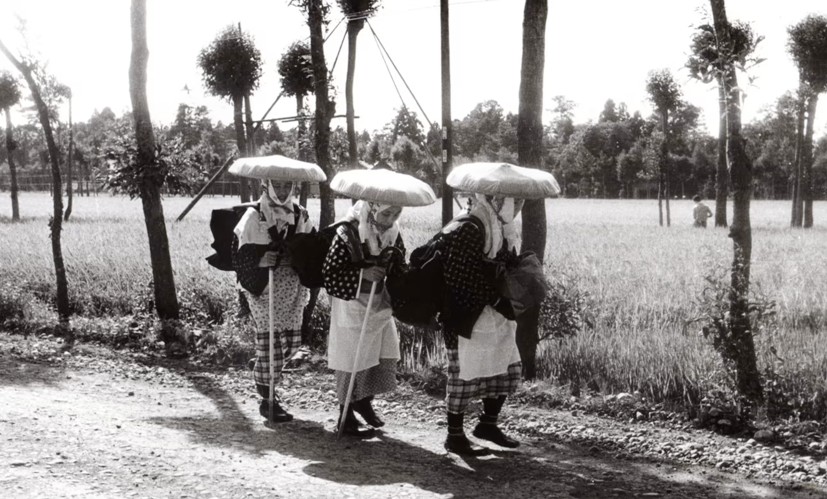
Life on the road was even more arduous. Three or four musicians, led by a
sighted guide, spent 300 days of the year walking from one village to the next,
mainly in Japan’s northwestern prefectures of Nagano and Niigata, although some
ventured to Fukushima on the Pacific coast, or as far as present-day Tokyo.
Carrying their instruments and belongings, they trekked through mountain ranges
and deep snow, each resting a hand on the shoulder of the woman in front. Those
who collapsed from exhaustion would have to be carried to the next village.
Three goze musicians trek through rice paddies on their way to perform at a
village in north-west Japan in this undated photo. Photograph: Courtesy of
Niigata Nippo Shimbun
The women were paid in rice that they would exchange for cash. “There was a
belief that the goze must have magical powers to have overcome so much adversity
and become musicians, so people would buy back the rice they had donated to the
women,” says Ogawa, who organises bus tours of goze-related sites and will
happily chat to visitors to the museum he has spent the past decade filling with
artefacts, from the waraji straw sandals the women wore on the road to rare
black-and-white photos of their performances. “They thought that feeding the
rice to their children would make them just as strong-willed,” adds Ogawa,
co-founder of the Takada Goze Culture Preservation and Promotion Association.
“It was the opposite of discrimination. People with disabilities suffered
terrible discrimination in those days, of course, but the goze were treated
differently.”
The women were expected to memorise a huge number of songs to play at private
homes and at festivals, many of them jōrūri narratives of the struggles of
ordinary people, sometimes with a spiritual message.
The last true Goze
The spread of modern entertainment, along with the introduction of welfare,
better education for people with disabilities and a more enlightened attitude
towards those with visual impairments hastened the demise of the goze, whose
numbers dwindled dramatically after the second world war.
Haru Kobayashi, who went blind when she was three months old, is regarded as the
last true goze. Born in 1900, she spent her childhood locked in a room at the
back of her family home in Niigata and began her career at the age of eight. She
continued performing until 1978 and was named a living national treasure and
received the medal of honour. If not for Kobayashi’s longevity – she died in a
nursing home in 2005 aged 105 – Hirosawa may have never discovered the history,
culture and music of the goze.
“Kobayashi-san was 101 years old when I met her,” says Hirosawa, who wanted to
interview the musician for her local radio programme, Rieko no Mado (Rieko’s
Window). “She had lost her sight, of course, and her hearing was failing too.”
“But she was determined to sing one stanza of a song to me. When I heard her
sing it was like thunder … I’d never experienced anything like it. It sent
chills down my spine, and I found myself crying the whole time, even on the
train on the way home.” Inspired by the encounter, she continues to memorise
more of the goze repertoire with the help of a teacher who once studied under
Kobayashi. “All I want is for people to enjoy the music … after all, that’s what
the goze’s original purpose was,” she says. Hirosawa had been warned by care
home staff that Kobayashi would not be able to sing during their meeting.
Hirosawa, who plays at events around Japan, knew for 20 years that she would
lose her sight. “I was really anxious about the future and wondered how I would
survive. My experience is completely different from those of the goze, of
course. I’ve been a radio personality for more than 30 years and have a family …
and that’s the case for other blind women these days. “But society still imposes
limits on what women can do … even more so for blind women. So when they hear me
play goze uta, I hope people get a proper feel for the struggles that ordinary
Japanese women experienced all those years ago.”
Her guide dog Sophia at her feet, Hirosawa readies herself for another song: “I
love coming out here and singing while I’m facing the mountains,” she says.
There is little doubt that the mountains are listening.