|
|
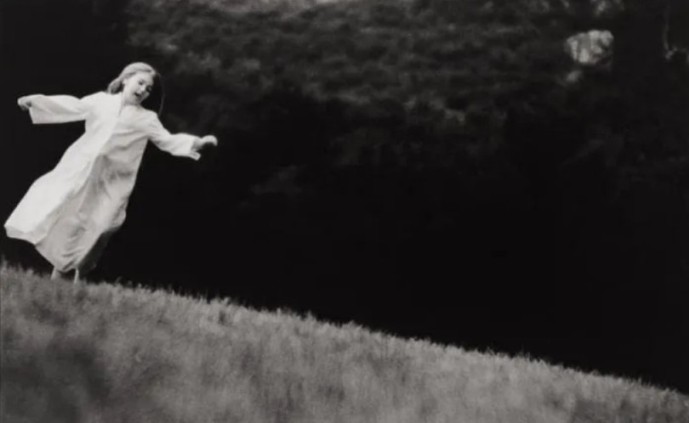
Bavcar's photography of his niece running across a field: »She had a little bell on her. I actually photographed the little bell, but it can’t be seen.«
Having presented the most recent theories
related to vision and defined my epistemological categories, I will now proceed
to the film analyses. My main objective is to show the exchange between the
attained theoretical categorization, the films, and the new questions that the
films themselves raise. The final film to be analyzed will synthesize the
epistemological categories and illustrate how they function. I shall, therefore,
spend more time analyzing Jardim and Carvalho’s film
Janela da Alma
since, as I intend to show, it epitomizes the essence of the appointed theories.
What follows is an introductory outline on the relation between blindness and
film.
Many films about blind characters depict a curious fascination, even
enchantment, of the blind character’s special abilities apparently directly
caused by their lack of sight. This is the case of
23 Paces to Baker Street
(dir. Hathaway, 1956). The blind man played by Van Johnson chides his sighted
friends, saying »You people with eyes, you’re so busy looking you never notice
anything!« (TC. 00:38:48–00:38:51). In
At First Sight (dir. Winkler, 1999),
blind character Virgil, played by Val Kilmer, nonchalantly shows his sixth sense
in foreseeing a storm: »We’d better get going, it’s starting to rain,« while the
girlfriend-to-be standing next to him is simply mesmerized by the accuracy of
his prediction (TC. 00:18:40–00:19:01). The following sequence takes place in an
abandoned house used as shelter from the rain. While the raindrops fall on the
ceiling, in puddles and on the ground, Virgil describes the soundscape in
detail. He says,
You feel everything at once. It’s the best way for me to understand dimension in
a room. Can you hear it coming down off the ceiling down the walls. […] Come
here, close your eyes. Listen with your whole body. Can you feel it? (TC.
00:19:04–00:20:16)
Meanwhile, the woman is in awe of the beauty of his account.
Wait Until Dark (dir. Terence, 1967) and
The Miracle Worker (dir. Penn, 1962)
are sample movies in which the blind characters inhabit both extremes of
stereotypical roles; they are heroines and, at the same time, subjects of pity.
Indeed, films can portray the blind as a suffering saint who exists for
philanthropic purposes. Such is the case in
City Lights (dir. Chaplin, 1931),
A
Patch of Blue (dir. Green, 1965), and countless other films in which the
characters’ disability induces compassion from others, sometimes unwanted: »I
guess I forgot it was help-the-handicapped week!« (TC. 00:40:07–00:40:11).
According to David Mitchell and Sharon Snyder in The Cultural Locations of
Disability, »disabled bodies have been constructed cinematically and socially to
function as delivery vehicles in the transfer of extreme sensation to audiences«
(162). While in other instances, it may be the character’s malformation, from
Freaks (dir. Browning, 1932) to the
Elephant Man (dir. Lynch, 1980) to the
half-orcs in The Lord of the Rings (dir. Jackson, 2001, 2002, 2003), the blind
figure has been used for his or her emotional function in the story, thus
enhancing the affective correlation of the spectator to the text.
In the aforementioned
At First Sight, Virgil is a massage-therapist who is met
by a client that at first does not notice he is blind. In subsequent scenes
Virgil’s now-girlfriend experiments blind-folding herself in order to feel what
it is like not to be able to see. The curiosity is aroused and suggested.
Filmmaker Wim Wenders, one of the interviewed in
Janela da Alma, speaks of his
blind aunt and of his own attempt as a child to go for as long as he could with
eyes closed in order to put himself in her situation. »I think I never made more
than half an hour, and then I just couldn’t physically bear it, I had to open my
eyes again« (TC. 00:25:19–00:25:47).
As for the selection process for the following film analysis, I have decided to
adopt movies that directly relate to the topic of vision and blindness. In
practical terms, the general theme will be that of blindness. Even though my
main focus is on film as a medium with conceptual implications, I will allow
myself the analysis of blind characters and their function within the narrative
(diegesis). As I intend to show, in most cases, the denotation of blindness is
intensified by the blind character’s role. His/her strength or weakness, for
example, substantiates the significance of sightedness, which in turn influences
the overall theoretical implications of blindness and vision in film. In the
end, be it diegetic, non-diegetic or extra-diegetic, the discussion converges on
visuality, thereby influencing its ontological significance.
Since there are so many films that deal directly with blindness (and actually
not that many that deal specifically with seeing), I will further delimitate the
corpus to films that have had historical accomplishment in the form of critical
acclaim through festivals and/or media reference. In other words, the film
should be known, even if in the level of academic discussion.
For a longer list of movies that feature blindness – a blind character or a
story about blindness, or a motif where blindness plays an important role –
the
Internet Movie Database provides more than 400 titles.
Introductory Analyses of Films in Relation to Vision and Blindness
1. Le Scaphandre and the POV
I shall start with Julian Schnabel’s Le Scaphandre et le Papillon (2007) in
order to give continuity to the already-mentioned perspectival point of view. In
the film’s representation of vision, perspective follows the logic of the
Cyclops since the main character can see only with one of his eyes, but that
makes no real difference for the spectator since he/she (most probably) watches
the film on a single, non-stereoscopic screen.
Nonetheless, Le Scaphandre et le Papillon stands out compared to other films
with similar motifs because it portrays visual impairment cinematographically
with a more complex use of the point of view shot. The point of view technique,
also known as POV, is one of the most cinematographically literal attempts of
aligning the film viewer with the film character’s visual perspective. When a
leading actor is the subject of the POV technique, it is known as subjective
viewpoint.
There are many notable examples of POV in cinema. To mention simply a few
firsts, there is George Albert Smith’s As Seen Through a Telescope (1900) which,
as the title foretells, shows a POV shot of what a man sees through his
telescope. Abel Gance’s Napoleón (1927) shows a first striking instance in
making the POV shot more natural. The camera and lens were wrapped in a sponge
pad in order to make them fit to be punched and have snowballs thrown at them.
Film photographer Jules Kruger wears the camera mounted on his chest. Gance says
of the POV sequences that the camera
defends itself as if it were Bonaparte
himself. It is in the fortress and fights back. It clambers on the wall of snow
and jumps down, as if it were human. A punch in the lens. Arms at the side of
the camera as if the camera itself had arms. Camera K falls on the ground,
struggles, gets up. (Brownlow 56–57)
In 1931, Rouben Mamoulian used the technique in his
Dr. Jekyll and Mr. Hyde. We
see through Jekyll’s point of view as he is on his way to a lecture. When Jekyll
later transforms into Hyde, Mamoulian uses the subjective camera once more to
show his disturbed reaction to his own poisoned drink.
Another poignant POV is used in Film (1965) by director Alan Schneider.
Throughout the twenty-minute film the main character, played by Buster Keaton,
attempts to evade observation by an all-seeing eye. The point of view switches
between the character’s POV and the objective point of view.
There have been films using the point of view camera angle which have gotten
negative press for using it excessively. In
Lady in the Lake (1947) by Robert
Montgomery, the camera attempts to substitute the visual perception of detective
hero Marlowe throughout the entire film; however, according to Sobchack, this
attempt only accentuates the difference between the film conventions and human
perception. As she puts it, »embodied spectators know and can also see the
film’s body and the human body [and its conventions of visual perception] as
distinct, different, and non-identical in nature and materiality« (The Address
of the Eye 232). The spectator is aware and can differentiate the two bodies at
play – the camera’s and his/her own – each consisting of their own non-identical
perceptions. Sobchack calls this differentiation »bodily disparity« (235). As
has been argued in the previous chapter, Sobchack characterizes the relation
between cinema technology and the body as non-metaphorical, with film
functioning not like a body but as a body. This argument contrasts with
Jean-Louis Baudry’s theory of the cinema apparatus, in which Baudry sees the
spectator and the cinematographic apparatus as being isolated and independent
(Baudry and Williams). The relationship is, according to this theory,
analogical. The apparatus attempts to reproduce the body perceptions, not to
extend those perceptions. By doing so, Baudry serves as a classic representative
for what Angela Krewani would call a »bodiless« cinema, in which the spectator’s
body is not taken into account (Krewani, »Sympathie und Affekt im massenmedialen
Umfeld« 2011).
A more recent movie that employs the POV from beginning to end is
Hardcore Henry
(2015) written and directed by Ilya Naishuller. The propaganda for the film aims
to sell the experience of individual participation through the POV. Through
the subjective view, the main character – you – gets to walk on top of high-rise
structures, slide down ropes from tall buildings, jump from a van to a
motorcycle, and interact with the other characters, very much like in a
videogame, perhaps more visually realistic, though less interactive.
Now, returning to Le Scaphandre et le Papillon, cinematographer Janusz Kaminski
was described by Jonah Corne as a cameraman who uses the POV technique in the
film »approaching the mimesis of human vision with something like the zeal of an
early ophthalmological researcher« (217). The technique represents character
Bauby’s impairment and very carnally translates the feeling of his
»stuck-together lashes […] tickling [his] pupil unbearably« (65). The
first-person perspective is augmented by the aural representation of hearing
disorder, mostly at the end of the film when Bauby’s state deteriorates and he
begins to have trouble making out staff members of the hospital and friends
visiting.
Throughout the film Julian Schnabel manages to represent vision and impairment
through metaphorical and literal avenues. Tess Jewell suggests that the film
straddles the fence between metaphorical and literal approaches to blindness in
a way that makes the narrative understandable in terms of established
conventions at the same time as it reaches toward a less symbolic method of
representing visual disability. (121)
2. Sensation Enhancers
Enhanced powers in spite of apparent physical disadvantage seem to be a main
motif in films about the blind.
The already mentioned
City Lights (dir. Chaplin, 1931) is an example of how
disabled bodies function cinematically as sensation enhancers, perhaps even more
so than social ones (Snyder and Mitchell 163). What happens when a good-looking,
tender, fair, and, more importantly, blind character plays a preeminent role in
a narrative? It increases the affective relationship of spectator to text
(Reinhard and Olson).
Even more poignant is the sense of pity-worthiness toward the blind woman
induced by all the narrative factors as the Tramp struggles to help the flower
girl. A frivolous psychoanalysis might compare the Tramp’s love with that of a
nurse that falls for the patient out of charity. To top it off, the story adopts
what in realist standards would be considered kitschy, namely, the happy ending
through the girl’s gaining sight.
Most movies with a blind character seem to follow the dialectical swig between
the help-worthy blind person and the hero/heroin-helper. Two renown ones are
The
Miracle Worker (1962) by Arthur Penn, and
A Patch of Blue (1965) by Guy Green.
The
Miracle Worker is based on Helen Keller’s autobiography The Story of My Life
published in 1903. It tells the story of Anne Bancroft’s character Anne Sullivan
and her struggle to teach the blind and deaf Helen Keller (actress Patty Duke)
how to communicate (Keller, The Story of My Life).
In
A Patch of Blue, accidentally blinded by her prostitute mother at the age of
five, Selina D’Arcey (Elizabeth Hartman) spends the next thirteen years confined
in the tiny apartment that they share with Selina’s grandfather. One afternoon
at the local park, Selina meets Gordon Ralfe (Sidney Poitier), a thoughtful
young office worker whose kind-hearted treatment toward her results in her
falling in love with him, unaware that he is black. The character’s blindness is
prototypical of a kind of holiness. The story suggests the virtues of blindness
in its neutrality towards color/race.
A recent series that has been quite successful is Netflix’s original
Daredevil,
which at the time of this writing just launched its third season. Main character
Matt Murdock is much like other Marvel superheroes who have a secret identity
(Spiderman, Batman, etc), but who carries his paradoxical weakness more
evidently: his blindness. His other senses are nonetheless superhumanly
enhanced. Murdock is a lawyer by day and a costumed superhero who fights crime
by night. Murdock’s blindness fuels his will and propels him to work harder.
Blindness is a condition for becoming a hero. Murdock is the typified supercrip
whose narrative »assigns almost magical, superhuman abilities to disabled
people« (Brylla and Hughes 62).
In alignment with the Mulveyan paradigm, even though Murdock is blind, he still
manages to attract or be attracted to good-looking women. This is also the case
in the feature film Daredevil (2003) with Ben Affleck as the acrobatic blind
superhero and Jennifer Garner as Elektra Natchios, who becomes Murdock’s
girlfriend and partner in combating crime.
Don’t Breathe (2016) by Fede Alvarez enhances the thrill sensation via the power
of a blind man in the dark. The film is about a blind veteran who has his home
invaded by three thieves. What was supposed to be an easy job (robbing a blind
man’s house) becomes an almost impossible challenge to survive when the blind
man, played by Stephen Lang, turns off the lights. Lights off mean the
equilibrium has been disrupted. To be blind in the dark is to have the
advantage.
As in the example above, sensation enhancers are adapted to the specific genre
they appear in. The fascination with blindness presents itself in every genre,
from cartoons to horror films. As a sample of sheer comedy, I would mention
See
no Evil, Hear no Evil (1989) directed by Arthur Hiller, in which a blind man
named Wally, played by Richard Prior, and a deaf man called Dave, portrayed by
Gene Wilder, team up to supplement each other’s disability. Hiller draws heavily
on slapstick satire, blindness and deafness being a source of many comic moments
created by the mere inability to see and hear. The same kind of comedy was
forerun by Stephen Bosustow’s Mr. Magoo (1960–61), a legally-blind senior
citizen who mistakes a dishwasher for a washing machine, a shoe for a cat, and
so on. Also in comedy there is still the appeal of incredible skills attained in
spite and because of blindness. In
Blind Fury (dir. Noyce, 1989), a blind
Vietnam veteran who happens to be a trained swordfighter needs to help rescue
the son of a fellow soldier. The character is both a source of amazement and
laughter.
Gin Gwai (2002) and sequels by the Pang Brothers are an example of the Asian
school of horror with motifs such as reimplanted corneas that eventually see
visions of ghosts. In the adventure genre, I should mention the Australian
TV-series Changi (2001). The opening episode titled Seeing is Believing shows
the story of a group of war veterans, centering on one of whom was blinded in
battle.
The Day of the Triffids is a science-fiction story about the human population
being blinded after the Earth is hit by a meteor shower. It became a movie in
1962, directed by Steve Sekely, then a TV mini-series in 1981 by Ken Hannam, and
again as a mini-series in 2009, created by Richard Mewis.
Almost all of the films dealing with visually impaired characters follow the
central theme of overcoming difficulties. Such is the case of Taylor Hackford’s
Ray (2004),
Insayt (2015) by Russian director Aleksandr Kott,
Sparsh (1980) by
Indian director Sai Paranjape, the TV series
Blind Justice (2005) by creators
Steven Bochco, Matt Olmsteadand, and Nicholas Wootton.
Blindness (2008) by
Brazilian director Fernando Meirelles is a movie almost completely based on José
Saramago’s novel, which approaches the topic of overcoming difficulty on a
societal-scale. The basic question in Blindness is what would happen if every
human being suddenly became blind. Besides the practical challenges, such as
finding food, a theme introduced by Saramago is ethics. The question of ethics
has more to do with being unseen than with blindness, general blindness being a
form of general invisibility.
On a more poetic level are films such as Conor McPherson’s
Endgame (2000), which
was made upon Samuel Beckett’s play. Furthermore, a recent documentary that
caught the attention of festivals is the aforementioned
Notes on Blindness
by
Pete Middleton and James Spinney. The film is based on theologian John Hull’s
tape recordings about his life after becoming blind in 1983.
In all of these films, blindness (or recovery of sight) is not a minor detail
but lies at the center of the plot. In these films, blindness ignites the story.
These films form a critique on vision, some of which seem to propagate
common-sense, others which bring new discussions to the table.
3. Visual Prosthesis
In Man with a Movie Camera (1929) Dziga Vertov puts into motion his concept of
the Kino-Glaz, or Cine-Eye, which he had started developing ten years prior in
his Variant for a Manifesto (Vertov, Kino-Eye: The Writings of Dziga Vertov).
Vertov envisions a symbiosis between human and machine which, according to his
predictions, would liberate man to full mobility and to an insight into a world
yet unseen:
I’m an eye. A mechanical eye. I, the machine, show you a world the way only I
can see it. I free myself for today and forever from human immobility. I’m in
constant movement. I approach and pull away from objects. I creep under them. I
move alongside a running horse’s mouth. I fall and rise with the falling and
rising bodies. This is I, the machine, maneuvering in the chaotic movements,
recording one movement after another in the most complex combinations. Freed
from the boundaries of time and space, I co-ordinate any and all points of the
universe, wherever I want them to be. My way leads towards the creation of a
fresh perception of the world. Thus I explain in a new way the world unknown to
you. (Vertov, cited in Berger 172)
This incorporated mechanical eye has remained an ideal in discussions on the
ontology of film. Vertov’s kino eye is reflected in the diegesis of several
films with the blindness motif.
In Blind Date (1984) by Nico Mastorakis, the main character suffers from
apparent psychosomatic blindness, with nothing physically wrong with his eyes.
The doctors develop an experimental device (today it could be compared to Google
Glass) through which he can experience a digital kind of vision by means of a
computer interface and brain electrodes.
In
Proof (1991) by Jocelyn Moorhouse, main character Martin is a blind young
man, played by Hugo Weaving, who walks around with a photo camera at hand. At
one point, when he senses someone is following him, he quickly turns around and
takes a snap shot. The stalker is now officially recorded, at this point the
only seeing witness being the film in the camera. Martin’s plan is to develop
the photo and have someone describe it.
In Bis ans Ende der Welt (1991) by Wim Wenders, character Hurt is a man who is
traveling the world taking pictures with a special camera whose images even
blind people can see, specifically in Hurt’s case, his visually-impaired
mother.
Leviathan (2012) by Lucien Castaing-Taylor and Verena Paravel is a dialogue-free
90-minute commotion of long takes, jump-cut edits which »throw the viewer into a
nausea-making, overturned world so vivid that it’s hard to believe its scenes
are real and not a clever CGI construction« (Hoare, The Guardian). The visuals
come from several small GoPro cameras attached to various places in a fishing
boat and on the heads of the filmmakers. Leviathan offers, literally, a
different viewpoint of the fishing industry in New Bedford, the whaling city –
the historic backdrop for Herman Melville’s novel Moby-Dick from 1851. The
visual approach in this film is innovative in that it gives the film spectator
unique angles from which to see. Prosthetic vision is given, so to speak, to the
spectator. The film sits on the border between documentary, art, and
experimental film. It is a bit unlike other documentaries that deal more
directly with (lack of) vision. Leviathan values angles, time, chance, and
fly-on-the-wallness.
Futuristic prosthesis for the eyes are cybernetic. Characters such as Star
Trek’s (dir. Roddenberry, 1987) Lieutenant Commander Geordi La Forge have a
better-than-average vision due to special technology. La Forge uses a device
called Visor (Visual Instrument and Sensory Organ Replacement) which is attached
through his temples to the brain, allowing him to see the electromagnetic
spectrum. In Ridley Scott’s Blade Runner (1982), replicant Roy Batty, played by
Rutger Hauer, expresses the notion of a camcorder-computed understanding of
vision in his moving final words:
I’ve seen things you people wouldn’t believe. Attack ships on fire off the
shoulder of Orion. I watched C-beams glitter in the dark near the Tannhäuser
Gate. All those moments will be lost in time, like tears in rain. Time to die.
(Chu 229)
4. Documentary Film and the Reality of Seeing Reality
Interpreting the ideas of Jean Baudrillard, Bill Nichols argues that »there is
no reality anymore out there to be recognized, only images that simulate
something that is no longer reachable except through these simulations«
(Representing Reality: Issues and Concepts in Documentary 6). In line with André
Bazin, the indexical link to the real has always been at the core of documentary
filmmaking because of its inherent photographic representation in continuous
movement. Reality, along with the load of significations the term carries with
it, is perhaps beyond the expected undertaking of documentary film, as has been
debated in recent film theory, especially by Bill Nichols; however, in cinema
there appears to remain a predilection for documentary film through its imbedded
assumptions and expectations, brought by the process of viewing the text, to be
the mediator of this very reality. According to Nichols, we need not jump into
denial since »the pain and loss that is not part of any simulation […] is what
makes the difference between representation and historical reality of crucial
importance« (7). It is, therefore, one of the tasks of documentary films to make
this difference reachable.
Barnouw (1993) observes that documentary films are able to borrow sound and
visual recording from the literal fabric of human lives. There are many
considerations involved between the perception of the audience regarding the
truth and the filmmaker’s vision. Echoing a popular concept, documentary film
portrays the genre as a link that exists between image on the one hand and
reality on the other.
As will be further explored in
Janela da Alma, the process involved in the
production of a documentary, from raw footage to editing sequences together, the
process of producing the text, involves a series of rhetorical choices that
create an argument about the subject at hand. Framing, sequencing, and layering
sound are all examples of the editing process that demand a filmmaker to
subjectively intervene in the construction of the world around the characters.
Several viewers will see the different stages in the making of the film, though
most will get to watch only the final cut. Furthermore, audiences vary in terms
of maturity, be it in cinematic grammar or in narrative complexity. Still, it is
suggested that most audiences are able to gather information concerning the
intentions and techniques used by a filmmaker. According to recent spectator
theory, as expressed by Bersani and Dutoit, »the camera’s point of view on the
world it films necessarily includes assumptions about the spectators of that
world« (Bersani and Dutoit 144).
A desire to enter and (even if only at a distance) experience the unknown is a
central characteristic of (documentary) film. Erik Barnouw, while writing on the
prophets of cinema, mentions Muybridge as having predicted a critical aspect of
documentary film, namely, »its ability to open our eyes to worlds available to
us but, for one reason or another, not perceived« (3).
What is the main theme of most every documentary but that of extremes?
Documentaries have as a rule utilized characters and themes that present an
extreme, many a time verging to the bizarre:
Grey Gardens (1975) by Ellen Hovde,
Albert Maysles, David Maysles and Muffie Meyer,
Vernon, Florida (1981) by Errol
Morris, In the Realms of the Unreal (2004) by Jessica Yu,
Grizzly Man (2005) by
Werner Herzog, to mention a handful. Blindness is simply one of the most
commonly-used extremes. Fictional realism also has a preference toward the
extremes. Just to name a few, here are well-known films which raise interesting
questions concerning discourses of disability:
Freaks (1932) by Tod Browning,
Elephant Man (1980) by David Lynch,
Misery (1990) by Rob Reiner,
Born on the
Fourth of July (1989) by Oliver Stone,
Boxing Helena (1993) by Jennifer Chambers
Lynch, American Horror Story (2011–), a TV series created by Brad Falchuk and
Ryan Murphy.
The films I consider in this investigation assume a series of conventions to
make blindness visible, and, moreover, to make blindness felt both emotionally,
by identifying with the character, and sensorially. According to Salerno, in
current film studies there has been a tendency of de-centering theories of
vision and the image, and of understanding the film experience as less cognitive
and more somatic. This is the case of Derek Jarman’s
Blue (1993) with its visual
minimalism inciting actual experience, not just representation. Jarman’s manner
of addressing vision, both his own and the spectator’s, is particularly
poignant. It stands on another extreme of filmic representation of blindness.
The character is Derek Jarman himself, though he is never seen. Actually,
nothing is seen except for a blue screen. It has been pointed out that Blue can
be taken in several forms, mainly as a film or as a radio play due to its hybrid
production status (Krewani, Hybride Formen 278). The one color is influenced by
Yves Klein’s monochrome works first issued as Yves Peintures in 1954.
The soundtrack plays a major role in conveying specific information while
augmenting experience alongside the monochromatic blue. Perhaps one of the most
radical and, to some extent, risky approaches to moviemaking would be the
crafting of a film such as Blue, which challenges its own core ontological
value. Imageless moving images: a paradox not far from what Derek Jarman
endeavored through a simple break of a common-sense cinematographic rule. If, as
one might argue, sight is at the top rank in the practice of film appreciation,
then Blue is the perfect exemplification of what a movie should not be. On the
other hand, the lack of differentiated visuals can be an opportunity to reflect
on the hierarchical status of vision over the other senses and how, as Vivian
Sobchack stated, this hierarchy »tends to occlude our awareness of our body’s
other ways of taking up and making meaning of the world – and its
representation« (»What My Fingers Knew« 64). In
Blue, you do not really see
anything. Your open eyes look upon a blue screen. In this way, paradoxically,
Blue represents blindness metaphorically and non-metaphorically at the same
time. The metaphor presents itself in the selected color, which converses with
the off-voice of the narrator throughout the film. The literalness is in
representing what Jarman actually saw.
Visual perception in general is questioned in Gary Tarn’s
Black Sun (2005). This
documentary explores the story of Hugues Montalembert, an artist and filmmaker
who lost his sight after having been attacked in a street in New York in 1978.
The film innovates in its poetic approach to sound and imagery and in the way
the viewer gets to see the images composed of a series of confusing sequences,
many times giving the impression of visual impairment or of being in a strange
dream. Concerning his style, approach, and aftereffects, Gary Tarn comments on
the making of Black Sun:
Hugues de Montalembert’s curious side effect, creating ›films in his head‹, as a
result of being denied images through his eyes, seemed the perfect story to tell
in this way. My own journey in making this film, and tracking some of de
Montalembert’s travels, allowed me to create my own version of such ›films‹.
A classic in the topic of visual arts is Ways of Seeing (dir. Dibbs, 1972),
produced by the BBC. In this series John Berger presents a myriad of aesthetic
and philosophical problems concerning the way people see, a topic very adjacent
to that of Janela da Alma but João Jardim and Walter Carvalho’s style is more
subjective and poetic, whereas John Berger’s is more expository and
performative. Through examples from the history of Art, more specifically
painting, Berger shows how the gaze has been revolutionized. By discovering why
this is so, according to Berger, »we shall discover something about ourselves
and the situation in which we are living« (TC. 00:0040–00:00:43).
In
Land des Schweigens und der Dunkelheit (1971), Werner Herzog presents lack of
vision (and hearing) by examining Fini Straubinger – an elderly woman who has
been deaf and blind since her teens – through her own witness and work with
other people who are deaf-blind. The film shows how Straubinger and other
deaf-blind grapple to get by and live in a world from which they are almost
completely forsaken.
Herzog’s film also brings into question the memories of vision and hearing
through the protagonist, standing midway as a reference for a documentary which
does not rely solely on talking-heads as does
Janela da Alma, but which in its
observative mode follows the main character’s personal account and story.
JANELA DA ALMA
1 - Introducing JANELA DA ALMA
Directed by João Jardim and Walter Carvalho, the film
Janela da Alma
(2001) is a thematic documentary on the subject of vision. It is composed of
traditional documentary-style talking-heads who express their understanding of
what it means to see and to be blind. There are nineteen interviewees, each with
some kind of visual impairment. Some simply wear glasses, others are totally
blind. The film tries to be more poetic than informative by showing
philosophical monologues intertwined with images of deserts, out-of-focus
lights, and fire. Among the characters are: Portuguese writer and Nobel laureate
José Saramago, musician Hermeto Paschoal, German filmmaker Wim Wenders, blind
Franco-Slovenian photographer
Eugen Bavcar, neurologist Oliver Sacks, Brazilian
actress Marieta Severo, blind city councilman Arnaldo Godoy, French filmmaker
Agnès Varda. Each speaker brings something to the discussion table about what it
means to see and/or what it means to be blind. Through the authority of a
combination of lived-ailment and profession, each speaker shares his/her
experiences of seeing or not being able to see.
The cover of the DVD, with the picture of an eye, also more than indicates what
one might expect as theme, even if generally, from this movie.
Here is a film that deals precisely with the subject of vision and blindness as
its main theme. I have foregrounded this single film as the pivot around which
the other chapters have been developed. There is arguably no other documentary
that takes the debate of what it means to see (and to be blind) to such a degree
of intellectual and poetic discussion. Though I have placed JANELA DA ALMA in
preeminence in this research, I am not lending it any ontological privilege. I
am isolating it as a worthy candidate that undoubtedly has the necessary essence
to undergo categorical scrutinizing. It is a film through which we can rethink
visuality in film and extra-film. In JANELA DA ALMA vision is confronted by
blindness, and in this duel, a body – made up of text, image, sound, and context
– will deliver an improbable winner. The film’s text and specific arguments will
serve to exemplify the epistemological concepts I have developed. In relation to
vision and blindness, JANELA DA ALMA is self-reflexive, presenting several
viewpoints from which to approach the topic.
Of all documentary films on the theme of vision, JANELA DA ALMA is perhaps the
most direct and extensive in terms of character discourse, approaching the topic
through social actors, each speaking directly on vision and blindness,
theoretically, and from self-experience. In addition to the spoken text, the
film also makes use of visual and sonic representation of (abnormal) vision. By
deriving conclusions from this kind of film hermeneutics, I hope to point to an
innovative way of understanding vision and blindness in film.
In preparation to analyze JANELA DA ALMA, I pose the following questions and
comments. Since the film follows the documentary genre tradition, especially
now, almost a century after Flaherty’s
Nanook of the North (1922), what does it mean for someone to watch what a
filmmaker prepared? Simply put, is there still space for surprise and wonder? In
the context of Ivan Illich’s perceived current passiveness of vision, light
being brought into the eyes, can the onlookers’ gaze be activated? Can the
moments of pure observation (Rosenthal and Corner), as called by Bill Nichols,
be given to the viewers as if they themselves were witnesses, co-creators or
borrowers of the filmmaker’s eyes? Or is it more so that, following Debord and
Baudrillard, the audiovisual worlds are simply and predominantly secure »areas
of anesthesia« (McLuhan and Lapham 181) and that our seeing and hearing »are
perishing through radio and film under the rule of technology« (Heidegger, The
Question Concerning Technology, and Other Essays 48)
On the one hand, subsiding the statements of McLuhan and Heidegger, while on the
other hand speaking through the medium of film itself, blind photographer
Eugen
Bavcar tells the interviewer of Janela da
Alma:
you are not seers, you are blind. Because nowadays we live in a world of
blindness. We see pictures through TV, ready-made images. We are unable to see
them, we’re blind because we have lost the inner vision. We have no distance
anymore. Of course we do see in a generally blind way. (TC. 00:08:10–00:08:30)
Another interviewee, German filmmaker Wim Wenders comments, »I think seeing
happens partly through the eyes, but not entirely« (TC. 00:07:30–00:08:00).
Both Bavcar and Wenders are documentary characters who share a common
understanding that vision happens not only through the eyes. This premise is
sustained throughout the entire film.
2 - A Brazilian Window
In biographical terms, director João Jardim was inspired by his condition of one
who wears glasses. As he personally states, Jardim was interested in finding out
to what extent his visual-impairment (myopia) molded his personality. His
personal question became a project of understanding what it means to be able to
see and not to see. In the film, the visually-impaired interviewees disclose
their personal points of view. The spectator is (indirectly) invited to put
his/herself in the characters’ shoes. Ultimately, JANELA DA ALMA invites the
viewer to ponder on the worth of a human being as seen by the individual and by
society.
Though João Jardim and Walter Carvalho belong to the so-called New Brazilian
Cinema, which can be dated as starting in 1992 with the new laws of cultural
incentive in Brazil (Nagib, The New Brazilian Cinema), it is possible to find
traces of Cinema Novo’s aesthetics of hunger in Jardim’s trajectory, one that
varies from a film that has become representative of a cult selection among a
group of cinephiles – JANELA DA ALMA – to a major award-winning movie such as
Waste Land (dir. Walker, Harley, Jardim, 2010). In relation to Cinema Novo’s
ideology, perhaps more suitable would be the term »aesthetics of garbage« (Stam
23), for if the subject matter is not directly related to trash, it does hint
toward dialectics of worthiness and uselessness. As I shall point out, in JANELA
DA ALMA Jardim makes much use of the commonly discarded out-of-focus scenes.
3 - The Opening Sequence
After the opening credits, the film begins with the sound of water at some
shore, then an out-of focus image of a small fire being started appears. Soon
the image is in focus and we see a hand lighting twigs with a match. A musical
soundtrack begins with a light piano motif. The scene fades to black and cuts
into a face of a white-long-haired, long-bearded middle-aged man, noticeably
strabic.
The image zooms in and out as if the cameraman, co-director Walter Carvalho,
were still in preparation procedures, before the actual interview. A voice –
most probably the director’s or the cameraman’s – asks the man (in Brazilian
Portuguese) to look into the lens to which the man responds confusingly, »oh,
okay, I am seeing your fingers. For me to look into the lens I have to get
closer« (TC. 00:02:40–00:02:50). While the interaction goes on, the image goes
in and out of focus as if the cameraman was zooming in in order to fix the focal
point in the man’s eye, a usual procedure in interview-style photography in
preparatory mode. To the confused reaction of the interviewee, the voice
explains, »just the direction of the look …« to which the interviewee explains,
»it’s difficult with the direction of the look because my sight, it dances.
Look, now I will try to look, you see?« (TC. 00:02:50–00:03:00). At this moment,
the camera zooms out and a subtle lettering appears at the bottom-left of the
frame: Hermeto Pascoal, musician. Pascoal continues to explain while trying to
look into the lens, »It’s how I would look here, right?«, »Right«, »I am looking
now … now I am seeing the girl over there.« and points to another direction,
»Because my sight,« cross-pointing at his own eyes, »one goes so and the other
so. I am seeing her, I am seeing everything. What a rich sight! I am seeing you
all at once!« (TC. 00:03:00–00:03:13). Cut to black while the audio has switched
to a sound of wind. We see an image which at first is difficult to discern. A
musical soundscape of a pan flute fades in while the wind has developed into a
storm with sounds of rain and thunder. We see the image as if the camera were
panning across a desert, through hills of sand, perhaps dunes. A more attentive
viewer may soon notice that it is actually human skin which we see in extreme
close-up. What appeared to be a dune is actually a breast, on top of it, not a
rock, but a nipple. The camera pans horizontally until it reaches the navel
synchronized with another sound of thunder.
Excluding the initial credits, this whole sequence counts for three minutes,
from which it is already possible to make many inferences. Firstly, the title of
the film – JANELA DA ALMA, Portuguese for Window of the Soul or Window to the
Soul – hints toward the general theme to be addressed.
The saying is said to date back to Cicero (106–43 B.C.) who is quoted as having
said, »the face is a picture of the mind as the eyes are its interpreter.«
Gregory Titelman also mentions the old Latin proverb »the face is the index of
the mind« (Titelman). The eye is very symbolic also in theological discourses
such as in the biblical account in Matthew 6:2287 with the eye referred to as
being a lamp that illuminates inward, the soul, as well as a light that casts
its rays outward to the world. One might even conclude that Jesus was speaking
from the premise of an extramission theory, which would not be an unlikely
standpoint two thousand years ago. Commentaries on these verses may present
varied translations and interpretations, a very current one being Eugene H.
Peterson’s The Message:
Your eyes are windows into your body. If you open your eyes wide in wonder
and belief, your body fills up with light. If you live squinty-eyed in greed and
distrust, your body is a dark cellar. If you pull the blinds on your windows,
what a dark life you will have! (Peterson)
The first scene of Hermeto Pascoal’s guided preparation to the interview has a
typically documental reflexive mode of representation (Nichols, Introduction to
Documentary 193) showing, as in a making-of, that there is a cinematic
arrangement of sorts with camera, crew and location intervening that which has
now been incorporated to the language of the movie. The spontaneity of dialog,
the technical »flaws« of camera focus, zoom and unbalanced audio-capturing of
the interviewer, all of this »impurity« constitutes the film style itself and is
not, as Nichols put it, »an impediment to truth but part and parcel of a culture
in which Plato’s Republic remains an (impossible) ideal« (Representing Reality:
Issues and Concepts in Documentary 8). Moreover, to the viewer of such a text,
such formal choices actually endorse the fact that what he/she is seeing is a
documentary as opposed to a fiction film. In Nichols’ line of thought, one could
say that the conventions of representation are thus made self-aware (as
empirical evidence) and that knowledge is hyper-situated. The viewer’s attention
is drawn to the devices as well as to the theme. It stresses epistemological
doubt by revealing the technical interventions. Meanwhile, it is only fitting
that JANELA DA ALMA should begin with a preparation mood while, at the same
time, raise the topic at hand: vision. We are thus ready to process the text at
hand, having been introduced to the theme and genre. The theme, vision; the
genre, documentary, along with its highly authentic sounds and images of
actuality bearing a palpable trace of how Pascoal and the (not visible but
audible) crew had acted (in the historical world).
When director João Jardim speaks to Hermeto Pascoal, a play of a symbolic code
between interviewer and interviewed takes place in the short unorganized dialog.
It is the observer and the observed interacting, both of whose gazes are
represented in the text. It is the encounter of the filmmaker with the social
actor actually starting to take place.
4 - Looking at the Reel
Of further importance in discussions concerning the documentary genre, Jean
Epstein sheds light in theorizing on photography, arguing that the image can be
understood as a symbol, but a symbol that is very close to the reality it
represents – especially if the image is photographic, and even more if it is a
moving one (244). André Bazin attributes photography’s attachment to reality, as
opposed to painting, to its essential objectivity, pointing out that the very
eye of the camera, the lens, is called objective (Bazin; Xavier). The link to
reality through photography has subverted the image’s psychology since this
objectivity confers a credibility power toward a belief in the existence of the
represented object, literally re-presented as in made-present again, a
transferal from the thing’s reality to the photograph. The photographical image,
therefore, according to Bazin, possesses an irrational power »even in spite of
critical spirit« (13). Following the rationale, cinema becomes the
implementation of time in photography’s objectivity, the image of a thing being
also the image of its duration (Bazin).
In JANELA DA ALMA it is José Saramago who raises the question of reality.
According to him, nowadays, more than in any other time in human history, we
live in a paradigm similar to that of Plato’s Cave. Echoing Baudrillard,
Saramago says, »the images which show us reality in some way substitute reality«
(Jardim and Carvalho). He calls the world we live in an »audiovisual world« in
which we are tied up, looking at shadows and believing they are reality. At
about one hour of the film, Wenders alludes to this audiovisual world when he
mentions the images that surround our daily life being mostly out of context. In
an ontological turn, this out-of-contextness has become reality, which brings us
back to Baudrillard’s simulacra and simulation. It is perhaps this notion of
spectacle that best expresses the ontological shift in the modes of vision and
the inability to experience seeing in any other way. It seems that JANELA DA
ALMA tries to make the several concepts of vision and blindness available for
scrutiny, sometimes attempting to clarify and expose hidden truths, while also
at times purposely blurring the lines of truth itself.
JANELA DA ALMA is, by all means, meant to be a feature film, a documentary film,
and, as its story unfolds thorough images and sounds, the film seems to
syllogistically refer to itself. It is a self-reflexive film in that it
questions its own text through the text of the characters and through the images
it has chosen to use.
5 - Representing Views and Gazes
The validation of the film’s documental aspect, through its reflexive mode, lays
out the path for what will be a turn of stylistic technique. At this point in
the film (TC. 00:03:15–00:04:31), we see an extreme close-up and a slow
left-to-right pan of human skin whose pores are very visible. The sound of rain
and thunder is reminiscent of a wilderness. The first impression is »could this
be a desert?« The panning reaches a bushy mash of black slivers. At this point
one might be amused by finally deciphering pubic hairs. Was it not a thick
forest? The sounds of rain and thunder served as a distraction, a surprise of
perception, as a metaphor of vision, and what vision signifies depending on the
observer.
The nearness does not intend to show skin as human eyes perceive it. Drawing on
Epstein’s Magnification, Mary Ann Doanne argues that the close-up is »an
autonomous entity, a fragment, a ›for-itself‹« (90). In this sense the close-up
in this initial scene reveals another reality altogether. It is so extreme that
it makes it difficult for one to say objectively what one is seeing. A literal
zoom-out would have solved (and perhaps killed) the mystery. This is where I
would first stake Laura U. Marks’ claim on a haptic visuality. As has been
argued, haptic visuality presupposes closeness as opposed to optical visuality,
which depends on distance (Marks, The Skin of the Film 187). In this case, the
viewer is less likely to identify with the image as would be proposed by a
psychoanalytical school of film analysis. The spectator’s gaze might rather be
inclined to engage with the textures on the screen. The textures make their
appeal to the multisensory spectator since »the representation is, directly,
visual, but the experience is multi-sensory« (Salerno 76). The extreme close-up
scenes in JANELA DA ALMA could, in Laura Mark and Vivian Sobchack’s theory, be
denominated haptic images, though I would prefer to focus on the subjective view
of the observer, not on the object (Crary; Marks).
Another step in the film’s discourse established on this conceptualization of
the haptic is the notion of closeness, not only to a texture or a body, but also
from another point of interest: the inwardness of the other. In JANELA DA ALMA,
forty minutes into the film, French filmmaker Agnès Varda speaks of her
experience of directing Jacquot de Nantes (1991). The film is based on her
husband Jacques Demy’s childhood. Demy was present during the shoot, and Varda
recalls:
the way I filmed his arms, and hands, and face so near, so near, like the
texture of that man … the skin. You can see each hair, you know, like you are
inside the skin. It is very, very near. I think that is a vision I only had
because I was afraid to lose him. (TC. 00:40:54–00:41:16)
According to Varda, the making of images is altered by feelings. No one else
could have shot that scene the same way. Another interviewee, Oliver Sacks
reinforces the idea that emotion »gets coated with the image« (TC. 00:43:04).
What one sees is enveloped by one’s feelings. When emotion and image are
disconnected, says Sacks, the result is an anomaly called Capgras Syndrome. In
this syndrome the eyes may be functioning perfectly, there is visual
recognition, but no emotional recognition. What happens with eyes and emotion in
neuropsychology, Varda reproduces in her own notion of filmmaking.
Now, returning to the issue of extreme close-ups, if the observer is too close
as compared to the capacity of closeness and focus of human eyes, the observed
object will be unfamiliar. Eyes divested of foreknowledge but keen to examine
are termed by Foucault in The Birth of the Clinic as an observing gaze.
The observing gaze manifests its virtues only in a double silence: the
relative silence of theories, imaginings, and whatever serves as an obstacle to
the sensible immediate; and the absolute silence of all language that is
anterior to that of the visible. (Foucault, »The Birth of the Clinic« 18)
Nonetheless, having looked long enough, one soon decodes the double meaning of
the scene. But instead of being fooled, the viewer is granted a revelation, one
of the film’s interpretations of the gaze. This interpretation is soon to be
corroborated by another protagonist, José Saramago.
We don’t have eyes, for example, like those of the eagle or the falcon. We
live within a possibility of seeing that is ours … that see neither too little,
nor too much. To make this clear, I’d say, if Romeo […] had the eyes of a
falcon, he probably would not fall in love with Juliet. (TC. 00:04:26–00:04:59)
The use of film to convey vision – one that a falcon would have – draws us to
Rudolf Arnheim’s formative position towards the film material as being based on
the manipulation of the technically visible, not the humanly visible, therein
lying the art of film since, after all, it will in turn be watched by humans.
The overlapping of meanings and interpretations of these short audiovisual
sequences stresses a kind of seeing which is a construction of both the
filmmaker and the spectator: a creative vision, vision being
a creative activity of the human mind. Perceiving achieves, at the sensory
level, what in the realm of reasoning is known as understanding. Every man’s
eyesight also anticipates in a modest way the admired capacity of the artist to
produce patterns that vividly interpret experience by means of organized form.
(Arnheim 47)
Saramago’s example of Romeo’s love being conditioned by his human eyes is
followed by another speaker whose face we do not yet see, we only hear his
voice. »The actual reality doesn’t exist. It is always a view, a conditioned
view« (TC. 00:05:23). And after comparing our own human imagination of how a dog
would see the world, as represented in many films, we now see the speaker titled
»Paulo Cezar Lopes, Literature Professor«, who goes on saying, »Each experience
of seeing is a limit. We don’t know the things as they are, only mediated by our
experience« (TC. 00:05:30–00:05:49).
From falcon to dog, now entering the subject of reality’s realness, JANELA DA
ALMA introduces other two aspects of vision: limitation and mediation.
6 - Good Bokeh, Bad Bokeh
The idea of limitedness in relationship to vision is cinematographically
represented in JANELA DA ALMA by several sequences of (deliberately) blurred
images. Interloping several interviews are out-of-focus shots of lights, some
yellow, some red, some blinking.
This, the first spark of inspiration for the actual making of the film (Schelin
380), seems to be an intrinsic value in its understanding of vision. João
Jardim, being shortsighted, expressed his curiosity in wanting to know how his
eyesight played a role in his life. The myopic effect became a choice in the
filmmaking, as Jardim recalls:
I would take off my glasses. And then, that scenery which is in the film,
that scenery of the city out of focus, (…) how it looked prettier out of focus
than in focus, how the city became magical in a theoretically incorrect manner.
(Schelin 380)
Myopia can easily be imitated by the camera. The light that comes into the eye,
instead of focusing on the retina, converges in front of it. The same happens
through the lens in relation to the camera sensor. Objects in a distance become
fuzzy. In such scenes, the viewer is made to be visually impaired. Just as in
the aforementioned Derek Jarman’s Blue, there are no glasses the spectator can
put on in order to sharpen and correct the image. Jarman virtually obligates you
to see blue, to experience his blindness. So does João Jardim in JANELA DA ALMA
with the extreme use of bokeh. A face that is very blurry due to the extreme use
of bokeh. One can make out the profile of a head, but not the color and contours
of the eyes, nose and mouth.
Turning now to the concepts of active and tactile visuality, according to the
previously-verified terms such as embodiment, the represented myopia is an
attempt to an embodied experience, as well as an aesthetic one. Following
Jennifer M. Barker’s modes of tactile vision, these images would fall into the
category of skin. She writes of Carolee Schneemann’s film Fuses (1967) and its
skin, which could easily have been meant for JANELA DA ALMA:
The film obscures its objects, not prudishly but playfully, […] to make
vision difficult and thus to invite the viewer to feel rather than to see the
film. […] Our eyes skitter over the film, enjoying the textures we can’t
identify but can only feel; or we squint and try to hold the film in place.
(Barker 23)
Following Barker’s skin premise, these blurred images fall into a subcategory of
tactile visuality that I would denominate as JANELA DA ALMA’s skin. Customarily,
cinematography techniques privilege objects that are literally and visually in
focus in order to emphasize their importance. It is also common to have a whole
scene in focus (deep-focus cinematography). Rarely though do films work with
importance outside the depth of field. In the case of JANELA DA ALMA’s blurred
sequences, the out-of-focus region is everything; that which would otherwise be
peripheral becomes central, an inside-out dialectic in which antithesis becomes
synthesis. Thus, we have the aesthetic quality of the blur, an integral part of
the cinematic history of the »un-visual«, perhaps a desire to engage in the
experience of the characters, literally, multi-sensorially by withholding vision
and limiting it. Denise Araujo calls this »defocusing poetics« (113–126).
Another speaker in JANELA DA ALMA, Carmela Gross describes what her sight might
feel like by explaining that »an image for this sensation would be when they
disguise a teenager’s face on TV, with those square computer graphics. I think
that’s exactly the right image for how it feels« (TC. 00:15:58–00:16:35).
Filmmaker Walter Lima reflects on when he first noticed his own myopia as a
child:
I started noticing I had trouble seeing in the cinema. I couldn’t see in
focus at the cinema. That’s how I first noticed. I used to see well, but at a
certain moment I began not seeing well. It wasn’t real life that called my
attention, it was films. (TC. 00:20:25–00:20:54)
7 - Window, Sound, and Soul
After interviewee Paulo Cezar Lopes gives his account on the limits of vision,
there is a sequence of a landscape traveling sideways, as if the image had been
shot from a moving train, looking out the window. The lower third of the frame
shows fast moving rows of earth, as in a plantation, all of which join at the
vanishing point in the horizon. The horizontal middle shows mountains moving
slowly, and above them the sky. The composition, obeying the rule of thirds
within a typical Renaissance Perspectivism (in motion), is accompanied by a
musical soundtrack of voices. The music is experimental in that the choir sings
in unpredictable patterns and rhythms and in no particular tonality. The music
is minimalistic and with many repetitive elements. There are sound effects not
commonly attributed to music: noises, rings, thuds. »Most of us are able to see
with our ears […] and see with our brain, and with our stomach and with our
soul. I think seeing happens partly through the eyes but not entirely« (TC.
00:07:30–00:08:00). Wim Wenders’ allusion to other bodily senses as related to
vision reinforces what Sobchack referred to as »cinesthetic subject« (2000,
2004), the film-seer having a combined meaning-making sense, in which sound, in
particular, plays a crucial role.
The image that follows is an extreme close-up of an eye. We hear the voice of
Brazilian poet Antonio Cicero:
If the eyes are the window to the soul, you have to look through this window
with another eye. And this other eye is also a window to the soul, and you have
to look through this window with another eye. The window doesn’t look. The eye
does the looking. It is a complicated metaphor that doesn’t lead to the solution
of the problem as to what vision is. You go to infinity and never reach the
actual soul. (TC. 00:06:55–00:07:28)
The etymology of the word window as understood in popular terms has its roots in
the Old Norse vindauga, meaning eyes of the wind or wind eye, having replaced
Old English eagþyrl, literally »eye-hole,« and eagduru, literally »eye-door«
(Merriam-Webster). From Latin we have the term fenestra, from which German,
Italian, French, and other languages also derive the term window. The notions of
sight, light, of an opening or a showing are therefore explicitly implied.
Glazed and transparent, a window allows not only passage of light, but also of
air, sound, and heat. The blinds, in itself a literal designation, prevent light
and onlookers. The window becomes a frame when defined by an absence. It defines
boundaries. These limitations delineate a space of difference. In a broader
sense, Christian Metz discussed the meaning of the imaginary signifier with the
introduction of cinema comparing it to the signifier of the theater, the former
of which bore »the absence of the object seen« (61). There is the inside and
outside of the frame and the three-dimensional standpoint of the viewer.
Architecturally, the window is currently one more screen, as Colomina states
that »the window in the age of mass communication provides us with one more flat
image« (336), homes and offices being filled with screens. But in the context of
modern devices, some even bearing the name, screen begets the meaning of
covering, shielding, veiling, hiding, and masking as in one who individually
looks at the television or computer screen in comfortable detachment. The eye is
the window to the soul and the »television a window on the world«. McLuhan’s
thought resonates Foucault’s seeing and being seen concept of Bentham’s
Panopticon when reality is put into a frame with the house being another
extension of man.
Not many ages ago, glass windows were unknown luxuries. With light control by
glass came also a means of controlling the regularity of domestic routine, and
steady application to crafts and trade without regard to cold or rain. The world
was put in a frame. (McLuhan and Lapham 121)
In the digital world, windows within windows, overlapping each other in tabs and
sidebars have become much more than just a metaphor, and more than just the
machine’s operating system, which went from textual to graphic. Perhaps such
connotations are beyond the intention of JANELA DA ALMA, or perhaps it is the
film that goes beyond.
The gaze as an image-generating and image-recognizing activity to be actualized
in perspectival painting became the aspiration of fifteenth-century Florence
artists. Illich speaks of a new skill that was developed:
to paint the image beyond the window in such a way that it would be a
facsimile, a likeness, of what I would see if I turned around and looked through
a real window onto that scene. Through the art of perspective, an attempt was
made to represent reality as it is and allow the viewer to contemplate it at
length and in detail. (Cayley 117)
This mode of vision was now possible due to the epistemological shift from an
eye that no longer gazed through the window but at the facsimile of reality.
Coming back to Cicero’s insight on the window to the soul being an infinite
journey of an eye looking through a window that presupposes another eye, and
another window, and so forth, it seems to be at the far opposite of the
camera-like eyes. The eye is one that is in continuous motion, attempting to
reach the soul that lies in the vanishing point.
8 - The Blind Photographer
JANELA DA ALMA speaks extensively about viewers, seers, spectators, the eyes.
All the while, ideas coming from the interviewed about vision and about
blindness are metaphorically and literally located in the eyes. The site of
reasoning is not the brain. The eyes are revered. In this respect, the film
tends less toward a scientific discourse, even though there are characters such
as neurologist Oliver Sacks. Vision is discussed and explored around the eyes as
organs and as the centrality of the visual apparatus. The arguments are
represented by speakers acting as natural philosophers of vision sanctioned by
their empirical knowledge. In contrast to a more Cartesian view, theirs moves in
opposition to neutrality, abstractness, and positivism.
The Bavcar sequence in JANELA DA ALMA plays a critical role in making a
compelling case for blind vision. He is blind – has been so since the age of
eleven. Though he cannot, as he puts it, »physically see«, he is, nonetheless,
able to make images (TC. 00:11:55). If photos are for seeing, Bavcar speaks for
an antilogy of photography.
The sequence begins with a black and white image of a man checking his mailbox,
taking out a magazine, bringing it close to his nose, and sniffing it. A
lettering appears on the lower left side of the frame: »Eugene Bavcar
photographer, philosopher« while in voiceover he speaks:
you are blind. Because we currently live in a world that has lost its sight.
Television proposes ready images. We don’t know how to see them. We don’t see
anything anymore because we lost the inner vision. We have lost the distance. In
other words, we live in a generalized blindness. I also have a small television
and watch it without seeing. But there are so many clichés that it is not
necessary that I see, physically, for me to understand what is being shown.
Sometimes I verify by telephone, I call someone, and they tell me ›yes, that’s
right, that is what is happening‹. (TC. 00:08:10–00:08:30)
The black and white sequence has Bavcar walking, probably from the outside
entrance of his apartment, along the corridors, into his home. Then, as he
starts speaking of how he came to lose his sight, we see close-ups of objects,
his hands, his glasses. The sequence feels like a casual making-of with handheld
camera, sudden zoom-ins and zoom-outs. As he speaks of his first experience as a
(blind) child in school taking pictures of his classmates and later having the
photos developed, he remembers thinking that »magic happened. The images were
there. I cannot see the images and, nevertheless, I am able to make them« (TC.
00:09:31–00:09:39).
Blind vision relies on a kind of paradox by reversing the importance of
unquestioned elements in the image-making world. As in Jocelyn Moorhouse’s Proof
(1991), the blind photographer knows that his subject is there, knows that if
his finger presses the camera’s button, a picture will be taken. What then is
this photographer taking a photo of? Bavcar describes the experience of
photographing his niece running across a field.
She had a little bell on her. Bavcar says, »I actually photographed the little
bell, but it can’t be seen« (TC. 00:10:15). The blind photographer listens and
orients the camera. The bell, the voice, the noises serve as supervision
(super-vision). Unrelated to these sounds is the actual end-result: a black and
white picture of an angelic child running through a field. The bell, the voice
and the noises are invisible.
The topic of images that the visually-impaired create is a recurring one in
JANELA DA ALMA since many of the interviewees are direct or indirectly related
to (audio) visual production. The category of blind vision is reinforced as
discourse in the repeated witnesses to successful and relevant production and
understanding of art in spite and because of lack of eyesight. It is an
understanding of a gaze that derives from the notion of active vision in that
even with eyes closed, one can engender images. Illich writes about a shift of
importance in the Middle Ages from lúmen to light when Alhazen theorized on the
experience he had when observing a projection of an eclipse inside a tomb (a
camera obscura). Alhazen noticed that an after-image of the eclipse remained,
even more strongly when he closed his eyes. He then developed and revolutionized
the then classic theories of vision by shifting from optics to photics.
According to Illich, a theory of vision based on after-images, actual images
which are seen with closed eyelids, resulted from Alhazen’s intro-spection
(»Guarding the Eye« 60). Through Eugene Bavcar the image is not only discussed,
but also experienced and, by its paradigmatic complexion, blind vision is
validated. When he photographs the invisible sound of his niece’s bell, Bavcar
relies on faith, a virtue not readily associated with photography.
Illich raises the issue of portraying invisibility from a theological standpoint
by commenting on a theory of vision made necessary for the fifth century Greek
Church Fathers who needed an underlying iconology for understanding Christ Jesus
being the image of the invisible God. In Illich’s theoretical background,
invisibleness is not detached from the image. From this outlook, it would seem
that the invisible holds the essence necessary for embodiment. To be sure, the
context of this invisibility surpasses that of perceptual psychology, which
presupposes the perspective of the viewer. In the years of the Early Church that
followed the discussions of iconography and iconology, during which there was
much contention, one doctrine eventually brought a peaceful consensus: the icon
was a threshold. The icon would be dealt with not as a picture, but as a
threshold to a heavenly reality. It bore traces of an otherliness left by the
prayerful artist. »This highly sophisticated view of the image as a gateway, not
for information, but for a bodily reach into the beyond« (Cayley 115) remained
for centuries to come until it was substituted by the perspectivist view, more
objective, more in line with the new epistemologies; now the picture of a saint
was but a picture. When Bavcar photographs the invisible bell, the invisibility
of the picture might be situated in the transparency of this threshold in as
much as it is a gateway through which (not just at which) to look.
In JANELA DA ALMA, Neurologist and writer Oliver Sacks also introspects on the
topic of looking at what is invisible to speak of the power to create images in
one’s mind:
The act of seeing and of looking, it’s not just looking out there … not just
looking at what is visible, but I think also looking at what is invisible. And
in a sense this is what one means by imagination. (TC. 00:21:19–00:21:34)
We notice the emphasis on vision shifting away from the eyes and into the mind
again. Perhaps because the eyeballs are so evident in comparison with the
interiorized idea of a mind, this premise is not as disputed. But as early as
two millennia ago, Pliny the Elder had already summed up the case for vision
happening in the mind:
The mind is the real instrument of sight and observation, the eyes act as a
sort of vessel receiving and transmitting the visible portion of the
consciousness. (Plinius Secundus)
The mind is understood as having a faculty that forms and manipulates images.
In another sequence of JANELA DA ALMA, sitting in the car, blind councilman
Arnaldo Godoy gives the driver a coordinate by asking him to take the next turn
left. When asked how he knows which way to go without seeing, Godoy explains
that he has a kind of a map in the brain. He sees the map in his mind through
other cues: »I have to pay attention to other reference points, downhill, turns,
street noise, they’re the signs I use as reference« (TC. 00:26:19–00:26:51).
Continuing the interview, Godoy also mentions that when he dreams he sees
images, colors, and shapes. In his erotic dreams he sees images of women. The
images produced almost solely in the mind, as the photographs by a blind man,
such as these issues are shown in the film, are a confrontation with
commonsense, or a clash with unchallenged orthodoxy.
Wim Wenders compares the experience of reading books and watching movies and
finds common ground:
What I loved so much about books is that whatever they gave you, it wasn’t
really inside the book. It was what you added as a child that made the story
happen. As a child you could read between the lines and you could add all your
imagination. Your imagination really completes the words. I felt that when I
started to see movies, I saw them just like that. I wanted to read between the
lines. At the time that was possible. In the westerns of John Ford you could
read between the images. There was so much space between every shot that you
could still project yourself into it. And now, today, movies are completely
closed, wall to wall. There is no space to dream yourself into. Most of the
films that come out today, they don’t leave you any space anymore. What you see
is what you get. You don’t have to dream yourself into them because they come
complete. (TC. 00:22:10–00:22:46)
And again, Oliver Sacks:
If someone says the eyes are the window of the soul, it suggests somehow, in
a sense, that the eyes are passive or that things just come in. But the soul and
the imagination go out. What one sees is continually modified by what one knows,
what one hopes, what one wishes, by one’s emotions, by the culture, by the
latest scientific theories. (TC. 00:24:00–00:24:24)
Sacks encircles the film’s position against the idea of passivity and toward
vision’s active-ness. The empirical understanding of light »coming in« seems to
be insufficient and no substitute for something that must »go out«, just as in
Brazilian poet Manoel de Barros’ interpretation of vision as transfiguration:
Things don’t come to me through my eyes … they don’t come in, they appear
inside me. They don’t enter through my eyes […] The eye sees, memory reviews
things, and imagination is what transfigures the world. (TC. 00:23:15–00:23:46)
Back to Eugene Bavcar, JANELA DA ALMA presents another aspect of blind vision,
namely: vision through words. One hour into the film, Bavcar opines: »Language
and images are linked, words are blind, but it is words which make things
visible« (TC. 00:55:00–00:55:09). As argued in the previous chapter, actions
described through symbols such as letters that form words will be deciphered by
the reader into sensation. The sensations are imagined. They may, therefore, be
visualized in the mind; a phenomenon termed »vivacity« (Scarry, Dreaming by the
Book). Scarry speaks of vitality and vivacity as characteristics that correspond
to the (real) perceptible object as opposed to the imagined one which, in many
cases, lacks these very characteristics. The act of imagining is tautologically
less palpable. Scarry likens this lack of solidity to Aristotle’s idea of
feebleness of images and to Sartre’s essential poverty of images. However, in
her study subtitled The Difference between Daydreaming and
Imagining-Under-Authorial-Instruction, Scarry sets out to show how »this
ordinary enfeeblement of images has a striking exception in the verbal arts
where images somehow do acquire the vivacity of perceptual objects« (»On
Vivacity« 2).
9 - Seeing with Glasses
»I don’t think of myself out of focus.« Plastic artist Carmela Gross speaks of
seeing the world out of focus, but she does not see herself out of focus (TC.
00:17:20).
Antônio Cícero explains how before he started wearing glasses, he saw trees as a
bark with a crown on top, the crown being a large mass of greenness. As soon as
he started wearing glasses he discovered the leaves (TC. 00:14:41–00:15:23).
Brazilian actress Marieta Severo says she can’t be on stage without glasses. She
needs to be able to see, specifically she needs to see the eyes of her fellow
actors. According to Severo, »I can’t even hear right« if a lens pops out. She
mentions, »you are in the other’s eye« (TC. 00:15:24–00:15:56).
As for Wim Wenders’ opinion on glasses, he says:
I think you are more aware of framing. Like, for a while, when I was thirty
or so I tried contact lenses. But even when I had the lenses on I was constantly
looking for my glasses because I saw sharp with the lenses, but I was missing
the frame. Your seeing is more selective. You are more aware of what you
actually see. If I don’t have my glasses on I feel I see too much. And I don’t
want to see all that much. I want to see more refrained. (TC. 00:17:46–00:18:33)
Under the tactile premise of skin (Barker), the eyeglasses can be conceived as a
protective shield, a physical barrier against potentially harmful elements such
as flying debris or even radiation, but also from less physical substances.
Eyewear is protective also in clothing the naked eye otherwise uncovered and
exposed to embarrassment. The layer of glass in front of the eye serves as a
coating of skin; transparent yet visible, a boundary that requires permission to
be trespassed. Writer João Ubaldo tells of how his wearing thick glasses was
never a major concern for him, although one kind of situation did bother him: in
bed with a lover when he was asked to take off his glasses.
The only thing I always refused, which happened very rarely, were girls who
asked me to take my glasses off in bed and I refused to do that. Not many
partners have asked me that. Few women asked me to take off my glasses. I
thought they were rather degenerate, insisting I do it without glasses, I
wouldn’t usually do it. (TC. 00:19:45–00:00:20:14)
Perhaps the use of spectacles is a practice that most people take for granted.
They are part of a person’s face. In our concept of tactile visuality, taking
them off is to become blind through amputation, a dis-membering of a
body-extension.
Filmmaker Marjut Rimminen is another character in JANELA DA ALMA who wears thick
glasses. Her point of tension, however, is her squint. Similarly to Hermeto
Pascoal, Rimminen had strabismus, though now, having undergone an operation, it
is almost unperceivable. Reflecting the personal thoughts of JANELA DA ALMA’s
director himself, she speaks about this condition as playing a major role in her
personality from early on as a child. Rimminen says,
I remember my mother always looking at me very depressed. Looking at you but
not communicating with you, but looking through you, ›oh, my poor child, oh how
horrible‹. And that has affected my sort of … that I’m a failure. Because my
mother looked at me that way. (TC. 00:34:30–00:35:01)
All in all, JANELA DA ALMA is a meditation on blindness, invisibility, and
limits of vision. It conveys metaphors to blind spots. Though vision might seem
obvious, the film puts the obvious into question and points to paradoxes,
contradictions and enigmas. Everything that might be otherwise overlooked about
vision is brought to the center of attention.

Dago Schelin is a Brazilian-German
filmmaker/musician. After receiving his B.A. in Languages (Portuguese and
English), as well as a B.A. in Popular Music in Brazil, Dago Schelin was awarded
DAAD scholarships for his M.A. studies in Media Production and his PhD in Media
Studies. Among other publications, Dago Schelin has edited and co-authored a
book on the interdisciplinarity of cinema called »Cinema Invites Other Gazes«.
Currently, Dago Schelin is a researcher at Philipps-University Marburg.
ϟ
Films, Blindness, and the Blind
in
Vision and Blindness in Film (chapter 3)
Dago Schelin
2019 Büchner-Verlag eG, Marburg
14.Nov.2026
Publicado por
MJA
|
