|
|
excerpt
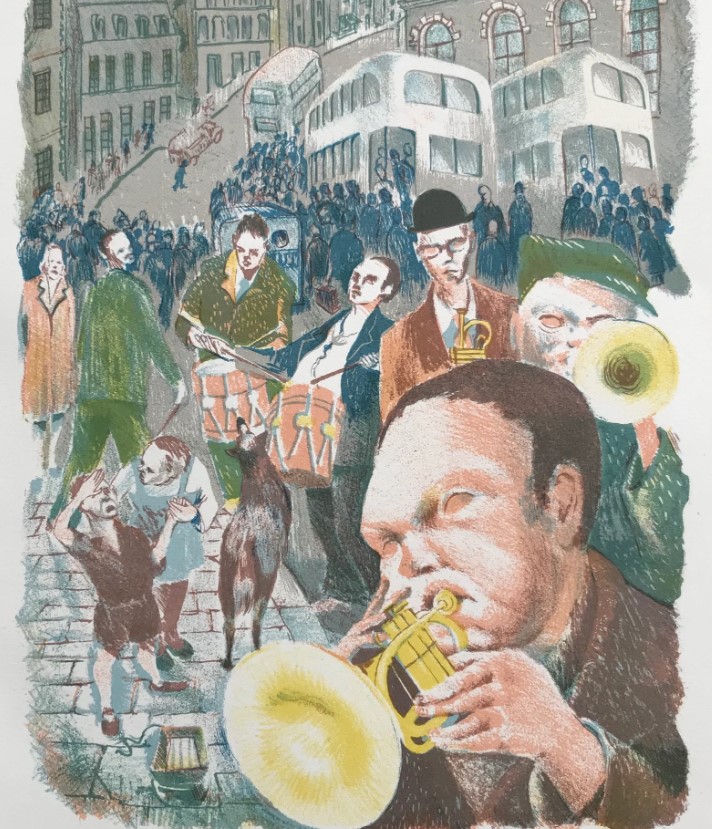
"The Blind Band" or "Brighton Rock" - by K. Lumb (lithography, 1951)
It was a fine day for the races. People poured into Brighton by the first train;
it was like bank holiday all over again, except that these people didn't spend
their money—they harboured it. They stood packed deep on the tops of the trams
rocking down to the Aquarium, they surged like some natural and irrational
migration of insects up and down the front. By eleven o'clock it was impossible
to get a seat on the buses going out to the course. A Negro wearing a bright
striped tie sat on a bench in the Pavilion garden and smoked a cigar. Some
children played touch wood from seat to seat, and he called out to them
hilariously, holding his cigar at arm's length with an air of pride and caution,
his great teeth gleaming like an advertisement. They stopped playing and stared
at him, backing slowly. He called out to them again in their own tongue, the
words hollow and unformed and childish like theirs, and they eyed him uneasily
and backed further away. He put his cigar patiently back between the cushiony
lips and went on smoking.
A band came up the pavement through Old Steyne, a
blind band playing drums and trumpets, walking in the gutter, feeling the kerb
with the edge of their shoes, in Indian file. You heard the music a long way
off, persisting through the rumble of the crowd, the shots of exhaust pipes, and
the grinding of the buses starting uphill for the racecourse. It rang out with
spirit, marched like a regiment, and you raised your eyes in expectation of the
tiger skin and the twirling drumsticks and saw the pale blind eyes, like those
of pit ponies, going by along the gutter.
[...]
Everything went well: the inquest never even got onto the newspaper posters; no
questions asked. The Boy walked back with Dallow, he should have felt
triumphant. He said: "I wouldn't trust Cubitt if Cubitt knew."
"Cubitt won't know. Drewitt is scared to say a thing and you know I don't
talk, Pinkie."
"I've got a feeling we're being followed, Dallow."
Dallow looked behind. "No one. I know every bogy in Brighton."
"No woman?"
"No. Who are you thinking of?"
"I don't know."
The blind band came up the kerb, scraping the sides of their shoes along
the edge, feeling their way in the brilliant light, sweating a little. The boy
walked up the side of the road to meet them; the music they played was
plaintive, pitying, something out of a hymn book about burdens; it was like a
voice prophesying sorrow at the moment of victory. The boy met the leader and
pushed him out of the way, swearing at him softly, and the whole band, hearing
their leader move, shifted uneasily a foot into the roadway and stood there
stranded till the boy was safely by, like barques becalmed on a huge and
landless Atlantic.
Then they edged back, feeling for the landfall of the pavement.
"What's up with you, Pinkie?" Dallow said.
"They're blind."
"Why should I get out of my way for a beggar?"
But he hadn't realised they were blind; he was shocked by his own action.
It was as if he was being driven too far down a road he wanted to travel only a
certain distance. He stood and leant on the rail of the front while the midweek
crowd passed and the hard sun flattened.
The End
.png/220px-Brighton_Rock_(Graham_Greene).png)
Henry Graham Greene
was an English writer and journalist regarded by many as one of the leading
novelists of the 20th century. Combining literary acclaim with widespread
popularity, Greene acquired a reputation early in his lifetime as a major
writer, both of serious Catholic novels, and of thrillers (or "entertainments"
as he termed them). He was shortlisted for the Nobel Prize in Literature several
times. Through 67 years of writing, which included over 25 novels, he explored
the conflicting moral and political issues of the modern world. 'The Power and
the Glory' won the 1941 Hawthornden Prize and 'The Heart of the Matter' won the
1948 James Tait Black Memorial Prize and was shortlisted for the Best of the
James Tait Black. Greene was awarded the 1968 Shakespeare Prize and the 1981
Jerusalem Prize.
'Brighton Rock' is a murder thriller set in
1930s Brighton. A gang war is raging through the dark underworld of Brighton.
Seventeen-year-old Pinkie, malign and ruthless, has killed a man. The title
refers to a confectionery traditionally sold at seaside resorts with the name of
the resort embedded in the centre and elongated down the length (so the same
name is revealed wherever the stick is broken), which in the novel is used as a
metaphor for the personality of Pinkie, which is the same all the way through.
ϟ
excerpt of
"Brighton Rock"
by Graham Green
First published in 1938
29.Jul.2025
Publicado por
MJA
|
