|
|
Five Lectures on Blindness
Kate M. Foley
Home Teacher of the Blind California State Library, 1919
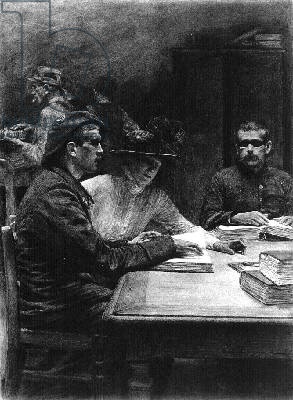
Blind Soldiers Learning to Read Braille
-
L'Illustration,1916 - J.Simont
FOREWORD.
The following lectures were written primarily to be delivered at the summer
sessions of the University of California, at Berkeley and at Los Angeles, in the
summer of 1918. We are printing them, however, so that the information in them
can be more widely distributed, since they are the outgrowth of almost a quarter
of a century spent in work for the blind, and were written from the standpoint
of a blind person, seeking to better the condition of the blind. They were
addressed not to the blind, but to the seeing public, for the benefit that will
accrue to the blind from a better understanding of their problems.
The successful work of Miss Foley as a student in the California School for
the Blind, as a volunteer teacher, and in recent years as home teacher for the
California State Library, makes these lectures particularly important and
authoritative.
Milton J. Ferguson,
State Librarian.
1. THE
PSYCHOLOGY OF BLINDNESS.
In view of the widespread interest now manifested in the blind and their
problems—an interest deepened by reports from the warring countries—I feel that
a knowledge of the psychology of blindness should prove of great help to those
wishing to take part in the re-education of the war-blinded soldiers.
As early as 1773, Diderot wrote an essay on the psychology of blindness, and,
as this essay was written at the very beginning of blind education, it is
interesting to note that his ideas coincide with the most advanced deductions on
the subject today. However, as these deductions are not very numerous, and as
the available literature is very scant, I shall be obliged to draw largely from
my own experience and that of other blind persons, in presenting the subject to
you.
First, let us consider the subject from the point of view of one who has been
blind from early infancy, whose fingers are his eyes, and whose mental vision
enables him to see many things not revealed by physical sight. A blind man once
said, when asked if he would not be glad to have his eyesight, "to improve the
organs I have, would be as good as to give me that which is wanting in me." This
sentence sums up the whole aim of blind education. Dr. Eichholtz, a noted
educator of the blind, says: "Education of the blind absolutely fails in its
object, in so far as it fails to develop the remaining faculties to compensate
for the want of sight." "Touch and sight must be developed by means which
practically in all respects are dissimilar. A blind man discerns the sensation
from the real presence of an object at his fingers' end, only by the force or
weakness of that very sensation." So, then, let us consider that, to the blind,
fingers are eyes, and remember that they have ten instead of two. As I have been
blind since early infancy, my own case offers an illustration in point, so I
hope you will not misunderstand the predominance of the personal note in these
observations.
Blindness does not lead to any refinement of the senses of touch, hearing or
smell, but to a greater keenness in the interpretation of the information
furnished by these senses. Diderot says, "the help which our senses reciprocally
afford to each other, hinders their improvement," and so the person in
possession of all the senses regards the blind man as a marvel of intelligence
and skill, just because, on losing his eyesight, his remaining senses come to
the rescue, and he continues to live and move and have his being without the
most precious of all physical senses. In the world of the blind child eyesight
plays no part, and so the other senses are made to do double duty, and the
extent to which these may be cultivated is limited only by the mentality of the
child, its early training and environment.
I think hearing is the first sense to be cultivated, both in the infant and
the adult suddenly deprived of eyesight. Through its ears, the child recognizes
voices, detects different footfalls, is enabled to measure distance with a fair
degree of accuracy, and can form a very clear idea as to the shape and
dimensions of a room. All this information is conveyed to the normal child
through the eyes. Dr. Illingworth, a noted educator of the blind in England,
says: "Of course, there is no doubt that blindness tends to a higher and more
perfect development of the sense of hearing, even in the uneducated, on the same
principle that
Nature almost always comes to the aid of her children in providing protective
agencies of one kind or another, even in the very lowest organisms, and,
naturally, for those who are blind, the sense of hearing is the first to fall
back upon for this purpose. Thus it becomes more highly developed, because there
is more frequent call upon, and exercise of, that sense." Another writer has
said, "but a distinction should be made between sensitiveness and an ability to
use the sense, between native sensory capacity of the sense organ, and the
acquired ability to use that capacity."
The second sense to be developed in the blind child is that of touch, and
this development begins at a very early date, supplementing the sense of
hearing. Long before the child is old enough to read, its fingers have become
its eyes, and each of the ten fingers carries its quota of information to the
active brain, the amount and quality of this information increasing with the
mental development. In addition to the fingers, the nerves of the face and those
of the feet contribute their share of information. The child learns to detect
differences in climatic condition by the feel of the air on its face. I have
often heard very young blind children exclaim, "It feels like rain! It feels
like a nice day! The air feels heavy! The wind feels soft! The wind is rough
today!" The nerves of the feet contribute their share of helpful knowledge,
calling attention to differences in the ground often unnoticed by the eye,
telling whether the path is smooth or rough, grass-grown or rock-strewn. The
auditory and pedal nerves are mutually helpful, the ear recording and
classifying the sounds made by the feet, often guiding them aright by recalling
certain peculiarities of sound—whether the ground is hollow, whether the
sidewalk is of board or cement, and whether there is a depression here or a
raised place there. I often wonder how deaf-blind people walk as well as they
do, when they can not hear their footfalls. I find walking much more difficult
when on a crowded thoroughfare, or when passing a planing mill or boiler
factory.
The last of the trio of senses whose development compensates in large measure
for the want of eyesight, is that of smell. Through this sense, the child comes
very close to the heart of Nature. Of course, the ear is charmed by the song of
birds, the hum of insects, the murmur of wind in the trees, or the sound of
mighty waters. Through the finger-tips, he learns the shape and size of each
flower and shrub and tree, traces the delicate pattern of ferns, notes wonderful
rock formations, and finds the first blade of tender grass coaxed to the surface
by the warmth of the Spring sunshine. But all this does not bring him the keen
pleasure he experiences when he inhales the fragrance of the rose, the perfume
of flowers with the dew still upon them, the smell of the freshly turned earth,
the newly cut grass, or the blossom laden trees. In the case of Helen Keller,
the olfactory nerves have been cultivated to a very high degree, and through
this sense she is often able to recognize her friends. A little blind boy once
told me that each member of his family had a distinct odor, by which he could
tell things worn by them, or books they had handled. Laura Bridgeman is said to
have selected the laundry of the pupils in her school by this unusual process. I
frequently astonish my friends by telling them when I pass a drug store or
hospital, a grocery, a confectioner's, or drygoods store, a paint shop, a florist's stand, or a
livery stable. I do not think the blind have a keener sense of taste than any
other class of people, although this claim is often made, even by the blind themselves.
We have, then, the senses of hearing, touch and smell, each playing its part
in the development of the blind child, and each playing it so well that the lack
of eyesight is not keenly felt in early childhood. Not until it is old enough to
understand the thoughtless remarks of well-meaning people, to catch the pitying
tone, to feel the compassionate touch, does it realize that this lack of
eyesight is to prove an almost insurmountable barrier to its future success.
I was in my sixth year before I understood the meaning of the word "blind."
Up to that time, I had romped and played with other children, climbed trees,
jumped ditches, accepting bumps and bruises as part of the game, and having no
sense of fear, since some child always held my hand. In fact, in those days, all
the children held each other's hands, and it was easier going, so. Is it not a
pity that, in later life, we feel so self-reliant we are unwilling to admit that
the way could often be made easier if we resorted to the childish game of
holding hands, and moved forward together as we faced the more serious struggles
of life. My first realization of the meaning of blindness came when, one day,
after hearing some people call me "poor child," and expressing their sympathy to
my mother, I asked if we were very poor, poorer than my playmates, and why I
could not go to school. My mother explained that we were no poorer than the
others, that the ladies did not mean it in that way, but were sorry that I could
not see and did not think I could ever go to school. But my mother assured me
that I was going to school, and that there I would learn to see with my fingers,
better than the ladies did with their eyes. My childish mind was aroused then,
and I asked every one what it meant to see, and soon realized that I did not
know what "seeing" really was, at least, not in the sense the other children
used the word. I was filled with wonder, since my world had hitherto seemed so
complete—I heard things, or felt things, or smelled things, and was
satisfied—and yet there was another medium of knowledge entirely unknown to me,
and until then unnecessary. How eagerly I looked forward to the time when I should learn to see and my heart was filled with childish rapture on the day
when I entered the school for the blind at Berkeley. My first question, on
meeting the Superintendent, was, "are you going to teach me to see?" How well he
performed this task, how wisely he guided my childish feet, how carefully he
developed my eager mind, stimulated my ambition, and renewed my faltering
courage, I did not realize until I was called upon to face life, with its trials
and opportunities. And here, where his work is so well known, I wish to pay my
tribute of love and gratitude to Dr. Warring Wilkinson. He was my great-hearted,
great-souled teacher, father and friend.
When I found myself in a place with children some of whom were, like myself,
blind from infancy, and others whose eyesight had been lost through various
accidents, and yet others who could see to go about, to tell the color of our
ribbons, and advise us of the approach of a matron or teacher my wonder grew
apace. This process of learning to see was varied and absorbing, but I soon
found that it had its limitations, and that, after all, eyes were very useful
possessions, and without them I could know nothing of color, could not picture
the sky, or any of the heavenly bodies; nor could I distinguish different people, unless I heard
their voices or steps, though no two had faces alike. I found, too, that some
children who could see colors, could not recognize faces, and I came to realize
that vision, however slight, was greatly to be desired. I could distinguish
light from darkness, and this enabled me to locate doors and windows; but color,
with its varying shades, was then, and is now, a mystery profound. But in my
desire to see, to be just like other children, I resolved to learn all I could
about color, and so I memorized the list of colors, which ones harmonized, which
were most pleasing to the eye, which were bright, which produced a sombre
impression. Thus I soon learned to speak of color with a degree of intelligence,
and to select my gowns with a view to pleasing the eyes of my friends. I soon
learned to associate certain phrases with certain colors—for instance, blue as
the sky, green as grass, yellow as gold, black as night, red as fire, and brown
as a berry. I also learned that a color had a variety of shades, and that at
times colors were changeable, it being difficult to distinguish blue from green
at night. The sky, with its starred phenomena, was even harder to conceive, and
I could not understand how clouds obscured the sun, or how old Sol could put the
blackest clouds to rout.
My ears and fingers continued to flood my mind with knowledge, and the want
of eyesight did not distress me. When I touched an object, or listened to a
lesson, my mind stored it away for future reference, and often now, when
recalling some facts in history or geography, I can hear the voice of the
teacher who read the particular passage.
I was eight years old when I first examined a horse, although I was familiar
with the sound of its feet on the pavement, and knew whether it walked, trotted
or galloped. The horse I examined had been driven a long distance, and so was
very warm; when my hand was placed upon its mane, the hair was damp and clung to
the back, and there was an odor of steaming flesh. A fly was tormenting the
animal, and, as it tossed its head impatiently, I could hear the rattle of
harness, and the sound of its restive foot upon the ground. These impressions
have always remained with me. My knowledge of the horse was acquired through the
senses of hearing, touch and smell. And so with the cow. I can hear its low
"moo, moo," hear the milk dropping into the pail, feel the hard outer shell of
the horns, and catch the odor that is ever present in the cow's domain. The cat
and dog have their peculiarities, too—the mewing of the cat, and the sounds
heard when it purrs while washing its face—the dog's quick bark, and the sound
it makes when panting for breath, as it rests after a long chase. I know the
animals have different colors, peculiar to them, but this knowledge has no place
in my mental conception of them.
In judging people, the voice is my infallible guide. I am instantly attracted
or repelled by a voice, and my estimate of character is rarely incorrect. By the
voice I am able to form a very accurate idea as to height, weight and age, so
here again I do not feel the lack of eyesight. The voice is an unfailing index
to character, and the trained ear is quick to catch the slightest variation in
tone, and can detect traits and moods hidden from the eye, because not
registered upon the face. There is a strong voice, a brave voice, a voice full
of hope and cheer; a tired voice, a crafty voice, a voice full of dull despair.
And so here again I do not feel the lack of eyesight in noting differences in
my fellow men.
I know that there are distinguishing marks, that heads are shaped differently,
and that hair and eyes have different colors, corresponding to the various
types, as blondes or brunettes. All this I know abstractly, but it is just one
of the bits of information tucked away in memory's storehouse. I do not suppose
many of you have ever heard a smile. I have. I hear a smile almost before the
lips can register it, and to me the sound is as musical as the laughter of a
very young child. I think hearing a smile must be like seeing the light in the
eyes, and so lack of eyesight is no deprivation in this connection.
All during my days at school, I went on acquiring knowledge, learning to see
many things, scarcely realizing the handicap of blindness, because every help
was given me, and I was surrounded by those whose condition was like my own. But
when I went out into the world, I found that many seeing people, so called, had
very little vision, although their eyesight was perfect. I found, too, that,
although I knew many things, and was well equipped to earn my own living, my
lack of eyesight was responsible for a corresponding lack of confidence upon the
part of the public. This was a great disappointment, for I knew I could succeed,
if only some one would give me the opportunity. After waiting twenty years, the
State Library gave me the opportunity. This lack of confidence upon the part of
the public is one of the most depressing features of adult blindness. Thus far,
I have considered the subject from the point of view of one who has been blind
from early infancy, but now I shall view it from the standpoint of one deprived
of eyesight in adult life, who is taking his first step in the dark.
M. Diderot says: "The help which the senses reciprocally afford to each other
hinders their improvement," and so the adult whose movements are no longer
directed by his eyes, feels utterly helpless and bewildered, as one who finds
himself on a strange road, very late at night, with no ray of light to guide
him. As the blinded soldier is uppermost in our thought today, I am considering
the mental condition of an adult suddenly deprived of eyesight, not that of the
man whose blindness has come on gradually.
The first sensation when thus plunged into total darkness is that of
unreality, and, just as the light of day dispels the gloom of night, so the
sufferer clings to the hope that any minute he may open his eyes, and find
things as they were before the darkness settled down, with all its weird
shadows, to fill his soul with dread. The continued darkness causes a feeling of
depression and repression, very hard to combat, and so the sufferer is in need
of "first aid"—in need of a friendly hand and a cheery voice to help him through
these trying days. Of this period, M. Brieux, Director of Re-education of the
Blinded Soldiers in Paris, says: "The blind are, for the time being, put back
into the helpless condition of children. They have to be sustained and given a
new education for life. They have to begin many things all over again.
Spiritually, they have lost their bearings, and are drifting about in restless
anguish. Physically, their whole organism has been shaken by the wound they have
received, and must have time after such a violent shock to recover its
equilibrium. Their power of judgment has often been temporarily destroyed. They
are weak in body and uncertain in mind. This double weakness lays on those who
surround them a double duty. Much will have been done when their material
welfare has
been assured, but the responsibility will not have been discharged unless they
have also attained to tranquility of soul and a sense of their own dignity. One
must have confidence, in order to give them confidence. Most of us have no idea
what powers to meet new demands are inherent in our organs. We have within us
capacities unknown even to ourselves, inactive, so long as they are not
necessary, awake and efficient, as soon as there is need of them. They are
reserves which most of the time we never call on. They are a hoard which we do
not touch. Our resources and our power of life are greater than we imagine. The
sudden loss of sight gives, after a time, something like the lash of a whip to
the whole organism. All the other senses are roused to greater sharpness. When
the blind soldier fully realizes this, he will perhaps arrive at a state in
which I have seen some men blind from birth, the state of being proud of being
blind. Why should they not be proud, when they feel that they are as capable of
accomplishing certain things, of practicing certain trades as other men? If,
with their lessened powers, lacking the power that we consider of supreme
importance, they can do things as well as we, are they not, therefore, cleverer
than we? Instead of talking to them of resignation, incite them to revolt at the
limitations of their condition. Inspire them to conquer circumstances. Insist
that they can. Picture life to them, its beauty and its power, and tell them
that it is good."
In administering to the needs of this readjustment period, the volunteer
should be an optimist, and should exercise common sense in guiding the adult
over the first lap of the unfamiliar road. I have advised the volunteers who are
now in France, and those preparing to go there, to take writing boards, games,
bright, pithy stories, and a lot of nonsense verse. I have told these Red Cross
workers that they themselves must know how to laugh, must be able to rise above
the horrors about them, for they are there to serve heroes, not cowards, heroes
who will laugh with a sob in their throats; heroes who, after a short respite,
will reach for a new sword with which to resume the battle of life. God grant we
may have the new swords ready for them—swords of hope, swords of confidence,
swords from which all the old prejudice and misconception have been
removed—swords of occupation and independence!
Of this readjustment period, Clarence Hawkes, the well-known blind naturalist
who lost his eyesight at the age of fifteen, says: "the loss of eyesight seems,
for a time, to upset the perfect working of the nervous system. The nerves have
to adjust themselves to new conditions, and rearrange the channels of
communication. On first losing one's eyesight, one is impressed with the fact
that all noises sound much too loud, and it takes several months for sounds to
get toned down to their normal volume, and one never quite overcomes the
tendency to jump at sudden sharp noises."
As to the blind child the senses of touch, hearing and smell prove efficient
carriers of knowledge, so these senses come to the rescue of the blind adult,
and compensate, in large measure, for the loss of eyesight. Training does not
increase the sensitiveness of a sense organ. It merely puts this capacity to
better use. So the blind adult does not suddenly come into possession of
wonderful powers, but, in time, his "acquired sense perception" enables him to
do many things hitherto considered impossible of accomplishment. But to the
casual observer, anything done without eyesight is considered little short of marvelous.
The adult soon learns to recognize voices and footsteps, to measure distance
with a fair degree of accuracy, and, in many cases, to go about alone, with only
the friendly cane for company. Many of the blind have what is defined as a
"sense of obstacles," and it is sometimes called a sixth sense. Dr. Illingworth
defines this sense as "an exceedingly subtle kind of instinct that enables a
blind individual to detect the presence or proximity of a person or object under
circumstances of absolute silence, and very often to know the nature of the
object." Dr. Illingworth believes that this remarkable power is of electric
origin and latent in everybody. This power seems to have its seat in the nerves
of the face, and is possessed by the blind adult as well as the blind child.
This sense of obstacles, this "touch at a distance," enables a person to tell
when he is passing tall buildings, fences, trees, and many other obstructions.
Mr. Hawkes says: "The sixth sense, if such it be, probably depends upon three
conditions—sound, the compression of the air, and whether the face be free to
use its sensitive feelers. This subject is still in its infancy, and time may
reveal many interesting facts concerning it; but for our purpose it is enough
that the blind have a sense of obstacles, and let us regard it as another proof
that we are wonderfully made and divinely led."
In a surprisingly short time, the blind adult becomes accustomed to the new
conditions, the various organs perform their new functions, and he finds life in
sightless land to be, in many respects, very like life in that world of light
and color, now only a memory. But a very living memory—enabling him to recall
the faces of his friends, the glow of sunset, or the rosy light of dawn with the
eye of the mind whose vision is keener, clearer than mere physical sight. This
ability to call up mental pictures is yet another of the compensations, and these pictures never fade, but come, when familiar scenes or objects are
suggested. The adult is deeply interested in form and color, and likes to have
them minutely described. This fact is not well understood by sighted friends,
and so the blind are often deprived of details which would give them keenest
pleasure, because friends fear to recall painful memories. In this connection,
and by way of conclusion, I shall give a poem written by one of our pupils, who
lost his eyes when a drummer boy in the Civil War. This man learned to read
raised type after being blind fifty-three years. His poem follows:
A BLIND MAN'S SOLILOQUY.
What, then, is blindness? This and nothing more:
The window blinds are closed, the outer door
Close shut and bolted, and the curtains drawn.
No more comes light of stars nor morning's
dawn,
Nor one lone ray from day's meridian
light.
And men pass by and say "within is
night!"
Not so; for Memory's lamp, with steady
blaze,
Shines on the hallowed scenes of other
days,
While Fancy's torch, prophetic, flashing
through
The vistas of the future, brings to
view
Scenes passing strange, but scenes that yet shall
be,
Which I can see, but which he can not
see
Whose dazzled orbs find nothing hid
away
Beyond the brilliant margin of today.
To me the radiant world forever
gleams
With the rich halo of my boyish
dreams;
The faces I have loved no wrinkles
know;
My dear ones' eyes ne'er lose their cherished
glow;
The hair of gold ne'er turns to silver
hair;
The young are young, the fair are always
fair.
With reason strengthened, feelings more
intense,
The senses, multiples of former
sense,
Vicarious servants for dead sight
become.
I see the city in the city's
hum;
I catch its subtle undertone of
trade;
I hear of fortunes lost and fortunes
made,
In sounds to him a mystery
profound
Who, seeing, knows not vision muffles
sound.
Distinct to him must sound become, to
whom
Life walks in darkness—call it not in
gloom.
'Tis only an exchange of good for good,
A new plant growing where the old one stood,
Old blessings taken, and new blessings given;
Sweet compensation, thou wert born in heaven!
There is not silence unto him whose soul
In darkness sits and listens. Like a scroll
On which the secrets of the world are
traced,
Blindness is but a sea-shell kindly
placed
Beside the ear, and in its varying
tone,
Who will, may make life's secret all his
own.
And thus misfortunes bless, for blindness
brings
A power to pierce the depths of hidden
things,
To walk where reason and fair fancy
lead,
To read the riddle of men's thoughts, to
read
The soul's arcana in each subtler
tone,
And make man's joys and sorrows all my own.
Nor can I sit repining at my
lot
As bitter or unjust, or curse the
shot
Which tore away my sight. The world is
kind
And gentle to her sons. Though I am
blind,
Smooth paths of enterprise have always
stood
Open for me, and, doing what I
could,
With hand or brain, with simple
earnestness,
Have gathered what was due me of
success.
O you, who sit in darkness, moaning
o'er
Your dead and vanished vision, mourn no
more!
Keep in the current. Be you brave and
strong!
The busy world is singing—join the
song,
And you shall find, if you no duty
shirk,
Who will may prosper, if he do but
work.
And as a last thought, permit me to quote the concluding words of Clarence
Hawkes' wonderful book, "Hitting the Dark Trail":
"If night has overtaken me at
noonday, yet have I found beauty in night. The sun at noontide showed me the
world and all its wonder but the night has shown me the universe, the countless
stars and illimitable spaces, the vastness and the wonder of all life. The
perfect day only showed me man's world, but the night showed me God's
Universe."
2. THE BLIND CHILD AND ITS
DEVELOPMENT.
As a foreword to this lecture, I shall quote from a paper entitled "Blind
Children And How To Care For Them," written by Dr. F. Park Lewis, an eminent
oculist of New York City, and a man who has devoted much time and thought to the
blind and their needs.
Dr. Lewis says: "It is the mind and the spirit which control, and when these
are great, they dominate and rise superior to mere physical deficiencies. The
inspiration of great ideals must be held out to the blind, even more than to the
seeing, from the very beginning. It is not enough that the blind man or woman
shall have physical strength, but his training must be so well balanced as to
give him poise as well as vigor. It does not suffice that the blind man shall be
as well educated as his fellow who sees. Handicapped by the loss of the most
important of his special senses, he must supplement this deficiency by a better
training of his mind and body. It is not enough that he should have the good
character of the average man. His word and his reputation should be beyond
question. He should be independent, and proudly unwilling, except when
absolutely necessary, to accept that for which he can not, in some way, return
an equivalent. He must be taught to reason with clearness and logical precision,
for he must succeed by the aid of his mentality and character, rather than by
his manual exertions. These facts are emphasized here, because if such qualities
are to be secured, the training which produces them should begin in the cradle."
If I could bring it about, a copy of the foregoing lines should be framed and
placed on the desk of every teacher of blind children, and such teachers
requested to read these words at least once each day.
In considering the development of the blind child, we must recognize the fact
that, in mental attainment, at least, he is the peer of the child who sees. But
in order to bring this about, the early years of the child must be carefully
supervised, and his training calculated to fit him for the tremendous task
awaiting him, a task requiring the courage of a Spartan, the wisdom of Solomon,
and the patience of Job. Unfortunately, the parents of blind children rarely
understand the importance of this early training. They are too often too
absorbed in their own sorrow at having a child so afflicted, too sure that loss
of eyesight means loss of mental vigor, to realize that their own attitude,
their own self-pity, may prove a greater handicap to the child than blindness
itself. If a child lives in a house where he is waited upon, and made to feel
that mere existence and the ability to eat and sleep are all that may reasonably
be expected of him, and that he must depend upon his family for everything, he
will grow up helpless, selfish and awkward, and no amount of later training will
entirely counteract the pernicious effect produced in these early, formative
years. When placed in school with other children, he will be very sensitive to
correction, and may become morbid and unhappy, thus giving a wrong impression of
the blind in general. If, on the other hand, the child is taught to be
self-helpful, permitted to join in the work and play of other children, made to
feel that, with greater effort, he may do just what they do, he will soon become
cheerfully alert and hopefully alive to all the possibilities of his peculiar
position. It is true that natural disposition has much to do with one's outlook on life, but
cheerfulness and a certain form of stoicism may be cultivated, and to the blind
child these qualities are absolutely essential if he is to attain any measure of
success in later life. It would be foolish for me to ignore the difficulties and
limitations in the path of everyone deprived of eyesight, either in infancy or
adult life, but I know that these very limitations and difficulties may aid in
forming a character whose quiet strength and unfaltering courage can not fail to
win the admiration and co-operation of all who witness its tireless efforts for
success. But in order to achieve success, let me repeat that such training must
begin at the earliest possible date.
You may never have thought of it, but the blind child has no model, no
pattern. It must acquire everything. It learns nothing by imitation. The normal
child copies the gestures and mannerisms of its parents, and so learns many
things unconsciously, and with little or no instruction. But the blind child
must be taught to smile, to shake hands, to hold up its head, to walk properly,
to present and receive objects, and the thousand and one details of daily living
so naturally acquired under ordinary conditions. Long before it has reached
school age, the blind child should be permitted to romp with other children, to
take bumps and bruises as part of the game, and should be encouraged to run,
jump rope, and join in all harmless sports, thus acquiring that freedom of
movement, muscular co-ordination, and fearless bearing, so necessary if he is to
cope successfully with the difficulties awaiting him. His toys should be chosen
to instruct as well as amuse, and in this way he should be made familiar with
the different forms, the square, the circle, the oblong, the triangle and the
pyramid. The Goddard form board and Montessori insets are invaluable at this
period. He should be trained to recognize the difference between smooth and
rough, soft and hard, light and heavy, thick and thin. He should be given
plasticine or clay with which to model, and be urged to reproduce his toys, thus
assisting in the muscular development and intelligent use of his fingers—another
essential equipment. As soon as possible, the process of dressing should be
taught. The child may learn this more readily if a doll is used as a model, and
he is required to put on its clothes each morning, and remove them just before
his own bedtime. This important process should be made as interesting as
possible, and each successful effort greeted enthusiastically, each failure
carefully pointed out, its cause discovered, and its repetition prevented, when
possible. In this way he acquires system, learns to put his clothes away in a
certain place, and to locate them again without assistance. His little fingers
should be kept constantly employed stringing beads, putting pegs in a wooden
board, cutting paper with kindergarten scissors, and modelling with plasticine.
If thus occupied, he will escape the mannerisms peculiar to the blind child
whose only amusement has been to put his fingers in his eyes, shake his hand
before his face to see the shadow, rock his body back and forth, and whirl
around in dizzy circles. I found just such a child, a girl of eight years, who
had never done anything for herself, and whose parents refused to send her to
school. It took me some time to win the child's confidence, but when I did, I
had no trouble to correct many of her habits, and I soon taught her to dress
herself and learn to read. When I asked her what she did all day before I brought her the
beads and the little scissors, and she answered, "Oh, I just sat in my rocker,
and rocked back and forth, shaking my hands." And when I asked why she did not
play and act like other children, she began to cry, and said, "Nobody never told
me nothin' else to do till you came."
When six years old, a blind child should be sent to the nearest state school
for the blind, or to a special class, if there is such a department in the
public schools of the city in which it lives. The necessity of sending the child
to school thus early can not be too strongly emphasized, and education of blind
children should be made compulsory, just as in the case of ordinary children.
This is a measure which should be considered by all those interested in child
welfare. The unwillingness of parents to send their children away to boarding
school at so early an age is one of the strongest arguments in favor of the
special classes in public schools. But it is not possible to have such classes
in the small cities and towns, and very often the home conditions are often
unsuitable for the proper development of a blind child, and so, in every state,
a residential school is an absolute necessity.
Such a school should consist of a kindergarten, primary, intermediate and
high school department, and the life of the children should conform as closely
as possible to that of a large family in a well-ordered home. Those in charge of
the children should be impressed with the responsibility of the task they have
undertaken and should do their utmost to assist in the work of fitting the
little ones for the preliminary skirmish in the battle of life. All children
should have constant supervision during the formative period, but more
especially does the blind child need watchful guidance in his work and at his
play. Little habits must be broken, awkward movements discouraged, self
confidence fostered, and every effort made to develop the child along sane and
normal lines, so that, in later life, he may have the poise and bearing so often
lacking in those who are blind from early childhood.
It is sometimes claimed that it is not essential that a teacher of the blind
be possessed of more than an ordinary education, and this is why so many schools
for the blind fail to turn out capable, cultured, self-reliant boys and girls.
Dr. Illingworth, the noted English educator, gives the following qualifications
for a teacher of the blind: "a sound education, self-control in a high degree, a
boundless enthusiasm, a determination to succeed, should be kind and
sympathetic, and at the same time firm, and should be true to his word." These
are qualifications which should be possessed alike by the blind teacher and
sighted teacher, and only teachers so qualified should be entrusted with the
divine privilege of bringing light to the minds of these helpless little ones. I
wish to add a few more qualifications to Dr. Illingworth's list, and they are
these: a broad, comprehending sympathy, a sense of humor, and a heart brimming
with love for all children—a heart capable of sharing the joy and grief of every
child heart. And I wish to emphasize, in a special manner, one of the doctor's
qualifications—namely, "a boundless enthusiasm," and to add yet another, a
living, breathing faith that teaching is a divine calling, and that the
opportunities for good or ill are limitless. To be successful, a teacher should
be able to bring himself to the level of his pupil. I once heard a man say of a
great teacher, "he had the heart of a boy, and understood our every thought and
feeling."
In many schools for the blind the inspirational value of a blind teacher is
overlooked or ignored. In this connection Dr. Illingworth says: "it is almost as
impossible for a seeing teacher to realize what it is to be blind, and know all
the difficulties of his blind pupil, as for a congenitally blind person to enter
into and share with one who can see, the beauty of a glorious picture or
landscape." Dr. Illingworth continues, "it takes a seeing teacher to become what
might be called a naturalized blind person, that is, one able to see things from
the blind point of view; though he is never in the favorable position of a blind
teacher who can say to a child, 'do it so; I can do it—I am blind like you.'" In
the residential schools Dr. Illingworth recommends that the ratio of blind
teachers to seeing should be one to two. He says, "their very presence is a
continual inspiration and incentive to the pupils," and he adds, "the education
of blind children in those subjects in which the methods of instruction are
necessarily and essentially totally different from those of the seeing, is best
in the hands of a properly qualified blind teacher." The wisdom of this
recommendation is recognized in the largest schools of England and France, and
some of them have blind superintendents as well. America is slower to recognize
the ability of the blind, but this period of reconstruction and readjustment
through which we are passing may quicken their sense of the importance of
employing blind teachers and superintendents, whenever possible. Superintendents
are no longer required to perform clerical work. All these details are left to
stenographers and bookkeepers. Neither is the superintendent expected to teach.
But he should be a scholar, a man of culture, with broad vision and high ideals,
and with a sympathetic knowledge of the difficulties to be met and overcome by
the students in his care. It should be the aim of the residential school to
train its pupils along lines best suited to their individual needs, and, when
possible, to fit them to become partially self-supporting, if not wholly so.
The child in a residential school knows very little of life outside the
buildings, knows little of the trials and struggles going on in its own home,
perhaps. Its days are well ordered. It is clothed and fed, and is not expected
to practice self-denial or to exercise any of the qualities of courage or
fortitude which the exigencies of later life demand. Clarence Hawkes says:
"courage a blind person should have above everything else. He must be literally
steeped in it. It will not do to have just the ordinary, temporary supply
allotted to the average seeing man—he will run out in a single day. But he must
have courage that is perennial, a ceaseless fount of it—courage for the morning,
courage for the noonday, and courage for the evening. Life is a battle and a
struggle which never ends. He must fight for hope and cheer, laughter and
happiness, every inch of the way along life's path." Another writer has said,
"courage is the standing army of the soul, keeping it from conquest, pillage and
slavery." But the child in the residential school knows little of all this, has
little occasion to know. Dr. Park Lewis says: "The added importance of having
blind children educated with those who see is, that they may realize more keenly
the real difficulties of life which are to be met, and which have to be
overcome. They will not always find kindness and courtesy, and they must be
prepared to adjust themselves to the harder conditions when they arise."
When the child finishes the required curriculum of the residential school,
and goes forth to his place in the world, he is often unprepared for the
struggle, unable to adjust himself to the altered conditions, lacking in
patience, perseverance and pluck; the "three P's" of which Clarence Hawkes so
often speaks, and without which he claims no blind person can successfully
overcome his handicap. The need for this preparation is better known to a blind
teacher or superintendent, and for that reason, if for no other, his presence in
the school is desirable. He knows the value of higher education to the blind,
and he will urge the pupils to fit themselves for college, reminding them that
blindness is a physical, not a mental, handicap. And who is better qualified to
fire the youthful mind, to strengthen the wavering ambition, and arouse the
latent enthusiasm, than one who has made the effort, has fought the fight, and
won gloriously!
Although Dr. Warring Wilkinson, who was Superintendent of the California
School for the Blind for over forty years, and his brother Charles, who taught
for the same period—although neither of these men was blind, they were true
teachers and college men, and understood the value of scholastic attainment to
the blind. As far back as I can remember, they urged us all to prepare for
college, and, to stimulate this desire, they kept in close touch with the work
of the university, and often brought essays written by the advanced students, to
encourage us in our literary efforts, assuring us with a little practice we
could write as well. Often, too, they would take classes to hear a lecture on
some subject under discussion, thus forging the first link between the school
and the university, in whose shadow our young lives were spent. In preparing us
for competition with seeing students, Mr. Charles Wilkinson used to say: "never
ask for quarter because of your blindness. Do your work so well that people will
say not, 'how wonderful this is considering your affliction,' but 'how perfect
in spite of it!'" This thought has remained constantly with me, strengthening
and encouraging me, enabling me to overcome difficulties that would otherwise
have been impossible to surmount.
It is of vital importance that the blind should have pleasant, well-modulated
voices, and for this reason elocution should be included in the course of study.
In recent years a number of blind students in eastern schools have been trained
as readers and public entertainers, a line of work in which eyesight is not an
essential factor. Reading aloud should be encouraged among the pupils, and
frequent speed tests given, thus stimulating in them a desire for reading.
The school at Berkeley has included business methods in its course of study,
and this is an excellent thing, because the day is not far distant when the
ability of the blind to fill positions as typewriters, stenographers, telephone
and dictaphone operators, and salesmen, will be recognized. And when this time
comes, let us hope that our young people may be ready and eager to prove their
worth in these lines of endeavor. If the students are made to feel that they are
blazing a trail, and making it less difficult for others to follow, their
ultimate success is assured.
Having outlined the aim and purpose of the residential school, and shown it
to be a necessary factor in the education of the blind in every state, I wish to
call attention to some of the advantages to be derived from coeducation of blind
and seeing children.
As early as 1900 Chicago started a special class for blind children as a part
of its public school system, thus inaugurating the movement in this country, if
not in the world. Since that time many large cities, including Boston, New York,
Jersey City, Rochester, Milwaukee, Detroit, Cleveland, Toledo, Cincinnati and
Los Angeles, have started similar classes, carrying the children from the
kindergarten, through elementary and high school, and preparing them for
college. The class in Chicago was started through the efforts of John B. Curtis,
a blind teacher, and the Superintendent of Public School classes of Cleveland,
Toledo and Cincinnati. Mr. R. B. Irwin, is a blind man, and so it is not strange
that a blind teacher of Los Angeles should be the first to recognize the need of
such a class in this state.
The State Library was glad to further this forward movement in the education
of blind children, and permitted me to devote a great deal of time to organizing
the class, and it provided the books and some of the apparatus for carrying on
the work for the first year. It still supplies many of the books, though the
Board of Education provides its own apparatus. Dr. Albert Shiels, Superintendent
of the Los Angeles City Schools, was glad to have a class for the blind in the
city, since he has seen how successfully the work was carried on in New York,
where more than two hundred children attend special classes, and this in spite
of the fact that New York has two state schools for the blind. When the home
conditions are favorable, and a special class is available, it is wiser to
permit the blind child to remain with its parents, to attend school each morning
with its brothers and sisters. In this way there is no break in the family
relation and the child does not grow indifferent to home ties, as so often
happens when he is sent to a residential school. Mr. Irwin says "the special
class is the twentieth century emphasis on the integrity of the home."
On January 2, 1917, the Los Angeles class started with eight pupils enrolled,
and on June 30 of this year the number had increased to seventeen, with the
prospect of more at the opening of the fall term. Teachers for special classes
are generally chosen from the regular school department, their work being
usually directed by a blind supervisor. In pursuance of my work as home teacher
I found a number of children for whom there was no room in the State School at
Berkeley, and before the special class was organized I taught these children in
their homes or at the library. Miss Frances Blend, a grade teacher, asked to
study with me, since she wished to teach the blind here or in the East. I sent
her to teach the children, and in this way she acquired the necessary
experience, learned to read and write Braille rapidly, and gained an insight
into the psychology of the blind child, so, when the board of education needed a
teacher for the special class she was ready and eager for the task. Since then
Miss Blend's sister has qualified and is now the second teacher in the blind
department, eight to ten children being considered all that one teacher can
properly care for.
Among the poor of every large city, there are children whose parents conceal
them, for fear they may be sent away to school. These are known as hidden
children, and I found one such child tucked away under the bed, and was told she
always hid there when she heard strange voices. She was a little Mexican girl,
and spoke no English. She is now one of the brightest children in the class, and
her parents are delighted that they need not part with her.
In the special class, the children are trained to speak intelligently of
things which they do not see with the physical sight, so that they may be able
to converse naturally upon ordinary topics, and need not have to plead
ignorance, on the ground of never having seen this or that object. Their minds
are filled with a love for all beautiful things, especially flowers and
pictures, and they are frequently taken to parks and museums. They are told
about the stars, the blue sky, sunsets, the majesty of the ocean, and all the
other wonders that enchant the eye; and they are taught to speak of "seeing"
these things, because they really do see them with the mental vision, keener, in
many instances, than mere physical sight. The boys of the polytechnic high
school made a wonderful doll house for the children—a house of four rooms, fully
furnished throughout. The children made their own rugs and baskets, tables and
chairs, and one boy modeled a bathtub of plasticine, perfect in design. The
house has a sloping roof, and it is thatched, and I must confess that my first
real knowledge of roofs was gained from examining that one on the doll house. It
has a chimney, too, and a stovepipe, and so the children learn a great deal from
this miniature home of their dolls.
In their special classroom, the children are taught Braille reading and
writing, and a great deal of time is given to these branches. They are taught
all sorts of handwork, basketry, weaving, knitting, modeling, and chair caning,
and, when old enough, they are sent with the other children to sewing, cooking,
sloyd and music classes. As soon as possible, they recite with the regular
classes, their lessons being previously read or explained by the special
teacher. This gives them the contact with normal children, so necessary to the
development of the blind child. Those not in favor of special classes claim that
this competition is too severe a strain, and that it is unkind and unwise to
place blind children with those whose physical advantages and opportunities for
study are greater. But we have found that the plan works admirably. The special
teacher trains her pupils to be self-reliant and helpful, insists that they join
in the games of the others, assuring them that, with greater effort, they, too,
may play, and it is delightful to watch them at recess or at noon, each blind
child affectionately led by a seeing child, the latter calling the teacher's
attention to the successful performance of some feat on the part of his blind
playmate. In the classroom, too, the spirit is the same, the blind child
remembering things for the one who sees, and the seeing child using his eyes for
the one who is blind. The special teacher trains the memory of her pupils to the
highest possible degree, impressing upon them that their minds are vast
storehouses in which to keep all sorts of knowledge tucked away for future use,
and that it is disastrous to blind children to forget. In mental arithmetic,
they usually lead the class. Their presence in the school is of the greatest
help to the others with whom they work in class. Their success in overcoming
difficulties is a stimulus to the pride and an incentive to the ambition of the
seeing child. The presence of the blind children is a constant reminder to them
of their superior physical advantages, and they are ashamed to have them
outstrip them, as they so often do, in intellectual work. And so the presence of
the blind child is sure to result in untold good, not only to the child so
handicapped, but to the entire school, removing as it must, the belief, now, alas, so
general, that when eyesight is lost, all is lost. Trained side by side with its
sighted companions, doing the same work as well, if not better, the later
success of the young blind seeker after knowledge is practically assured; for,
as I have said, in mental attainment, at least, the blind child is the peer of
the child with eyesight,—here, beyond cavil, the chances are equal.
To my mind, the coeducation of the blind and seeing is a step in the right
direction—a very forward step, since it will ultimately bridge the gulf of
misconception and skepticism now separating these two classes—a gulf which must
be bridged if we hope to arrive at a sane and satisfactory solution of the
problem of finding employment, not only for the returned blind soldiers, but for
the thousands of intelligent blind men and women who are waiting eagerly,
hungrily, for a chance to prove their ability, a chance to earn their daily
bread. When blind and seeing children are trained side by side, from the
kindergarten, through the grades into high school, and on to college, perhaps,
the barriers dissolve, the blind boy and the seeing boy are comrades—they have
played together, worked together, and together they have planned their future.
The seeing boy knows the blind boy will succeed because he has seen him
victorious in many a mental skirmish. Just this May, right here in the
University at Berkeley, a blind student graduated fourth in a class of more than
one thousand seeing students. It may be interesting to note, in passing, that
there are seven blind students now attending the university, and that the state
provides three hundred dollars a year to defray the expense of a reader for each
student. New York was the first state to provide readers for blind college
students, and this was brought about through the efforts of Dr. Newel Perry, a
blind graduate of the University of California, now a teacher of mathematics in
the California School for the Blind. Dr. Newel Perry was largely instrumental in
the passage of a similar bill in this state, and so once again, the blind are
indebted to a blind teacher for advancement.
But all the children in the special classes will not care to go to college,
and for those who do not, other work will be provided, manual training given,
and all sorts of trades encouraged. Here, too, they will have the added stimulus
of studying side by side with their sighted companions. It is my earnest hope
that some day this state will establish a technical school for the blind. In
such a school, a deft-fingered intelligent blind boy could learn electric
wiring, pipe fitting, screw fitting, bolt nutting, assembling of chandeliers and
telephone parts, trained as a plumber's helper, and taught to read gas and
electric meters, by passing the fingers over the dial—in short, a variety of
trades and occupations could be pursued with profit to the school and to the
students. But while waiting for the establishment of such a school, there is
much to be done by way of preparation. We must prove the truth of Clarence
Hawkes' assertion that "blindness is, after all, but a 25 per cent handicap in
the race of life." But it is a handicap, no matter what profession is
adopted. I analyze the handicap thus: 24 per cent of it is the prejudice and
unbelief of the public, and the other 1 per cent is the lack of eyesight. I
believe this is not too strong. In speaking of the handicap, Clarence Hawkes
continues: "a blind person, in order to succeed equally with the seeing, must
put in 125 per cent of energy before he can stand abreast of his seeing
competitor."
But in order to prove blindness to be but a 25 per cent handicap, we must
train our blind children from their earliest infancy. We must not sidetrack
them. We must plant their feet firmly on the highroad of life, encourage their
first, faltering steps, teach them to go forward fearlessly, with head erect and
shoulders squared, warn them of pitfalls and hidden thorns, show them the wisdom
of making haste slowly when the path is steep or uneven, impress upon their
minds the importance to others of their success, and, above all, train them to
have confidence in themselves, teach them to realize that, because of their
struggles and limitations, they have a mental equipment and reserve force
possessed by very few of their more fortunate fellow beings. Thus trained and
fortified, our young blind people will work like Trojans to prove their ability
to those who doubt it, and succeed in removing one obstacle after another, until
they stand ready to take equal chances with any who may be pitted against them.
The hand of the sightless worker is steadier, and his courage greater, because
of the years of struggle and constant effort of which his sighted competitors
can form no conception.
And so those in charge of the education of the blind, whether in residential
schools or public school classes, have a herculean task before them, but if
their hearts are in the work, if they are alive to their wonderful opportunity
for service, and if they have faith in the ability of their pupils, the future
success of these handicapped young people is practically assured. As with the
nation today, so with those interested in the welfare of the blind—we look to
the children for the fulfillment of our highest ideals, and hope, in their
advancement, to see our "dearest dreams come true." I am often called visionary,
and I am proud to confess that I have a vision, a wonderful vision of the future
of the blind. It may not be realized during my lifetime, but if some of the
children I have inspired will take up the torch, and carry it on unfalteringly,
I shall be satisfied. Meantime, I walk by the light of my vision along rough
roads, across strange streams, up hills that are steep and rock-strewn; and,
though my courage sometimes fails, and my strength seems unequal to the task,
the light shines clear and steady, and I go forward, in the glad assurance that
one day my vision will be realized, my cherished dream for the emancipation of
my people, the emancipation of the blind, must "come true."
3. THE RE-EDUCATION OF THE BLIND
ADULT,
With Special Reference to the Blinded Soldier.
"A voice came in the darkness
And lifted the curtain of Mind;
I saw that
fingers could be
Also eyes to the
blind.
I touched, I thought, I saw,
And the dark shades rolled aside.
And to you
my heart pays tribute.
Dear teacher, friend and
guide."
These lines were sent to me by one of my blind pupils after he had learned to
read and write the Braille characters. They express the purpose of re-education,
and indicate the means by which it may be attained. Rehabilitate, reconstruct,
re-educate—these are familiar terms in this hour of stress and world conflict.
To the minds of many, these words may present problems that are entirely new,
but to the social worker, and those whose lives have been spent in the service
of the handicapped men and women of our civil communities, the problem presented
is no new one, the only difference being that, whereas, hitherto, only a few
recognized the problem, today, stirred by the knowledge of war and its frightful
consequences, every one is eager to share in the rehabilitation movement now
sweeping over the land. The re-education of the blinded soldier is, after all,
only the re-education of the blind adult, and he has been with us, lo, these
many years! Adult blindness has increased alarmingly in the past half century,
and the problem of providing for this unfortunate class has assumed proportions.
The prospect of having to care for thousands of blinded soldiers has led to a
consideration of the blind and their possible rehabilitation, and much good
should result from the united effort. We extend a cordial invitation to all to
"come over to Macedonia and help."
The California State Library has been engaged in the re-education of the
blind adult since it opened its Books for the Blind Department in December,
1904. At first it supplied books to those who already knew how to read, but soon
it became evident that its field of usefulness could extend to the adult
suddenly deprived of eyesight, and not eligible to a school for the blind. And
thus the need for home teaching became apparent long before the State Library
could employ such a teacher. I realized this need, even before leaving school,
and it was my privilege to teach as a volunteer for twenty years prior to my
appointment as home teacher for the State Library. During that period I taught
the blind of this and neighboring states, and, before books were made available
by the State Library I copied stories and poems suited to the tastes of my
individual pupils. In this way I came in close touch with the blind and their
problems, and my every waking moment was devoted to their service and although
there were
"Heavy burdens in the load,
And too few helpers on the road,"
I clung to the belief that some day help would come, and I should be
permitted to enlarge my scope of usefulness, and reach all who needed
re-education. And this hope was realized in July, 1914, when the State Library
asked me to accept the position of Home Teacher of the Blind of the state.
As early as 1890 Pennsylvania started home teaching in this country, but its
work was privately maintained. Since then other states have established such
departments, Massachusetts, New York, Ohio, Illinois, but these have special
appropriations for carrying on the work. Our State Library is doing it out of
its general appropriation, and as a phase of its extension. It is the only state
library maintaining such a department in connection with regular library work.
Some of the large cities have reading rooms in their public libraries, where
books are loaned on application, and where reading is taught to those who can go
there for lessons.
The duties of the State Library home teachers are manifold. This department
has steadily grown in importance until now it is recognized as the very bone and
sinew of work for the blind in this state. Some of the teacher's duties are,
first, to teach raised type to all who can not see to read ordinary print, (a
person need not be totally blind in order to read in this way, as many learn who
can see to go about alone): second, to search for, and when possible, place
either in the school at Berkeley, or the special class in Los Angeles, all blind
children who have reached the age of six years; third, to conduct a campaign for
the prevention of blindness and conservation of vision in adults and children;
and, lastly, to set forth the needs of the blind, convince the public that its
attitude toward them is often an added affliction, and correct a few of the many
mistaken ideas concerning those deprived of eyesight, who are, necessarily,
somewhat handicapped in the race of life. The importance of this last duty can
not be overestimated, and so my next lecture will present this subject in its
many phases, with the hope of creating a better understanding between the blind
and the seeing—an understanding which will not only help the blind adult now in
our midst, but aid materially in the re-education of the blinded soldier. My
task is not an easy one, but I love my work and my pupils, and I have come to
know that the public needs, not so much to be instructed, as to be reminded.
Our first borrower was a lady of ninety years, and so we realized at once
that there was practically no age limit in this work, thus proving the truth of
the well-known saying, "we are never too old to learn." A man of ninety, with
hands toil-worn and crippled from rheumatism, was able, after a few weeks of
study, to read with pleasure, his only regret being that he had not learned
twenty years before, when blindness first came upon him. When it is considered
that, during all those years, the man had not read a single word, his progress
is truly remarkable, and the fact that he is reading has stimulated others who,
on account of their advanced age, hesitated to study the raised types. The
requirements for study are simple—a love for reading, persistent application,
and a determination to succeed. If a person did not care to read with his eyes,
he will certainly not be willing to learn with his fingers. This is a fact not
well understood, and it is very generally supposed that all blind people want to
learn to read. Among our elderly borrowers are doctors, judges, ministers,
teachers and authors, and to them the reading has given a new lease of life.
There are invalids among our elderly people—men and women in wheel chairs, with
crippled limbs, sometimes deprived of the use of one hand—but they are reading,
and their pleasure is beautiful to see. One woman of eighty-seven, who has not
walked for four years, and blind one year, learned to read last January, and since that
time she has read twenty books, besides knitting squares for the Red Cross.
The type read by the elderly borrowers, and those with toil-hardened hands,
or suffering from some nervous affection, was formulated by a blind man, Dr.
William Moon, of London, about 1845, and is called Moon type. The characters are
large and distinct, many of them being shaped like the ordinary printed letters.
They are easily learned, and this type is invaluable, not only for old people,
but in cases where, in order to restore lost confidence, a quick return is
imperative. Dr. Moon lost his eyesight in early manhood, and spent the remaining
years of his life perfecting his system, printing books and pamphlets, and going
about teaching the poor of London, thus inaugurating home teaching for the
blind. Moon type books have been printed in many languages, and thousands of men
and women have been blessed and brightened by the unique philanthropy of this
blind man. His son, Robert Moon, brought the type to Pennsylvania, and that
state and ours lead in the number of Moon books in circulation. Often when a
borrower has read Moon for six months or a year, he is able to learn the
Braille, his fingers being trained by the Moon to remain in a proscribed space,
and his confidence in their ability fully established. This is a potent factor
in mastering a dotted system, as the progress is generally slow and laborious,
especially for elderly people.
The fact that an adult can learn to read with the fingers seems very
wonderful to the uninitiated, and, indeed, it is a long step forward, but the
ability to substitute fingers for eyes is only one of the marvels wrought. Helen
Keller has truly said that "idleness is the greatest burden of the blind," and
this is why our work with them is so acceptable, though the reading is, after
all, only the means to an end. While training the fingers to perform their new
functions, I strive to renew hope and courage in the hearts of the pupils,
assuring them that they may still do many things that were possible before their
blindness. Self-reliance and helpfulness—minus self-pity—this is the formula I
use when urging the pupils to make the most of life; for when a man is sorry for
himself, he is on the road to despair, and his condition is well nigh hopeless.
When the pupils are able to read and write once more, after having given up all
hope of ever doing so, their confidence is restored, and a way is opened to new
and hitherto undreamed-of possibilities. Old aims and pursuits, relinquished
when the eyesight failed, are once more remembered and discussed, and, in many
instances, resumed, thus bringing back the light, not to the eyes, but to the
mind, through work. John Newton says: "You can not shove the darkness out of a
room, but you can shine it out." I see this miracle performed every day,
yet to me it is ever new, ever wonderful, stimulating me to greater efforts for
my people—because the blind are my people, and their joys and sorrows,
triumphs and defeats, find an echo in my heart.
When the raised alphabet is mastered, books are sent from the State Library
to the homes, through the mail, free of cost, and thus there is no expense
incurred, and as this service is tax-supported, there is no element of charity
connected with it. At present, the State Library employs two home teachers, and
the number will be increased as the need arises. One of these, Miss Catharine J.
Morrison, is stationed at Los Angeles, having been appointed to take my place
there when I was transferred to San Francisco last October. The arrangement for
this transfer was one of the last official acts of the late State Librarian, my
well-loved chief. Mr. Gillis was devoted to the blind, and extended the service
to this section at the earliest possible moment.
The State Library selected me as home teacher, not only because of my years
of experience with the blind, but because, blind from early infancy, I was
familiar with the handicaps and discouragements that overwhelm the adult but
recently deprived of eyesight. The pupils have confidence in a blind teacher,
because they know that every step in their difficult path is familiar to her
feet. The qualifications for a home teacher are, briefly, these: personality,
adaptability, tact, a sense of humor, a broad, comprehending sympathy, a
strongly hoping heart, unlimited patience, and a determination to do what is
best for her pupils, no matter what the opposition, or how hard the task may be.
"He who can plant courage in the human soul is the best physician," and this is
one of the chief duties of the home teacher. Some knowledge of nervous diseases
is also essential, and it is often necessary to exercise the greatest care and
patience in giving the first few lessons, as an unwise word, or a failure to
understand conditions, may lead to untold misery. This is especially true in
cases of sudden blindness, as the pupil is often afraid to move about his own
room, confused by the altered conditions, and bewildered by a multitude of
sounds hitherto unnoticed. It is absolutely necessary to have the co-operation
of the family, and I am often obliged to insist that changes be made in the
household arrangements, in order to help a pupil through the trying period of
readjustment. This is sometimes fraught with difficulties for both pupil and
teacher, but the latter should never lose sight of the comfort and benefit of
her charge, and should care nothing for unreasonable objections or selfish
protests.
The blind adult is in need of some one who, while recognizing the undeniable
calamity and loss, is yet ready to lend a steadying hand, encourage the
uncertain feet to their old, free movements, lead the troubled thoughts into
other channels, and find new methods of doing old things. Thus encouraged, the
blind adult will soon resume his normal attitude, realize that much good work
may yet be done, and that others have blazed a trail which he may follow, if he
will. But if his family and friends feel that, because eyesight is lost, all is
lost, and tell him that, because of his affliction he can do nothing, he will do
nothing. But if they tell him he has a handicap, and that they will help him to
work it off, all his fighting blood will come to the rescue, and he will say,
with Emerson, "the king is the man who can." I give this sentence to all my
pupils, and their spirit leaps to the call, and, holding to my hand for the
first few, uncertain steps, trusting in my assurance that very soon they will
find their way along this new path, the bent shoulders straighten, the bowed
head is lifted, the darkness is dispelled by the light of purpose, soul sight
replaces physical sight, and the pupil is ready to face life again, undaunted
and unafraid. What a wonderful privilege, what a rare opportunity for service,
to the teacher alive to the possibilities of her unique position! "When the song
goes out of your life, you can not start another while it is ringing in your
ears; but let a bit of a silence fall, and then, maybe, a psalm will come, by
and by." To live by a song is all very beautiful and wonderful, but to live by a psalm
is braver and worthier. And, in the case of the blind adult, the readjustment
period may be called the interim between the song and the psalm.
During these trying months, the blind adult should not be left alone, to
fight his way "out of darkness, through blood, into light." He should have
immediate and competent care at the hands of one who is familiar with his needs,
and familiar, too, with the possibilities of his altered condition. An
occupation, however light, is an absolute necessity. Enforced idleness is an
added affliction, and one not easily borne. The government realizes this fact,
and its program for the blinded soldier includes many forms of handcraft, to be
taught in the hospitals. Netting is taught, and the soldiers are encouraged to
whittle. I was glad to see this latter occupation included in the "first aid"
program, as I have recommended it for many years. When a man whittles, he
whistles, maybe not just at first, but some day, almost before he realizes it,
he finds himself whistling, and he is then well on the road toward a sane
acceptance of the new conditions. I have found whittling to be as soothing to
masculine nerves as knitting or crocheting to feminine ones. The ability to use
the hands in some light work, removes the feeling of helplessness and enables
the adult to keep his mind on his fingers; and this effort at concentration is
often the means of preserving reason, and reviving in the soul the desire to
take up the struggle of life again.
At this stage, the adult should be induced to learn to read raised type, and
to write letters to his friends. There are several writing devices by means of
which a blind person can once more use pencil or pen, and the ability to do this
marks another milestone in his progress.
When the adult is able to read and write once more, perhaps to use the
typewriter, he feels encouraged, and begins to ask what other blind men are
doing, and to wonder what avenues of usefulness still remain open to him.
Whenever practicable, I induce the men to resume their former occupations, or
suggest other lines of work suited to their altered condition. One young man who
was an electrical engineer before his blindness, now wires houses in Los
Angeles, his work always passing the inspector, despite the opposition of
sighted competitors. He has his own shop, and there he assembles chandeliers,
repairs motors, and charges storage batteries. It takes him longer to do the
work than formerly, but its character is the same, and his heart sings with the
joy of the task, and he is working off his handicap, in the hope that others may
follow where he leads. In May he cleared one hundred and fifty dollars, above
all expenses. Another young man supports two small children raising poultry,
designing his own roosts, coops and troughs. Another man is making good selling
janitor and sanitary supplies to hotels and apartment houses. Two of the men are
doing well in a house to house canvass for brushes of various kinds. Several men
are in the real estate business, and one has bought a home and is supporting his
aged father. Another does expert work with the typewriter and dictaphone.
I encourage the women to knit, crochet, sew and cook by proving to them that
this is possible without eyesight, and I feel certain that, through such
efforts, many a domestic tragedy has been averted. I induce the older men, or
those who can not take up any line of business, to work in the garden, chop
wood, cut lawns, go to the near-by stores, and make themselves a necessary factor
in the household. The possibilities of our work, and the real good accomplished,
can not be told in words, but its effects may be seen in many homes where men
and women, strengthened and encouraged, are once more assuming their rightful
places in the household, sharing the work and the responsibility, just as in the
days before blindness came upon them.
In order to bring the work within reach of those to whom it is not possible
to give oral instruction, we have a correspondence course for pupils in this and
neighboring states. In this way, we are reaching people from Humboldt to San
Diego county in this state, and the list includes persons from Arizona,
Washington, Nevada and Oregon. This course is well known to every county
librarian in the state, and even custodians of very small branches send us the
names of blind persons in their vicinity. Among the correspondence pupils is a
man who was superintendent of a power plant before losing his eyesight, and he
still holds the position, despite his handicap. He tests meters in three power
houses daily, walking a distance of three miles in order to reach them all. I
taught him to read and write two systems, to use a writing board, and he has now
mastered the typewriter. He is a brave man silently fighting his way along the
dark trail, and I am privileged in being permitted to guide his unaccustomed
feet over the rocks and crevices I have long since learned to avoid. Another of
the pupils is in the insurance business, and is also one of the Four Minute men
in his country's service. I could give you many more instances of the splendid
courage of these men and women who, though deprived of the most important of the
special senses in adult life, are cheerfully doing their best, wasting no time
in straining after the fruit just over "Fate's barbed wire fence."
Our work carries us into hospitals and almshouses, and, through the
co-operation of charitable organizations, we find the poor and, in addition to
teaching them to read, we endeavor to better their condition, and the charities
are always glad to second our efforts. The teacher in Los Angeles goes regularly
to the County Hospital and County Farm, and up here I teach in the San Francisco
Hospital, Relief Home, and in the San Leandro Infirmary, and it is a great joy
to minister to these lonely, friendless souls. In the Relief Home I have a
splendid class, and I go there once each week, and read to all the men in the
ward, blind and seeing, before giving the lessons. Two of the men are knitting,
one is making squares for the Belgian baby blankets, and the other a muffler for
the Navy League. When I asked for volunteer knitters, one old colored man said,
"Madam, my hands are not steady enough to knit, but I can hold the yarn for some
man to wind."
I am also teaching in the State Industrial Home for Adult Blind in Oakland,
and I look upon the afternoon spent there as the red-letter day of the week. I go
from there each Tuesday with a fresh supply of courage and inspiration. The men
collect funny stories to tell me, and the women show their appreciation in
countless, little ways. The State Library is proud of its borrowers in this
institution, and not long ago had some pictures taken, showing the men reading
and the women knitting. It is an inspiring sight to see the men waiting for
their lessons. They come in from the shop, where they have been sorting broom
corn, sewing or
tying brooms—young men and old—all eager to avail themselves of the services of
the teacher, anxious to learn everything possible that will help to broaden
their outlook on life—fine, brave fellows, all of them. Many have become blind
within recent years, victims of industrial accidents in factories, quarries or
mines. The thought of the blinded soldier has roused these men to renewed
effort, in the hope that their success as broom makers may encourage other blind
men who must learn a trade after the war. And their broom shop is a wonderful
place to visit, with seventy blind men, and a blind foreman to inspire and
encourage the workers. The business of the institution is principally wholesale,
although some of the blind men have worked up a good retail trade in Oakland.
The sales of the institution average $6,500 per month, and with increased
capital, more material and a larger plant, it could handle three times its
present business. The board of directors will ask the legislature to increase
the appropriation, to enlarge the plant, and to provide an industrial teacher to
go into the homes of the blind, teach them weaving, basketry, chair caning and
knitting, the Home to market the products, deducting the cost of material from
the amount paid to the workers. This industrial teacher is greatly needed, and
it is hoped the legislature will make it possible for the Home to enlarge its
sphere of usefulness and provide employment for many who are not inmates, but
who need to contribute to their own support.
The men of the Home are not alone in their desire to help in the hour of
their country's need. More than a dozen women are knitting for the men in the
trenches. They are an Auxiliary of the Navy League, and their work is the finest
of any turned in by the thousands of knitters in the bay region. They knit socks
and sweaters, helmets and mufflers. One of the women made five pairs of socks in
one week, with never a dropped stitch anywhere. This same woman made three
sweaters in ten days, all perfect garments. The wife of the superintendent is
the teacher, and two of the blind women help the others by picking up dropped
stitches, straightening puckers, and suggesting easier methods to the
inexperienced workers. Those who can not knit, snip rags for the ambulance
pillows, hem Red Cross handkerchiefs, and sew on hospital quilts. In addition to
this, a blind invalid in San Francisco rips up work poorly done by seeing
knitters, and the members of our wonderful auxiliary make perfect garments from
the used wool. This stimulates them to do their very best, for they know they
are proving to the public that the fingers of the blind worker are deft and
sure, and that, given the opportunity, they can knit as well, and often better,
than their more fortunate sisters. They feel, too, that they are doing their
best to promote the comfort of the soldiers, doing it evenings, after working in
the shop all day, where they cane chairs and make toy and whisk brooms. I am
sure we need not go to the hospitals of France in search of blind heroes—we have
them right here in our midst, and are proud of them. The State Library permits
me to devote all the time necessary to keep the women supplied with wool, and
return the garments to the Navy League. The library regards this as a part of
its campaign of enlightenment, and it is confident untold good will result, both
to the public and to the blind. In addition to their work, both men and women
read a great deal, and dozens of books are mailed to and from the Home each
day.
And so the State Library is doing its share toward the re-education of the
blind adult, has been doing it for the past thirteen years. It provides the best
books available in the various types. It has over eight thousand books in
circulation, and its list of borrowers numbers more than one thousand. The keynote of this department is Service, and each borrower is made to feel that
his success is of vital importance to the Library, and when a new reader is
added to the list, a note is usually sent, welcoming him to the family circle.
For we are all like one large family circle—with common aims, common interests
and a common goal—namely, to spread far and wide the gospel of home teaching, to
do our best in order to help others similarly placed, and to prove ourselves
worthy of the help so generously given by the State Library.
Another potent factor in the work of re-education is the Matilda Ziegler
Magazine, a periodical in raised type published since 1907, through the
generosity of Mrs. Matilda Ziegler, head of the Royal Baking Powder Company of
New York. This magazine is printed in New York City, and sent to the homes of
more than twelve thousand persons in the United States and Canada. It is like
any other magazine, with current events, timely articles, short stories, poetry,
a woman's page, and a page of humor. In addition to this, every month there is
an article telling of the success of some blind person, the account written by
the man or woman in the form of a letter to the editor. And the manager, Mr.
Walter G. Holmes, is a man with a heart of gold; he has his finger on the pulse
of the blind of the country, and he believes in them, loves them, and brings out
the best that is in them. Every number contains a map of some of the warring
countries, and so the readers are kept in touch with all the vital issues of the
day. Many a man is induced to learn to read raised type just to read this
magazine. And so Mrs. Ziegler's philanthropy can not be too highly commended,
and her name and that of Mr. Holmes are enshrined in the hearts of the blind.
Her service to them is incalculable.
The government is making extensive preparation for the re-education of our
blinded soldiers, both in the hospitals of France and the hospital school at
Baltimore. The grounds and some of the buildings of this school were given to
the government by Mrs. T. Harrison Garrett of Baltimore, and no expense is being
spared in providing every care and facility for the training and comfort of the
blind soldiers who are to be rehabilitated and returned, not to the battlefields
of France, but to the battle ground of life. The government plans to begin the
re-education in the base hospitals, to continue it at the ports of embarkation,
and complete it in the hospital school at Baltimore. The training in this school
is to be patterned after that of St. Dunstan's in London, where the work of
re-education, under the direction of Sir Arthur Pearson, himself a blind man, is
meeting with the greatest success. The Red Cross Institute for the Blind is on
the same grounds as the Hospital School, and is supplementing the work of the
government in a most able manner. Typewriting, dictaphone, switchboard
operating, telegraphy, osteopathy, massage, and salesmanship are to be taught to
those who are fitted for these branches; and trades and occupations, including
piano tuning, winding coils for armatures used in electric motors, joinery, mat
and mattress making, broom and basket making, rug weaving, and shoe cobbling are to be taught
to those who are not fitted for the professions. The government will send over
to France at least one blind teacher for each base hospital, for his
inspirational value to the men during the first trying months of the
readjustment period. Blind teachers will be employed in this country, too, and
the government is already looking about for those best qualified for such
positions. All blind soldiers will be given an opportunity to learn to read and
write the raised system, and provision is being made for an enlarged circulation
of books, and for newer publications to be embossed in the universal Braille
system. In this work, the volunteers who learn to write Braille can materially
assist, by copying short stories, timely articles, and nonsense verse to be
distributed among the blind of their communities, and for the pleasure of the
returned soldiers.
When the men have been a sufficient time in the hospital school, they are to
be returned to their own cities and towns, and the government, through its agent
empowered to find employment for handicapped soldiers, will endeavor to secure
work for them in existing industrial institutions and plants in the various
states. It is also planned to place capable blind men in shops with the seeing,
whenever possible. I say whenever possible, for it will take time and much
effort to persuade employers to include blind men among their employees. But the
day is not far distant when the public will see the wisdom of providing work for
its handicapped men and women, and condemn those who fail to co-operate with the
government in securing positions for those qualified to fill them. The
government is generous in its appropriation of funds to carry on this
re-education, but it does not include the civilian blind in this program. The
blind adult in civil life must be employed or cared for by the civilian
population, and this brings me to the discussion of the attitude of the public
toward the blind since three-fourths of the blind of America could be gainfully
employed right now, if the public would only believe in them, would only give
them an opportunity to prove their ability. With his remaining faculties keenly
alert, with a courage and fortitude born of many trials, the blind adult is
prepared to face life squarely, undaunted and unafraid, asking only to take his
place on the firing line, to march shoulder to shoulder with his seeing brother,
and to do a man's work in the world.
4. THE ATTITUDE OF THE PUBLIC
TOWARD THE BLIND.
In discussing this subject I realize I have a most difficult and delicate
task before me—a task which only a blind person can adequately perform. I
approach it with no misgiving, with no unkind feeling, for, as I have previously
stated, I believe the public needs, not so much to be instructed, as to be
reminded, and I believe it will be glad to have some of its mistaken ideas
corrected, and thus bring about a better understanding between the two
classes.
In the first place, I wish to mention some popular fallacies concerning the
blind. Chief among these is the idea that all blind people are so much happier
than sighted people. This belief seems very general, and comes, I suppose, as a
result of the feeling of the average human being that, if deprived of eyesight,
he could never be induced to laugh again. The blind adult soon realizes that
"humor is a shock absorber," and that "mirth is the soul's best medicine." When
my pupils fail to recognize the efficacy of humor, I establish a rule that they
must laugh at least once during each lesson, and very soon they agree with
Charles Lamb that "a laugh is worth a hundred groans in any market." One of my
foreign pupils said to me when I spoke of his cheerful attitude, "Madam, I laugh
that I may not weep." And this is the key to much of the cheerfulness of the
blind, whose philosophy is not often understood by their sighted friends. There
is nothing really remarkable about making the best of a trying situation, unless
it is the small percentage of persons who do so. People feel so sorry for the
blind that they are often unable to address them at all, or, when they do speak,
convey a whole world of well-meant but misdirected sympathy in a few ill-chosen
words. This misdirected sympathy is one of the hardest things the blind adult
has to bear, and often when I urge a man to go out among his friends as he did
when he could see, he answers, "I can't do it just yet. I can't bear the pitying
tone. It would make me lose my grip, and I must not let go." And sometimes I go
to his friends and explain the situation, and persuade them to call on their
friend, take him out with them, talk to him of the ordinary, commonplace
happenings, keeping their sympathy well disguised, or, rather, showing a
comprehending sympathy, a sympathy that recognizes a brave man's effort to
accept his fate unwhimperingly.
Another popular belief is that the blind are naturally very religious.
Unfortunately, this belief seems to be shared by those who selected many of the
books to be printed in raised types, since about one-half of the books selected
are of a religious character. The blind are naturally introspective, and their
power of concentration is greater than that of the average person, but I have
not found them to be unusually religious. I do not think that blindness
increases or decreases the religious tendency.
A third fallacy is that the blind can tell colors by feeling. This is
absolutely impossible. I have heard of men who could tell the difference of
color in horses, but, upon questioning them closely, I found that the texture of
the hair varied in light and dark colored animals. Of course, there is an odor
about some colored dyes, such as black and indigo blue. Some of the blind are
themselves responsible for fostering this belief, but they do it to test the
credulity of the public, and they do not know the real harm they are doing to
the cause.
It is a common belief, too, that all blind people like music, and are
especially gifted in this art. I do not believe that the percentage of really
musical blind people is greater than that of persons who see. Sometimes a blind
man or woman will study music either as a pastime, or in the hope of making a
living, but the lack of eyesight does not increase or diminish one's musical
ability.
In the lecture on the psychology of blindness, I endeavored to prove that the
blind were not possessed of greater faculties than their seeing fellows, but
that loss of eyesight made it imperative to cultivate the remaining senses to a
very high degree, and that such cultivation led to a greater keenness in the
interpretation of the information furnished the remaining senses. When told that
the blind do many things well and quickly by employing methods different than
those who see, the information comes as a shock, when it is not entirely
discredited. There is an idea prevalent among so-called well informed men and
women that a loss of eyesight carries with it a loss of mental vigor, and a
total inability to engage in any of the world's work. This belief, and the many
foolish notions which it breeds, presents one of the greatest difficulties to be
met, and, if possible, overcome, by the blind man or woman obliged to earn a
livelihood. So potent is eyesight considered that, without it, some people think
it impossible to perform even the simplest duties, and the person obliged to
substitute fingers for eyes, and memory for pad and pencil is regarded as a
marvel of intelligence and skill, and as possessing a sixth sense. Anything done
by the blind, from recognizing a voice to remembering a street number, is
considered wonderful by the average person, and this attitude is very trying to
the blind adult who is striving to adjust himself to new conditions, and train
his remaining faculties to the highest possible degree of efficiency. The
commiseration and incredulous words of his friends is one of the greatest trials
which the blind adult is called upon to bear, and it is not strange that he is
often embittered and discouraged, and unwilling to subject himself to the
thoughtless comments and undisguised pity of his former associates. These
associates do not realize that their attitude has changed or that they are
adding another burden to the already heavy load borne by their friend. They are
sorry, honestly sorry, and want so much to help, but to their minds blindness is
the greatest of all afflictions, and loss of eyesight is accompanied by a
corresponding loss of physical ability and mental vigor, unless the person so
afflicted is unusually gifted, and, in that case, he is regarded as the marvel
of the age. Unfortunately, the percentage of gifted people is no greater among
the blind than among the seeing, and so it is not strange that many of the
former class are unable to cope with the difficulties and discouragements that
blindness entails, when thousands of seeing people succumb to what they consider
the unequal struggle for existence. As a class I honestly believe that blind
people are more courageous than seeing people, and I am sure that a greater
demand is made upon their stock of courage. This demand will be lessened when
the public learns to look upon blindness as a physical, not a mental handicap,
and when, instead of compelling persons so handicapped to sit on the side lines
holding their broken swords, it leads them forward, places a new sword in their
hands, and brings them the glad tidings that they are needed on the firing line.
Loss of eyesight is always deplorable, but it is not so terrible as the isolation which
generally follows it, an isolation due, in large measure, to misconception, lack
of information, and misplaced sympathy on the part of the public, generous to a
fault in bestowing alms, but slow to believe in the ability of the blind, and
the wisdom of employing them. If the public could be brought to look upon the
blind, not as an isolated class whose affliction entitles them to the pity and
generous alms of those more fortunate, but as men and women, with normal aims
and desires, just as full of hope, just as eager to work, and just as interested
in things as when they saw them through the natural medium, their handicap would
be lessened and their lives much happier. Most people think all that can be done
for the blind is to divert them, amuse them, provide for them in institutions,
or encourage them to accept private charity. This lack of understanding on the
part of the public is the greatest drawback to the advancement of the blind, and
often leads to untold misery. Occupation the blind should have, must have, if
they are to enjoy any degree of happiness, or retain their self-respect. Loss of
eyesight does not deprive a man of his desire to earn his daily bread, or to
provide for those dependent upon him. He is willing and eager to work, and
should be given the chance. A French physician, himself without eyesight, said:
"So long as the blind can still bring their stone, however small it may be, to
the building of civilization, or of bringing happiness to their kind, they feel
that they live; and whatever be the wounds received, they are not out of the
battle of life—the inequality of arms only increases their ardor." This
inequality of arms should, and usually does, act as a spur to the courageous man
or woman, but to the mind of the average sighted person, this inequality seems
to apply inability, and so very little is expected of the blind, and little
thought is given to their possibilities. Senator Gore, the blind Senator from
Oklahoma, says: "It is a mistake to tell the sightless their loss is
insurmountable or inconsequential. It is neither. The sightless confront a
situation, not a theory. We ought to study their problems, and help them to
lessen their burdens, to smooth their path, and to multiply their resources, to
enable them to adapt themselves to a new and sometimes a strange environment; to
help them to adjust themselves to a new set of circumstances, which presents a
different problem, as it presents a different situation from those who possess
the sense of sight." "And," the Senator concludes, "the greatest service we can
render to the blind is to help them to help themselves." And this is where the
public can help, though, as I have said, in its mistaken kindness, it more often
hinders, and encourages the blind to accept alms, instead of making it possible
for them to become self-supporting, self-respecting men and women.
The constantly increasing number of blinded men in the warring countries has
made it imperative to find work in which they can successfully engage, and
trades and occupations hitherto untried have been found to be both practicable
and lucrative. What Sir Arthur Pearson is doing for the blinded soldiers at St.
Dunstan's is little short of marvelous, and his success should help the cause in
all parts of the world. In Eastern cities, a large number of the blind are
gainfully employed, and new avenues of usefulness are being opened to them. At
Ampere, New Jersey, Dr. Schuyler S. Wheeler has formed what he calls the Double
Duty Finger Guild. This is composed of some twenty blind people, sixteen men and
four women, and they have been taught to wind coils for armatures used in electric
motors and mill machinery. These people earn from a dollar and a half to two
dollars a day, and their work is done as well as that of the sighted employees,
though, just at first, a little more time is required. They are making up this
discrepancy slowly, but surely, and it is thought they will soon do the work as
fast as the sighted operatives. Unfortunately, on this coast, we have no
factories where this winding is done, as most of the electric concerns here do
repair work, which varies so that it would be difficult for the blind operative
to keep changing from one kind of work to another. Henry Ford employs a number
of blind men in his factory at Detroit. There the men fit nuts to bolts, wind
armatures, assemble different parts of machinery, and fold paper boxes. In his
factory Mr. Ford also employs other handicapped men, and has machinery
especially devised for their use. He believes that all large factories should
employ a certain percentage of handicapped workers, as its contribution to the
rehabilitation movement, and it is to be hoped his example may be followed by
employers all over the country. The Light-House for the Blind in New York City,
the Cleveland Association for the Blind in Ohio, and other similar associations
are doing splendid work in arousing the interest of the public, and in finding
employment for blind men and women, both in their homes, and in shops with
sighted persons. Mattress making and upholstering have been found particularly
adapted to the blind, and in Boston thousands of mattresses are made and
renovated yearly by blind workers employed in the shops of the Massachusetts
Commission for the Blind. Folding towels in laundries, wrapping bread, packing
catsup bottles and fruit cans are some of the things being successfully done in
the East. And the increasing shortage of labor will induce employers throughout
the country to see the light, and realize that what the blind operative loses
because of lack of sight, he makes up by increased concentration and
faithfulness to duty. In the West, the people have very little faith in the
ability of the blind, but in time we hope the social consciousness will become
less lethargic, and that the mental and physical needs of this class will be
given the consideration accorded to them in the larger cities throughout the
East. The San Francisco Association for the Blind, a privately-maintained
institution, is doing good work in arousing public interest, and in its shops
the men are taught to make brooms and reed furniture, and the women to weave
rugs and make baskets. It is in constant search for new fields of endeavor, and
this spring it induced one of the largest canneries to employ over twenty blind
people to sort asparagus, and the same cannery has selected a number of the best
workers to cut fruit in its orchards in the Santa Clara Valley. All this is very
encouraging, but it is only a beginning, as there are hundreds of blind in this
state who should be contributing to their own support. This is why an
enlargement of the plant of the Industrial Home for Adult Blind in Oakland is so
urgently needed, for, after all, the state should assume the duty of providing
its handicapped civilians with employment, instead of caring for them in
almshouses, or permitting them to become objects of private charity. The state
should see to it that its blind children receive an education which will fit
them to earn their own living. All schools for the blind should be under the
direct supervision of Boards of Education, who should give the same careful
consideration to the problem of educating blind children as is now given to the
education of
seeing children. And this is one argument in favor of classes for the blind in
the public schools. Vocational training is of more importance to the blind child
than to his more fortunate brother, and when this is recognized, one of the
barriers to his success will be removed. Is there any reason why an intelligent
blind youth especially interested in medicine, should not be trained as an
anatomist, a heart and lung specialist, an osteopath or a masseur? He does not
need eyes to listen to heart beats, find the third vertebra, or rub the kinks
out of a refractory muscle. In Japan the government reserves massage as an
occupation for the blind, and in the hospitals of England and France blind
masseurs are given the preference, and their work receives the highest
commendation. Los Angeles has a blind anatomist at the head of its College of
Osteopathy, and several blind osteopaths.
When mentally equipped, all blind students should be sent to college, and
urged to fit themselves as teachers. In every college and university blind men
should occupy chairs in history, English, economics, and mathematics. I know two
blind men in this state well qualified to teach any of these subjects, who are
forced to accept inferior positions, because educators generally fail to realize
that blindness is no bar to mental attainment, and that the ability to teach
does not depend upon the ability to see with the eyes. This will be better
understood when the coeducation of blind and seeing children becomes more
general—God speed the day! As music teachers, concert players, leaders of
orchestra, or masters of the violin and 'cello, the blind should have an even
chance of success, but their inability to read music at sight, or watch the
director's baton often deprives them of positions which their quick ear and well
trained memory would enable them to fill with profit to themselves and
satisfaction to the public.
And so in all the professions. I know a man who, before he lost his eyesight,
was considered an eminent lawyer, but now his associates regard him pityingly,
and his clients take their business elsewhere. When the light went out of the
eyes of this brilliant man, it did not take his brain as well. He is fitted to
be a consulting lawyer or court pleader, and could occupy a chair in a college
of law. Surely, there is something radically wrong when these conditions exist!
Surely the public needs to open its eyes, and polish its glasses in order to see
more clearly that there is a mental blindness, more pitiful, more far-reaching
in its consequences, than physical blindness, however hard or uncomfortable the
latter condition may be. Some one facetiously suggested that I call this lecture
"bringing light to the seeing," and, in a sense, this is what I am trying to do.
But the light is carried by a kindly hand, and the hand is the index to a heart
in which there is no bitterness, no malice, no distrust—a heart brimming over
with love, with hope, with confidence, and with a belief that the public will see the light, and, seeing it, and reading my message in its beams,
will pass it on to others, adding to it as it goes, until it floods every corner
of our vast state, and result in untold good for my people. And let me tell you
how this light may be disseminated—let me apportion your share in this labor of
love, this highest form of social service, this movement of re-education now
sweeping over the land.
I am so often asked by those who wish to volunteer in their country's
service, "What can I do to help in the re-education of the blinded soldier?" And
I invariably answer, "You can first help in the re-education of the public, and
this will be the greatest service you can render to the men blinded in battle."
In order to know what lines of work will be available for them when they return,
we must look about and see what the adult blind of our civil communities are
doing. If we can not employ all these who are willing and able to work, how can
we hope to employ an increased number later on? Let us ask ourselves what the
blind can do, and then, how much of this are we permitting them to do? If we are
an employer of salesmen, and one of our employees has recently lost his
eyesight, let us ask ourselves why, when he came to us and urged us to let him
continue to sell our goods, we told him that, although he had been a faithful
worker, and we were exceedingly sorry for his misfortune, we could not retain
his services, because competition was so great, and so many unexpected things
happened, and we felt we could not entrust our business to any one who did not
possess all his faculties. We meant to be very kind, and we thought every word
we said was true, but was it true? Did that man sell our goods with his eyes, or
did he sell them by using his tongue and his personality to persuade customers
to patronize us? If he had a boy to go about with him, could he not talk as
convincingly, work as hard, and, indeed, might he not put forth a greater effort
to extend our business and make himself invaluable to us? This is a typical
case, and one that occurs almost daily. So it is in all lines of work the blind
man or woman attempts. A blind piano tuner asks for work from house to house,
just as a sighted tuner has to do, but, whereas we sometimes employ the latter,
we refuse the former, saying, we could not trust our instrument to the hands of
a blind man, and maybe we offer him a small piece of silver to lessen the hurt
we have unwittingly inflicted. Perhaps a man with defective eyesight asks to
clean house or help in the garden, or work on a ranch, or perform some light
task in a store. The same condition obtains. We are so hurried these days, we
must have the work done with the greatest possible expediency, and so we can not
entrust it to any one who is handicapped, although we are sorry, and really wish
we could do something for such people. And so sometimes, men who started out
with high hopes and lofty ideals are forced to the streets, there to depend upon
the spasmodic charity of the passerby, and to attract this wavering attention of
the public, the man resorts to all sorts of subterfuges, from holding up pencils
and gum to grinding out popular tunes on a wheezing old hand organ. Sometimes
these men have families and feel they must make this effort to maintain them.
Many of them try to sell newspapers on the corners of our principal streets, but
here, too, the competition is very great, and little boys patrol the curb,
holding the ever-ready paper under the nose of the hurrying pedestrian who,
though he may be conscious of the blind man selling in front of a building,
thinks he can not spare time to go to him for a paper, and so snatches one from
the waiting boy, throws him the pennies, and jumps on a moving car. Selling
newspapers is better suited to a blind man than almost any other line of
business. I mean the man who has never learned a trade, or who has no special
profession. If the government could commandeer this line of work for its blind
civilians, I am sure there would be fewer itinerant street musicians, gum or pencil venders.
Of course, after a while, the blind man reduced to playing on the streets,
becomes accustomed to the excitement, the roar of traffic, and covers, I will
not say earns, more money than he could by canvassing, piano tuning, or making
brooms. And so, once started on this road, once accustomed to the acceptance of
public charity, it is almost impossible to induce the street vender or musician
to try a more legitimate means of livelihood. He invariably says, in answer to
the protest of those who have the interest and advancement of the blind at
heart, "When you can find me a job where I can earn as much as I do right here,
I'll take it, but until then, I must live, and I must help to support my
family." Meanwhile these street merchants are creating an erroneous impression
in the minds of the unthinking, but ever sympathetic public, leading it to
believe that begging is all that the blind can do; and so, when asked to employ
a blind person, even in the smallest capacity, people mention the blind of the
street, and say they will gladly contribute to the support of the sightless
either in institutions, or by private charity, but they do not believe in their
ability to perform work of any kind. Of course, this is not the answer given in
every case, but it is the reply generally made to all such requests. This is the
sad state of affairs here and in many of the large cities throughout the
country, and this is why the State Library is conducting a campaign for the
enlightenment of the public. Whenever possible, I raise my voice in this cause,
before clubs and organizations, high schools and colleges, in order to change
this mistaken attitude, in order to urge a saner point of view. In presenting
this gospel of work for the blind, I put the matter very plainly, prove to the
public that it is to blame for many of the conditions I deplore, laugh at its
incredulity, score its misconception, urge a broader, more comprehensive
sympathy, and usually leave the platform with the assurance that I have won many
recruits in this campaign so dear to my heart.
As I said in my last lecture, the government has a well-defined plan for the
re-education of its blinded soldiers. But suppose this plan is carried out, and
the men are returned to their home cities, qualified to pursue a certain line of
work, only to find that the public does not share the government's confidence,
is unwilling to give them an opportunity to prove their ability? The public will
cheerfully pay taxes to care for these men in idleness and seclusion, thus
diverting to the rear of life's battle line these heroes who have given the most
precious of all their physical possessions in their country's cause. The soldier
killed on the field of battle pays the supreme sacrifice all in a moment, but
the sacrifice of the blinded soldier is lifelong. Are we going to find
employment for these returned heroes, or are we going to add yet another burden
to their already heavy load? Are we going to add the burden of dependence to the
burden of darkness? If we want these men to know that we appreciate the service
they have rendered to their country, let us provide occupations for them, and in
order to do this let us begin by employing the civilian blind, the blind right
here in our midst. Let us study the problem with an open mind, freed from the
old prejudice and unbelief; let us turn the light on ourselves, and see that it
is we who sit in darkness. Let us ask the blind leaders of the blind what work
can be done without eyesight, and let us be guided by their judgment, their experience.
And, as a bit of Red Cross service, let us employ the blind; let us create a
demand for their labor; let us ask for work made by the blind, and tell our
friends to ask for it; let us buy our newspapers from the men on the streets,
and let us give our magazine subscriptions to blind men who have subscription
agencies; let us patronize blind lawyers, osteopaths, salesmen, piano tuners and
musicians. Let us find other and broader avenues of usefulness for these our
civil blind heroes, who went into the dark with no blare of trumpets, no
applause from cheering multitudes, and who wear no badge of honor on their
breasts. Let us do this, so that when the blinded soldiers return, we may
welcome them with the glad tidings that we have work waiting for them, that we
know they can do it, because blind men and women here have blazed the trail, and
have, by their splendid courage and boundless enthusiasm, succeeded in changing
the attitude of the public, and removing the last lingering vestige of doubt as
to the ability of the blind to become self-supporting, self-respecting citizens.
In this campaign of enlightenment, this bit of Red Cross service for the blinded
soldiers and the blind adults of our civil communities, every one of you can
help, and I feel sure it will be unnecessary for me to ask a pledge of
co-operation from any one who has heard me speak this afternoon. The State
Library is heartily with me in every phase of this campaign, and, with its
co-operation and encouragement, I go fearlessly forward, overcoming obstacles,
uprooting prejudices, laboring with heart and mind and voice in the service of
the blind and in the hope of bringing about a clearer understanding of their
needs in the minds of the public.
And now, in conclusion, let me tell you my dream for the future of the blind,
a dream which, please God, will one day come true. I dream of seeing blind men
occupying chairs in our colleges and universities, blind heart and lung
specialists, anatomists and osteopaths, lawyers and lecturers. In my dream, I
see blind salesmen, telegraphers, musicians, piano tuners and electricians, and
other men making brooms, brushes, mattresses and furniture now so often made by
prison labor. And in my dream, I see blind women teachers, stenographers,
dictaphone and switchboard operators; and other women knitting, crocheting,
sewing, cooking, weaving rugs and making baskets, and doing the work side by
side with their more fortunate sisters, and doing it as well, and often better.
Then and only then will the greatest sting be removed from blindness; then and
only then will the blind beggar depart from our public thoroughfares, and when
all these things come to pass, my dream for my people will be realized. Aren't
you going to help to make my dream "come true"?
5. PREVENTION OF BLINDNESS AND CONSERVATION
OF VISION IN ADULTS AND CHILDREN.
Helen Keller, in writing on prevention of blindness, says: "Try to realize
what blindness means to those whose joyous activity is stricken to inactivity.
It is to live long, long days, and life is made up of days. It is to live
immured, baffled, impotent, all God's world shut out. It is to sit helpless,
defrauded, while your spirit strains and tugs at its fetters, and your shoulders
ache with the burden they are denied—the rightful burden of labor."
When I was twelve years old, the well-known oculist, Dr Barkan of blessed
memory, came to examine the eyes of all the children in the School for the Blind
at Berkeley. I was the first to be examined, and I remember distinctly every
word of the great doctor when, after looking at my eyes, he turned to the
superintendent, and said sadly, "Needlessly blind! her eyesight could
have been saved." These words made a profound impression upon my childish mind,
and as I sat and listened, while child after child was examined, and heard again
and again the same remark, "needlessly blind!" I resolved to know more about
this eye disease with the very long name, ophthalmia neonatorum, to learn its
cause, and see just how it might have been prevented. But we did not hear as
much about prevention as we do now, and, although I did not forget the matter,
it was many years before I had an opportunity to study it further. When I did, I
found that at least one-fourth of the children in schools for the blind in this
country were there, just because a simple precaution was not taken at the time
of their birth.
Five years before I knew there was such a thing as unnecessary blindness
(since I had been told I was blind as the result of a severe cold in the eyes),
a Belgian doctor, Professor Crede, a famous obstetrician of Leipsic, appalled at
the number of children who lost their eyesight within a few days after birth
from a virulent eye infection, determined to try the effect of a simple
prophylaxis, a two per cent solution of nitrate of silver, dropped in the eyes
of every newborn child. The effect of the prophylaxis used in Dr Crede's clinic
was marvelous, reducing the number of cases from ten per cent in 1880, to
one-fourth of one per cent in 1886.
"Babies' sore eyes," or ophthalmia neonatorum, is defined by Dr Sydney
Stephenson as "an inflammatory disease of the conjunctiva, usually appearing
within the first few days of life, due to the action of a pus-producing germ
introduced into the eyes of the infant at birth." Dr Crede found that, by
putting two drops of the solution into each of the infant's eyes at birth, all
danger of infection was averted. The solution is harmless to healthy eyes, and,
in ninety-nine cases out of a hundred, destroys infecting germs when they are
present. The cost of the drops is nominal, about two cents per patient, and yet
over ten thousand persons in the United States, and as many more in other
countries, have been deprived of the most important of the special senses
through the ignorance and neglect of doctors and midwives, and the public at
large, as to the gravity of the disease, and the methods of prevention. It is
estimated that twenty babies in every one thousand have sore eyes, and that from five to
eight of these cases are serious, and capable of causing blindness. Infant
ophthalmia is found among all classes, but more especially among the poor, who
must so often depend upon the services of a midwife or neighbor who, in most
instances, does not know the meaning of the word antiseptic. Consequently, it
was found necessary to make laws for the prevention of this disease. For various
reasons, it is difficult to pass a law making the use of a prophylaxis
compulsory, and in only a few states has this been done. But in more than thirty
states the immediate reporting of infants' sore eyes is compulsory, and in
thirteen states the prophylaxis is distributed free to doctors and midwives.
In our own state, every precaution is taken to prevent infant ophthalmia. Dr
Edward F. Glaser, secretary of the State Board of Health, has given this subject
unlimited time and study, and, with the help of the California State Library,
California Society for the Prevention of Blindness, and many social and civic
organizations, has conducted a continuous campaign, and has succeeded in passing
a law which is both simple and effective, and which has resulted in lowering the
percentage of infantile blindness, and in arousing the public to a sense of its
duty in this regard. Dr Glaser and the above-named organizations have also
rendered yeoman service in securing the passage of laws prohibiting the use of a
roller towel, and for the licensing and registering of midwives.
In this state, the law for the prevention of infant ophthalmia provides for
the immediate reporting of every case of babies' sore eyes, and failure to do so
is considered a misdemeanor, and a third offense results in the revocation of
the license to practice medicine. In 1915, the State Board of Health purchased
23,000 prophylactic outfits. These are little wax ampules, containing just
enough one per cent nitrate of silver solution for the eyes of a child at birth.
These ampules are distributed free to physicians and midwives all over the
state, and in the past two years, more than 16,000 have been so distributed. In
California, the birth certificate asks these questions: "Was a prophylactic for
ophthalmia neonatorum used? If so, what?" The birth certificate must be filed
within five days. Few doctors have the temerity to ignore these questions, or
confess that they have used no prophylactic, so the questions on the certificate
insure the use of the nitrate of silver solution in nine cases out of ten,
though its use at birth is not made compulsory. Dr Glaser reports that the birth
certificates in fourteen of the largest cities of the state, for the year 1917,
show that on eighty-seven per cent of the certificates filed, the questions had
been answered, and the prophylactic used. In Berkeley, every one of the birth
certificates filed in 1917 reported the use of a prophylactic. The State Board
of Health insists on the reporting of all communicable diseases, and infant
ophthalmia is considered one of these, and in this connection, Dr Glaser says,
"a case reported is a case safeguarded, a physician aided, and a community
protected." But it is necessary to urge a ceaseless warfare against this most
prolific cause of infantile blindness, and social and civic organizations,
churches, schools, and all individuals who deplore needless suffering, are asked
to give the subject the widest publicity. Physicians are only now beginning to
realize that, in all phases of preventive medicine, their strongest, most
necessary, and, indeed, essential ally, is the public, and the needed stimulus
to a better medical performance is an intelligent knowledge on the part of the people as
to what should be done.
It is a common belief that ophthalmia neonatorum is an indication that one or
both of the infant's parents have led unclean lives, and so, until recently, it
has been difficult to have all such cases reported. While ophthalmia neonatorum
is often the result of the social evil, the introduction of other
pus-producing germs into the eyes at birth is responsible for a large number of
cases. So it should be remembered that babies' sore eyes is not a disgrace (any
baby may have the disease), but blindness from babies' sore eyes is a
disgrace, for, in almost every case, it can be prevented.
Dr Park Lewis says: "And when we think of the long life of darkness of the
blind, the limited possibilities of the child to be educated, the narrow lines
in which he may hope to be trained, the fields of usefulness from which he will
be cut off by his blindness, his dependence on others for things he should
otherwise do for himself, the financial loss to the community for his
maintenance when he might, under happier conditions, not only have been
self-supporting, but possibly independent—the pity of it all comes with added
emphasis. The importance, then, increases of every intelligent human being
knowing that the most serious forms of birth infection of the eyes, in almost
every instance, should not have occurred." Dr Lewis continues, "The majority of
the blind are not wage earners, and are thus not only an added expense, but an
economic loss. The education of each blind child costs the state yearly about
three hundred and fifty dollars, while it costs but thirty dollars to educate a
seeing child for the same period. Ophthalmia neonatorum is a crime, because of
the suffering it brings to helpless, innocent persons, and because it leads to a
reduction in economic efficiency, deprivation of many pleasures and privileges
and, very often, immeasurable misery, suffering and sorrow during a lifetime in
the dark."
Of the twenty children brought to me for inspection during the past three
years, fifteen were blind from infant ophthalmia, and, as I myself am a victim
of this same disease, I am leaving no stone unturned in my efforts to save other
children from hardships and limitations that are wholly preventable, and I feel
that I am peculiarly fitted to help in this great work.
There are other common causes of blindness in children, one of which is
phlyetenular keratitis, usually the result of poor or improper feeding, or lack
of ventilation, and it often leaves the cornea badly scarred. Tuberculosis of
the eyes results in much the same condition, often causing total blindness.
Measles and scarlet fever cause blindness or defective vision. Parents do not
realize the gravity of these diseases, and fail to cleanse the eyes frequently,
or to keep the room properly darkened. In some cities, during epidemics of these
diseases, health officers are requested to distribute circulars, calling
attention to the danger to the eyes, and giving instructions as to their care.
In this state, measles and scarlet fever are among the communicable diseases
which must be reported.
Trachoma, a virulent form of conjunctivitis, is a communicable eye disease
which must be carefully safeguarded. It flourishes in unsanitary surroundings,
camps, and homes where the family uses the common wash basin and towel. There
are not many cases in this state, but even one is too many. We are profiting by
the unhappy experience of Kentucky and other Southern states, and are adopting
drastic measures for its prevention.
Interstitial keratitis, or inherited syphilis, is a common cause of blindness
in children, though, in many cases, the blindness is only partial, and, if taken
in time, the remaining eyesight may be saved. This disease usually appears
between the ages of four and twenty, often following some childish malady, and
it requires the greatest care and most nourishing food to counteract its
pernicious effects. The victim of interstitial keratitis is never strong, and,
although a blood test may show a negative condition, any serious illness may
cause the constitutional trouble to reappear.
It is a common belief that children will outgrow cross-eyes. This is not
true, for the eye that turns either in or out, will, sooner or later, become
useless, simply from disuse. Such children should have attention as early as
possible, even in infancy, as properly fitted glasses will usually restore such
eyes to their normal condition.
Children are often needlessly blind as the result of an unwise and harmful
selection of toys, such as scissors, forks, toy pistols, air rifles and bows and
arrows. The observance of a sane Fourth of July has lessened the number of
accidents to the eyes of children.
I have thus far spoken of the prevention of blindness in children, and now I
wish to call your attention to what is being done for the conservation of vision
in childhood. In the lecture on the development of the blind child, I mentioned
special classes for blind children in the public schools. In most of the cities
having such classes (Chicago and Los Angeles excepted), sight saving classes, as
they are called, are maintained. In these conservation classes, the children do
not read with their fingers, but books in heavy face, large type are provided.
And for these books we are indebted to Mr R. B. Irwin, the blind supervisor of
special classes in Cleveland. So here again we find a blind man planning not
only the advancement of blind children, but the conservation of vision of
partially-sighted children. In these classes desk blackboards are provided, and
a great deal of oral instruction is given, and the amount of reading is limited.
A great deal of handwork is required and everything possible is done to save
eyestrain. Much time and thought is given to the proper lighting of schoolrooms,
and to the color scheme of the buildings. Light should not be judged by its
brightness, but rather by the way it helps us to see what we are looking at.
Walls should have light paper or tinting, as dark walls absorb light strongly,
instead of reflecting it. Reds, greens and browns reflect only ten to fifteen
per cent of the light which falls on them; while cream-color or light yellowish
tints reflect over one-half the light.
As a result of the ophthalmic work of the medical inspection departments of
many of our public schools throughout the country, much is being done to help
children who are partially blind, or suffering from some visual defect which may
lead to blindness if they continue in school under ordinary conditions. Every
large city should have one or more of these conservation classes, and the demand
for them will increase when the public realizes their importance in saving the sight of
school children. Dr De Schuynitz, an eminent oculist of Philadelphia, in an
address on conservation of vision, asked these questions: "Shall children be
allowed to trifle with their most precious possession? Shall our homes be
permitted to disregard the rules of visual hygiene? Shall children, and those
children of the larger growth—men and women—remain on the side lines because
they can not see well enough to play the great game of stirring life, with its
joy of untrammeled effort? Shall they not have a game which they can
play? Shall we of these better walks of life pursue our way in smug contentment,
and permit the preventable causes of blindness to continue their black business,
and ever add to the roll of their victims?" The leading oculists of the country
recommend sight-saving classes, and many of them give their time and money to
the service of these handicapped children, establishing clinics for their care
and treatment. In Los Angeles the Parent-Teacher Association has a wonderful
clinic, and Dr Ross A. Harris and his assistants have saved the eyes of hundreds
of children who would otherwise have become public charges. But here again it is
necessary to educate the public. An old schoolmaster, rich in the wisdom of ripe
experience, has said, "More children's eyes are injured in the home than in the
school," and his words receive daily verification. But in schools where medical
inspection is given, and where a visiting nurse is in attendance, untold good is
being accomplished, and children who should wear glasses, and attend
conservation classes are promptly sent to the oculist, and assigned a place in
school.
The commonest visual defects are, first, inflammation of the cornea, or
imperfections of the lens—the cornea is often so scarred as to make vision
imperfect; second, myopia, or progressive shortsightedness, a condition in which
the axis of the eye gradually grows longer. This lengthening is accompanied by
stretching of the eyeball, and such children always run the risk of the inner
and most important part of the wall of the eye, the retina or nerve layer, being
torn away, and blindness resulting. When nearsightedness is discovered early,
and glasses are given that make distant vision normal, and all needless near
work forbidden, the myopia may be held in check, and any considerable increase
prevented. Teachers are usually the first to notice such defects, but many
parents do nothing when their attention is called to the matter. But happily
these conditions are improving, and the school nurse and school clinic, and all
the clinics maintained by public and private charities, are accomplishing
wonderful results. When preventive medicine and preventive social service are
joined in the effort to help mankind, there must result a saving of our most
precious physical possession, and an addition to human joy. The National
Committee for the Prevention of Blindness and Conservation of Vision, with
headquarters at 130 East Twenty-second street, New York City, carries on a
ceaseless campaign of enlightenment by means of pamphlets, lectures, charts,
lantern slides and posters, and the work of this society is directed by Mr
Edward M. Van Cleve, Superintendent of the School for the Blind in New York
City. The leading oculists of the United States are members of the society.
Charts and lantern slides are loaned to societies for the prevention of
blindness in the various states, and pamphlets on many important topics are sold at a
nominal cost. When addressing a large gathering in New York, and urging the
wisdom of publicity, Dr De Schuynitz said: "We are here to help in the work of
health education, of eyesight protection; we are to call on society for aid in
devising measures, and for means to carry them out, in order that effective
results shall merge into perfect victory. We are here, too, I take it, to cure
those who are dull-sighted in this regard, so that, with vision cleared, they
shall join in the struggle for ocular conservation and make it possible to give
sweetness of disposition and ever-present cheerfulness, not to the blind, the
good God sees to that, but to those who shall be saved from blindness."
In New York and Boston, the children are given instruction in hygiene, taught
to properly care for the nose, throat, eyes and teeth. These lessons begin as
early as the second grade, and are illustrated with charts showing how perfect
teeth and eyes should look. These lessons include the harmful effect of enlarged
tonsils and adenoids, and the children are very anxious to be in as perfect
condition as those shown in the pictures. A teacher of one of these classes in
Boston took her children to a museum, where they spent a morning studying
statuary. The next day, wishing to see how they had been impressed by what they
saw, she asked, among other questions, "What do you remember about Aphrodite?"
One little boy held his hand up, saying, "She has adenoids." "What makes you
think so?" asked the teacher, wonderingly. "Why, she had her mouth open all the
time." The children learn just how far from the eyes a book should be held, and
often call attention to a companion whose myopic condition makes it necessary to
hold the book very close. And so the outlook for the children is very promising.
With conservation of vision classes, classes in hygiene, with school nurses and
clinics, with medical inspection of schools, and with the public aroused as
never before to its responsibility towards its boys and girls, we should have
less need for oculists and schools for the blind, and fewer persons should be
obliged to go through life deprived of the light, which was God's first gift to
the world.
Before discussing the prevention of blindness in adults, I wish to say a few
words concerning the attitude of oculists toward patients suffering from eye
diseases which, in all probability, will result in loss of vision. If, for some
special reason, the oculist fears it would be unwise to tell the patient that
blindness is imminent, he should at least urge him to conserve his remaining
vision, and advise him to do as many things as possible by touch, and warn him
of the consequences of eyestrain. But, whenever possible, it is kinder to
prepare the patient for oncoming blindness, so that he may shape his life
accordingly, and may be induced to learn to read raised type, and use a writing
device, before the light is entirely gone. Most of us exclaim over our trifling
hurts, the mosquito bites of life, but when the real trial comes, when we know
we must face a great crisis, we square our shoulders, take a long breath, and
meet the inevitable with courage and fortitude. I wish the oculists could hear
as I do the despairing cry of men and women who were led, until the very last,
to hope for a restoration of eyesight, and then told that in their particular
case, all usual remedies failed. Dr Daval, an eminent French oculist, who lost
his eyesight at sixty, makes an eloquent plea to his colleagues to tell their
patients the truth, and, instead of treating them when they know that loss of
eyesight is
inevitable, advise them to study methods used by the blind, even though they may
not need to use the knowledge for months or even years.
There are a number of eye diseases that may be inherited, and those having
such diseases should be told that they will transmit them to helpless, innocent
children. The social evil is largely responsible for the infections of which
ophthalmia neonatorum is only one result, but since this disease comes so often
from a cause which is not generally discussed, it is particularly hard to
combat. Forty per cent of existing blindness, and a vast amount of physical
degeneracy, is the direct result of venereal causes.
Certain forms of glaucoma may be inherited, and children whose parents have
had this disease should watch their own eyes very carefully, since, if taken in
time, the progress of this disease, in certain forms, may be arrested. Persons
who see rings around the lights should heed the danger signal and see an
oculist.
Retinitis may also be inherited. I have known of three generations becoming
blind from this cause.
Nearsightedness may also be inherited. I have known this condition of the eye
to be present in four successive generations, and in the last generation, the
young woman became totally blind from detached retina, due to excessive
eyestrain while in school. If you could see my records, and count the number of
cases where blindness is given as the result of straining nearsighted eyes, you
would realize with me that progressive myopia should be classed as one of the
preventable eye diseases, and a vigorous campaign waged against the marriage of
persons so affected. Nearsighted people should be especially careful to avoid
eyestrain, and should not work by artificial light. Bookkeepers, hotel clerks,
and women who do fine sewing at night should be cautioned against such work, if
they are myopic.
Optic atrophy is an eye disease very baffling to oculists, sapping the vision
slowly but surely, as a rule, but occasionally destroying eyesight in a very
short time. Electricians and those working in chemical laboratories are
susceptible to optic atrophy.
A common cause of eyestrain is reading on street cars, or using the last,
lingering bit of daylight to finish a chapter or complete some fine work. It is
easier to turn on the light than to spend years in the dark.
The eyes of many people are ruined because, instead of going to an oculist to
have their eyes properly fitted to glasses, they go into a ten-and-fifteen-cent
store, try on a lot of cheap glasses, and purchase the ones that magnify the
best, and feel most comfortable on the nose. The cheap varieties of glasses are
often made from bits discarded by opticians, and never intended to be used
again. People are not always careful in selecting eye shades, and often use
those made of very inflammable materials, which frequently catch fire, and
destroy the eyesight.
I can not understand how people can trifle with the most precious of their
physical possessions, and yet my records teem with such instances, and the
victims realize when too late how criminally thoughtless and careless they were.
Some of our grown-up children need instructions as to the use and abuse of their
eyes. In Los Angeles, I addressed the various Parent-Teacher Associations on
these important subjects, and I believe that the note of warning sounded by one
who is herself a victim of unnecessary blindness, went straight home to every
heart.
The percentage of adult blindness is increasing at a very rapid rate, owing
to the numerous accidents in factories and workshops, accidents that are, in
many instances, preventable. Owners of factories, quarries, mines and other
industrial plants have become alive to the necessity of safeguarding the eyes of
their operatives, and much needed legislation is being enacted in all parts of
the country. The National Council of Safety, an organization in existence but
five years, has accomplished a great deal and this council co-operates with
State Industrial Accident Commissions, and with civic and social organizations.
The National Council of Safety estimates that there is one worker killed every
15 minutes, day and night, in the United States, and one injured every 15
seconds, day and night. This gives 30,000 killed and 2,000,000 injured, and of
this number 200,000 are eye injuries. The National Committee for the Prevention
of Blindness estimates that there are 100,000 blind in the United States, and
half this number are needlessly so. Mr Will C. French of the State Industrial
Accident Commission estimates that we have 1,000,000 employees in the state, and
we have 300 industrial injuries daily, including Sundays. We thus have
approximately 100,000 industrial accidents each year in this state. Since 1914,
there were 23,451 eye injuries, and of these 549 were permanent injuries, and 11
resulted in total blindness. The medical and compensation costs of these eye
injuries will be about $788,000. The 11 blind call for life pensions. The State
Library home teachers are teaching 7 out of the 11 cases, and the Industrial
Accident Commission is very glad to co-operate with us.
In California we have an average of 26 eye injuries each working day, and
this number is likely to increase, especially in the shipbuilding industry,
because of the chipping steel, use of emery wheels, and machinery in the
construction of vessels. The State Accident Commission advocates goggles, one
pair to each man. There are four kinds of goggles used. Those for the protection
against flying material, for protection against intense heat and light, for
protection against gases, fumes and liquids, and dust goggles. Masks are urged
for welders and babbiters, and these masks are so strongly constructed that they
not only fit the eye, but have shields at the sides of each lens to prevent the
flying chips from entering the eyes from the sides. In most of the large plants
there are committees of safety composed of employees, and they do much to reduce
industrial accidents. Precautionary leaflets are circulated among the workmen,
and attractive posters, printed in all languages, are used. Some of these are
very effective. One shows a man saying "good-bye" to his wife and five little
ones, and underneath is written, "How could they do without you?" One of the
best known slogans, and one carrying conviction, is "You can see through glass
goggles, but you can't see through glass eyes."
Many trades and occupations have their well-recognized types of injury. In
the bottling works eyes are frequently lost through the impact of popping corks.
The bursting of unprotected water gauges caused many cases of blindness yearly
among engineers and machinists. In the grinding trades eyes are frequently lost
by bits of flying emery becoming imbedded in the eyeball, and the Industrial
Accident Commission recommends iron or glass guards for emery wheels. In
factories, quarries and mines more serious damage is done by larger bits of
metal or stone. Sometimes harm is done in an attempt to remove the foreign body from
the eye, as the hands of the one performing this service may not be clean, or
the instrument used may be the corner of a soiled handkerchief, a toothpick or
match, or even, as sometimes happens, the tongue. More eyes are injured from
infection than from the presence of foreign bodies, which, if properly and
carefully removed, might result only in temporary inconvenience and the loss of
a few days work. Workmen should not trust to the shop or factory doctor, but
should go to the company doctor at once. Immediate and competent care should be
secured without delay, and this will save eyes, and also save employers and
insurance companies a great deal of money.
Lime-burn, solder-burn, and all the so-called dusty trades produce chronic
inflammation of the eyes, which often results in total blindness. The National
Council of Safety enumerates fifty-five industrial poisons, thirty-six of which
affect the eyes. Absorption of drugs often causes blindness—tobacco, wood
alcohol, lead, used in so many industries; bisulphide of carbon, used in making
rubber; nitro-benzol, used in the manufacture of explosives, and some of the
anilin dyes. Hoods and exhausts should be used to prevent the escape of
dangerous fumes, vapors and gases. For men exposed to great heat, antisweat
pencils have been manufactured, and when these are rubbed over the goggles, the
glass will remain clear of steam for hours. Special eye coverings are designed
for men working over acids, or in sand blasting. One of our pupils, a man past
fifty, who had worked in a creamery for over twenty years, and who usually wore
goggles when making tests with sulphuric acid, neglected to take the
precautionary measure one morning, and some of the acid splashed up into his
eyes. He is totally blind, and must begin life all over again. There have been
so many cases of blindness as a result of dynamite explosions occurring in
quarries and mines, that laws have been enacted for the protection of workmen.
When a blast has been fired, and it is not certain that all the charges have
exploded, no person is permitted to enter the place until forty-five minutes
after the explosion. My records prove the great need for this precautionary
measure, and I only wish it had been enforced years ago, before so many men in
the prime of life had been deprived of eyesight, and of earning capacity as
well.
Improper lighting and ventilating in factories, shops and stores, and work
requiring excessive eyestrain, contributes to a long list of disabilities often
resulting in total blindness. The passage, by our last Legislature, of the
Common Towel Bill, prohibiting the use of roller towels anywhere in the state,
has removed one of the most flagrant causes of infection, and one to which very
little attention was paid by factory workers generally. I know one young man and
two young women whose total blindness is the result of infection from the use of
a roller towel.
I trust all these facts and figures may not prove wearisome, for it is
necessary to know them if you are to realize the extent of the work being done
here and elsewhere to prevent blindness and conserve vision. I have not
mentioned all the activities of the State Industrial Accident Commission, or the
National Council of Safety, but a visit to the Safety Museum, 525 Market street,
San Francisco, or to the Union League Building, Los Angeles, will enlighten you
further as to the progress of the Safety First movement, and convince you of the
wisdom and
humanity of it. Let us adopt prevention and conservation as household words; let
us do our share in spreading the gospel, and soon we shall have fewer blind
babies, fewer children sitting on the side lines, and fewer men and women
deprived of eyesight at the floodtide of life. This is another of my dreams, and
this one is already coming true.
"Let there be light!" was the first recorded
utterance of the Most High God. "Let there be light!" has been the watchword on
the lips of human progress during all the centuries that have gone, and they
must be the battle-cry of Progress during all the centuries that are to come. I
am sure we shall all be glad to do our share to preserve this light for our own
and future generations.
ϟ
Project Gutenberg - Five Lectures on Blindness, by Kate M. Foley - was produced by Bryan Ness, Janet Blenkinship and the Online Distributed Proofreading Team
http://www.pgdp.net.
This eBook is for the use of anyone anywhere at no cost and with almost no restrictions whatsoever. You may copy it, give it away or
re-use it under the terms of the
Project Gutenberg License included with this eBook or online at
www.gutenberg.net.
5-Jun-09
Publicado por
MJA
|

